"Scale" and "authentic" usually point in opposite directions on LinkedIn. Most creators who try to scale their LinkedIn output lose voice along the way — engagement drops, comments thin out, and the content starts sounding like it could have been written by anyone. The pattern is so predictable that B2B audiences in 2026 actively distrust content that reads "AI-written" — engagement falls 30-50% versus authentic personal content (2025 Edelman B2B Thought Leadership Study).
This guide is the voice-first scaling system — the tools, documents, and workflows that let you publish 5x more content without losing the voice that makes the content work. It works for solo creators going from 2 posts/week to 5, and for B2B teams running 10-employee LinkedIn advocacy programs.
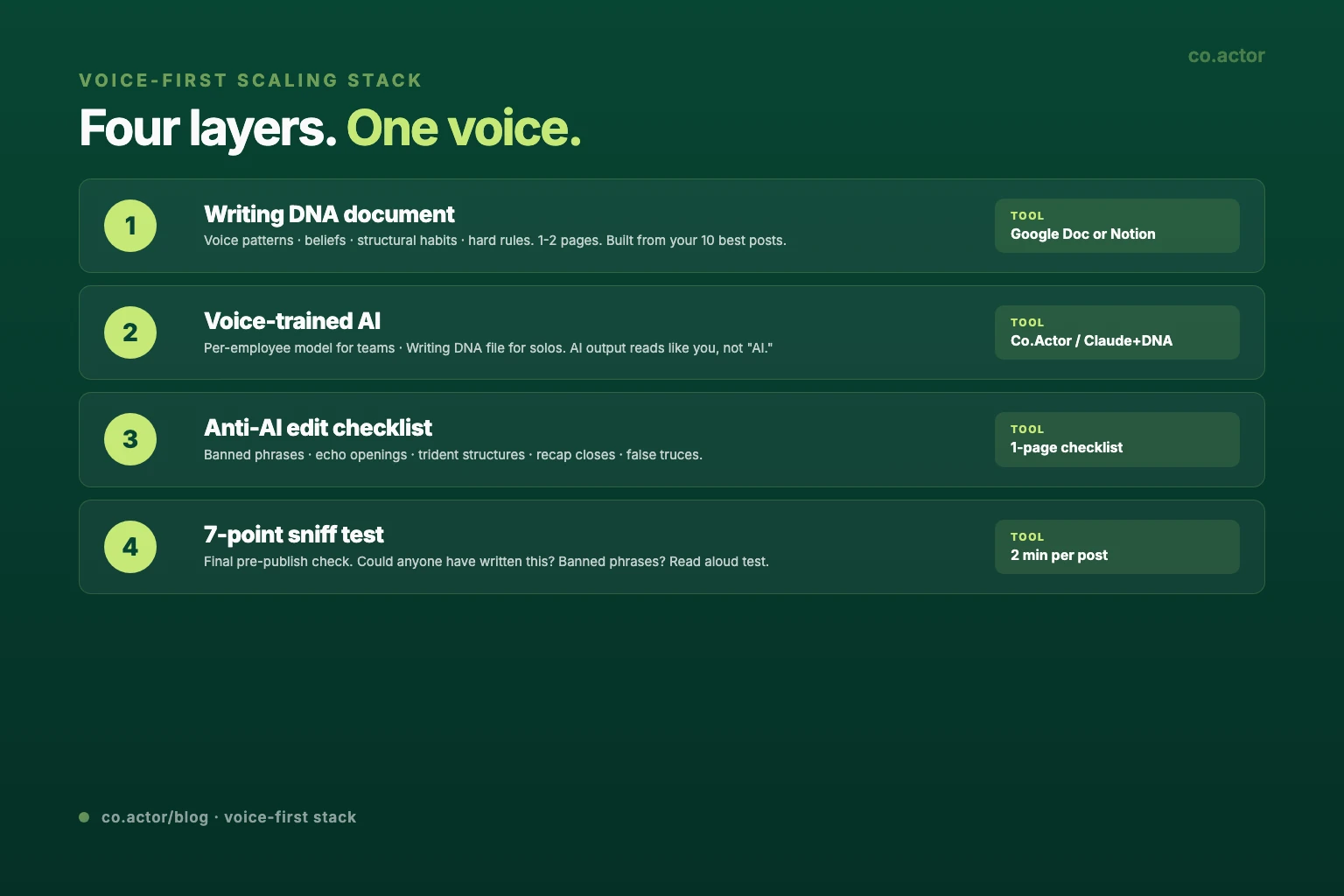
TL;DR — The Voice-First Stack
- Writing DNA document — 1-2 pages capturing your voice patterns, beliefs, structures, and banned phrases.
- Voice-trained AI — Co.Actor for teams (per-employee models); Claude/GPT + DNA file for solos.
- Anti-AI edit checklist — banned phrases, structural patterns, tone traps to scrub pre-publish.
- Sniff test — 7-point check before any post goes live.
- For teams: per-employee voice + shared calendar + approval workflow.
Why Voice Matters More As You Scale
The instinct when scaling content is to focus on volume and structure — more posts, more variety, more topics. Voice gets treated as a finishing detail. This is backwards. As LinkedIn's 360Brew algorithm has matured through 2024-2026, voice authenticity has become a stronger ranking signal than topic relevance.
Three forces converge in 2026:
- 360Brew reads comments semantically. Posts that generate substantive comments rank higher; posts that get generic "+1" responses get suppressed. Authentic voice generates real conversation; generic AI doesn't.
- Audience AI-detection is high. 2025 Edelman research found most B2B decision-makers identify AI-written content on sight. Detection actively reduces trust in the author.
- Personal voice outperforms brand voice 561%. LinkedIn 2024 data: identical content posted from a personal profile gets 561% more reach than from a company page. Authentic personal voice is the distribution multiplier.
The implication: scaling without voice preservation isn't just neutral — it's actively counterproductive. Each generic post drags down your account's average performance and makes the next post less likely to land. Voice-first scaling preserves authenticity as the multiplier and uses systems to add volume on top.
The Voice-First Scaling Stack
Four components, in order of leverage:
Layer 1: Writing DNA Document
A Writing DNA is a 1-2 page document capturing how you specifically write. Without it, no other layer works — AI tools, ghostwriters, and team workflows all default to generic patterns when they don't have a voice spec to follow.
Four sections:
- Voice patterns. Sentence rhythm (short and punchy / longer and reflective). Paragraph length (one-sentence paragraphs / 2-3 sentence paragraphs / full paragraphs). Opening style (scene / number / question / statement). Closing style (call-to-action / open question / abrupt stop).
- Beliefs. What you stand for. What you push back against. What you consider table stakes. What you find tiresome about your industry. Specific.
- Structural habits. Formats you use repeatedly (story → lesson, framework, contrarian opinion). Formats you don't use (PSAs, motivational posts, hot takes on news cycles).
- Hard rules. Banned phrases ("game-changer," "leverage," "delve into," "transformative"). Never-use words. Formatting taboos (no emoji blocks, no hashtag walls, no calls to "share this post").
Build it by analyzing your 10 best-performing past posts. Write down what they have in common. The artifacts are pattern, not rule — but documented pattern lets AI and team members produce content that matches. Detailed methodology in how to use AI for LinkedIn content without sounding like AI.
Layer 2: Voice-Trained AI
Once the Writing DNA exists, the next leverage point is feeding it into AI. Two paths:
- For teams (5+ employees): Co.Actor trains a voice model on each employee's actual writing samples. 10 employees → 10 distinct voice models → 10 different posts that read like 10 different people. The team workspace handles per-employee training, shared calendar, role-based approval, and aggregated analytics. Critical for scaling employee advocacy without flattening everyone into one generic company voice.
- For solos: Upload your Writing DNA to a Claude Project or ChatGPT custom GPT. Every content prompt in that project references the DNA. Output is voice-aligned without needing dedicated LinkedIn AI tools.
The trade-off: voice-trained AI takes 15-90 minutes to set up. Generic AI takes 5 minutes. The setup pays back in the first week of use — voice-aligned drafts need 10 minutes of editing per post; generic drafts need 30-40 minutes.
Layer 3: Anti-AI Edit Checklist
Even voice-trained AI occasionally drifts into generic patterns. The anti-AI checklist is the catch-and-fix pass before publishing. Five categories to scrub:
- Banned phrases. "Game-changer," "leverage" (as a verb), "delve into," "transformative," "seamless," "cutting-edge," "robust," "excited to share," "thrilled to announce," "in my experience," "the truth is."
- Echo openings. AI restates the prompt as the first sentence. "Hiring is one of the most important decisions" → cut. Open with a scene, number, or tension instead.
- Trident structures. Intro + 3 points + summary, every time. Let structure serve the idea — sometimes one argument with proof, sometimes a story, sometimes one observation and a question.
- Recap closes. "By focusing on X, Y, and Z, you'll be able to..." → cut. End forward: a real thought, a question, or just stop.
- False truces. "While there are challenges, there are also opportunities" → cut. Have a position.
Layer 4: The 7-Point Sniff Test
Final pre-publish check. Run any AI-assisted or scaled content through these seven questions:
- Could anyone have written this? If yes — add a specific story, number, or angle that only you would have.
- Any banned phrases? Search for them. Replace or delete.
- Does it open by restating the topic? Rewrite the opening.
- Does it end with a summary or inspirational close? Cut the last paragraph.
- Is every claim backed by a specific number? If not, add or remove the claim.
- Would your team recognize this as your voice? Check against your Writing DNA.
- Would you say this out loud to a friend? Read it aloud. Rewrite anything that sounds like a brochure.
For Solo Creators: Scaling From 2 to 5 Posts Per Week
The voice-first stack works at solo scale with one person managing all four layers:
- Week 1: Build your Writing DNA. 60 minutes analyzing past posts.
- Week 1: Set up Claude Project or ChatGPT custom GPT with DNA + Source of Truth + Anti-AI Writing Guide. 30 minutes.
- Weeks 2-4: Batch write 5 posts/week using AI-assisted drafting. 90 minutes per batch.
- Ongoing: Run the 7-point sniff test on every post before publishing. 2 minutes per post.
- Monthly: Review last 4 weeks of engagement. If dropping, edit Writing DNA. Voice evolves; DNA should evolve with it.
Total time investment: 90 minutes one-time setup + 90 minutes/week batch + 10 minutes/week sniff test. Output: 5 voice-aligned posts/week sustainably.
For B2B Teams: Scaling Across 10+ Employees
Solo-stack scaling breaks at team scale. Three new problems appear:
- Each employee has their own voice. One company-wide AI generates 10 similar-sounding posts. Per-employee voice training is the only solution.
- Approval workflows. Marketing needs to review for brand alignment without flattening individual voices. Approval flow must preserve voice as a feature, not strip it as a risk.
- Aggregated visibility. Which employees drive most pipeline? Which content patterns work company-wide? Spreadsheet workarounds break within a quarter.
Co.Actor solves these three by design — per-employee voice models, role-based approval that flags brand issues without rewriting voice, and aggregated analytics across all employee accounts. For B2B teams running LinkedIn at scale, this is the only purpose-built option in 2026. For more on team LinkedIn architecture see the LinkedIn content engine.
Warning Signs You're Losing Your Voice
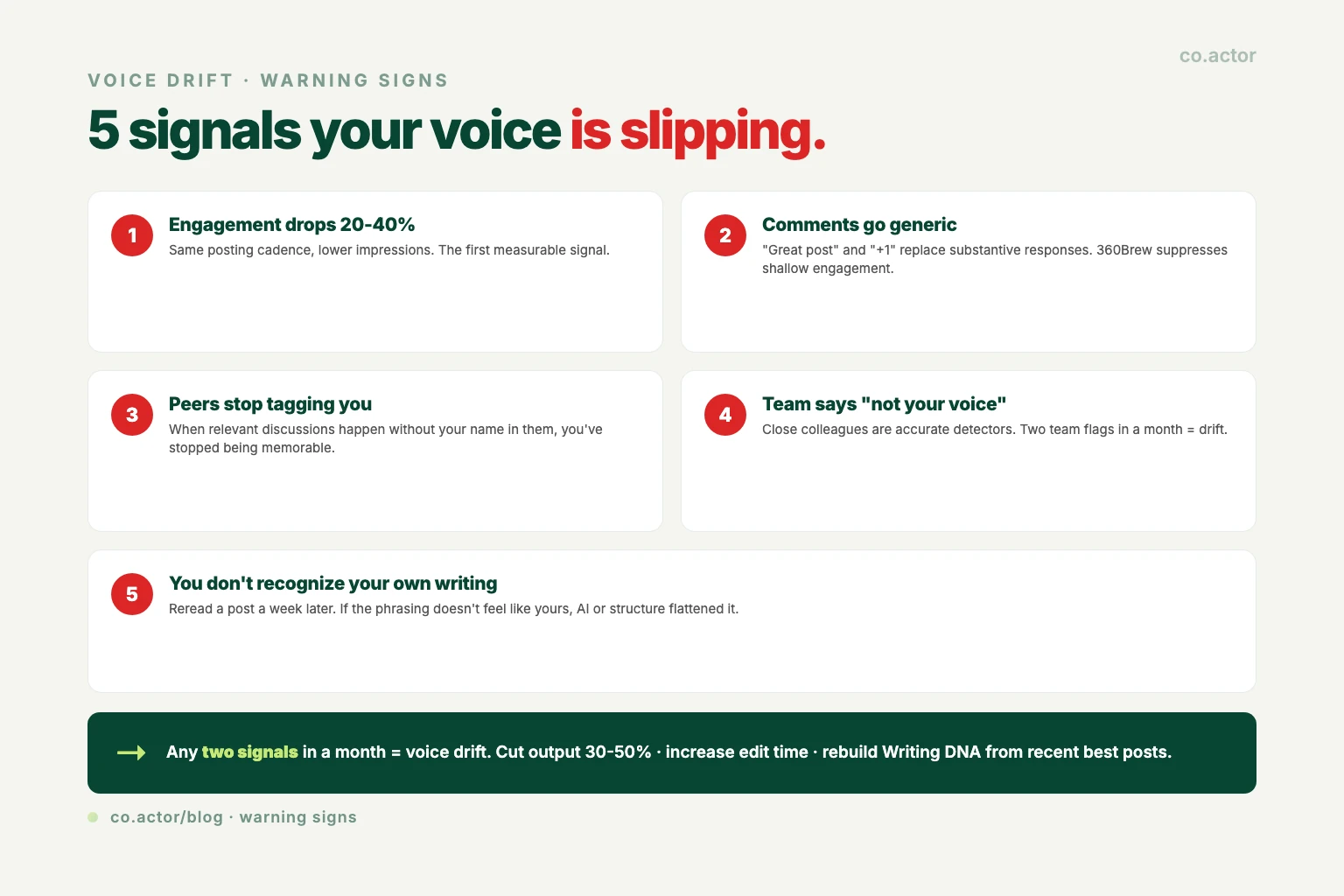
Voice drift is gradual. By the time you notice the engagement drop, you've usually been generic for 4-6 weeks. Five early signals:
- Engagement drops 20-40%. Same posting cadence, lower impressions per post. The first measurable signal.
- Comments shift to generic. Substantive responses ("This matches what we saw at X company...") replaced by reactions ("Great post," "+1," emoji). 360Brew downweights posts with shallow engagement.
- People stop tagging you. When peers stop linking your content into relevant discussions, you've stopped being a memorable voice in their feed.
- Your team says "this doesn't sound like you." Close colleagues are the most accurate detectors. If two team members independently flag posts, the voice has drifted.
- You don't recognize your own writing. Reread a post a week later. If the phrasing doesn't feel like yours, the AI or the structure flattened it.
Any two of these in a month means voice drift. Usually the cause is AI volume outpacing voice editing. Fix: cut output 30-50%, increase edit time per post, rebuild the Writing DNA from recent best-performing posts.
Frequently Asked Questions
What tools should I use to maintain authentic voice while scaling LinkedIn engagement?
Three-tool stack: Writing DNA document (1-2 pages), voice-trained AI (Co.Actor for teams, Claude/GPT + DNA for solos), anti-AI edit checklist. Plus the 7-point sniff test before publishing.
Can you scale LinkedIn content without losing authenticity?
Yes, with voice-aware systems. Naive scaling (generic AI, untrained ghostwriters, volume-over-quality) drops engagement 30-50%. Voice-aware scaling preserves authenticity through per-creator voice models and structured editing.
What's the difference between authentic voice and brand voice?
Brand voice = company tone in a style guide. Authentic personal voice = how a specific person actually writes. LinkedIn rewards personal voice 561% more than brand voice on identical content (LinkedIn 2024 data).
Can AI write LinkedIn content that sounds authentic?
Voice-trained AI can. Generic AI cannot. Training on user-specific writing samples is what closes the gap between "AI-written" detection and authentic-sounding output.
How do you build a Writing DNA document?
Capture four sections in 1-2 pages: voice patterns (rhythm, length, opening/closing), beliefs (what you stand for), structural habits (formats you use), hard rules (banned phrases, taboos). Build from analyzing your 10 best-performing past posts.
How do B2B teams maintain authentic voices across 10+ employees?
Per-employee voice training, not centralized content. Co.Actor builds individual voice models so 10 employees produce 10 distinct authentic voices. Combined with shared calendar, role-based approval, aggregated analytics.
What are the warning signs I'm losing my voice on LinkedIn?
Five signals: engagement drop 20-40%, comments shift to generic, people stop tagging you, team says "doesn't sound like you," you don't recognize your own writing. Any two in a month = drift.
Scale Voice, Not Just Volume
Co.Actor trains an AI voice model for each employee — so when your team scales from 5 posts/week to 50, each post still reads like the person who put their name on it. Per-employee voice + team workflow + voice-aware analytics. Try Co.Actor free.
Serge Bulaev is CEO and Founder of Co.Actor. He writes about LinkedIn voice, employee advocacy at scale, and how B2B teams preserve authenticity when content volume grows 10x.
Sources
- Edelman — 2025 B2B Thought Leadership Study
- LinkedIn Marketing — Personal vs Company Page Data
- arXiv — 360Brew: A Decoder-only Foundation Model for Personalized Ranking
Related Reading
Written by
