If you run a business, you've probably had this conversation. Someone asks why your company page barely gets any reach. You explain that LinkedIn's algorithm now favors personal profiles. They ask whether you should just delete the company page. And you don't have a clean answer — because the truthful one is "it depends on what you're trying to do."
This article gives you the clean answer. We'll walk through the actual reach gap (it's worse than most people think), the things only a company page can do, the decision framework for when one earns its keep, and the two-page strategy that works in 2026 — where the personal profile drives distribution and the company page does the work it was built for.
TL;DR — What This Article Covers
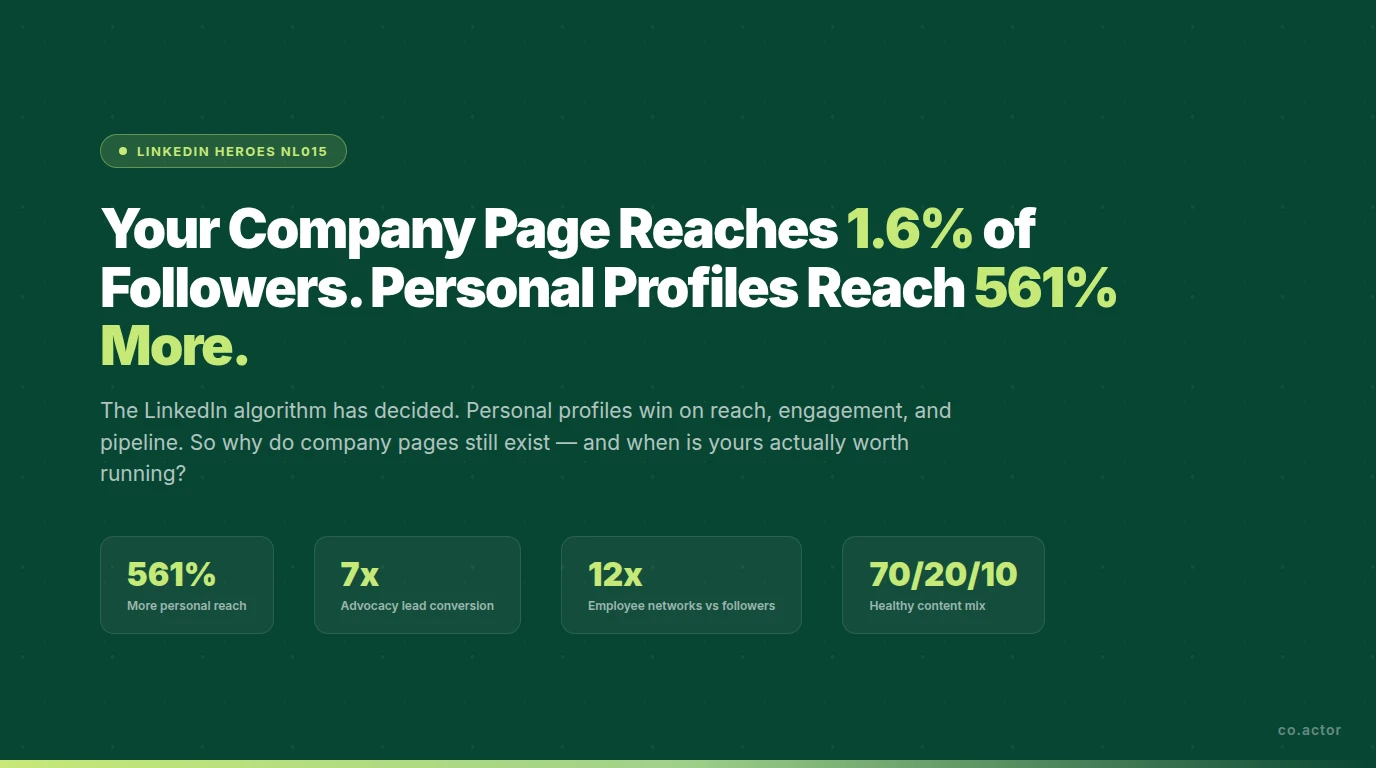
- Personal profiles get 561% more reach and 5x more engagement than company pages publishing identical content. Company pages now reach roughly 1.6% of their followers.
- A company page is still required for some things — paid ads, job posts at scale, visitor analytics, multi-admin operations, and Showcase Pages.
- The two-page strategy is the one that works. Personal profiles run distribution; the company page runs as a credibility hub and ads platform.
- Employee advocacy converts 7x better than traditional leads — networks are 12x larger than the company follower base.
- If your company page is solo, generic, and posting one corporate update per week, kill it or rebuild it. A neglected page hurts more than no page does.
The Reach Gap, in Numbers
The data on personal profiles versus company pages used to be "interesting." It's now overwhelming.
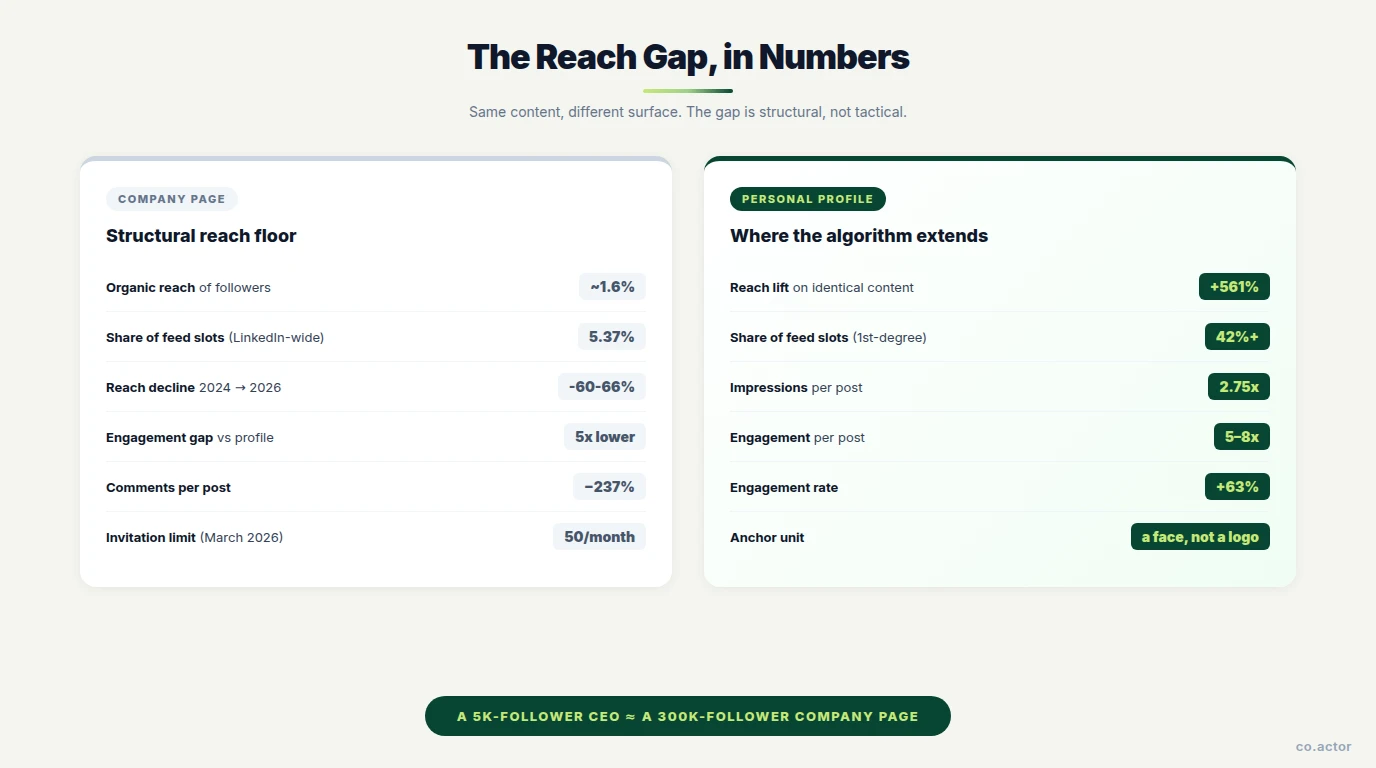
Personal profiles produce 561% more reach on identical content. They generate 2.75x more impressions and 5x more engagement on average. Some studies put the engagement gap at 8x. Personal profiles get 63% higher engagement rates and 237% more comments per post.
Company pages now appear in roughly 5.37% of all feed slots — fewer than one in twenty posts a typical user sees. First-degree personal connections, by contrast, account for over 42% of feed visibility. Organic reach for company pages dropped between 60% and 66% from 2024 to early 2026. The same post that reached 10,000 people on a company page in 2024 now struggles to reach 4,000 — same followers, same content, different algorithmic era.
The reason isn't a bug. It's the design. LinkedIn's 360Brew model treats trust as something that lives between people. The platform was built around professional relationships — and relationships are between people. When the algorithm asks "who would find this useful," it pulls more confidently from the network of an individual it has read for months than from a brand account where the author behind the post is unclear.
That's why a CEO with 5,000 followers can produce the same engagement as a company page with 300,000. The follower count is roughly 60x smaller. The output is roughly the same. The posts that win on LinkedIn in 2026 are written from a face, not a logo.
The Things Only a Company Page Can Do
If personal wins on reach, why does a company page exist at all? Because there's a list of things it can do that personal profiles cannot.
- Run paid ads. LinkedIn Sponsored Content, video ads, document ads, message ads, lead gen forms — all of it requires a verified company page. You cannot run paid distribution on LinkedIn from a personal account.
- Visitor analytics on the page itself. Company pages show you anonymized data on who's viewing — companies, industries, job titles, seniority levels. Personal profiles only give you metrics at the post level.
- Multi-admin access with role separation. A company page can be operated by multiple team members with different permission levels — content admins, paid media admins, recruiter admins, analyst access.
- Showcase Pages and Product Pages. Sub-pages dedicated to specific product lines, services, or audience segments. A B2B company with three product lines can give each its own content stream and follower base.
- Job postings and recruiter integration. Posting jobs at scale, integrating with LinkedIn Recruiter, branded application flows, and candidate analytics all run through the page.
- Brand verification. A verified company page increases trust signals across every interaction — verified checkmark, workplace verification of employees, brand badge on ads.
- Premium Page features. Auto-invitations to people who engage with your content, custom CTAs, customer testimonials, dynamic banners, credibility badges.
The takeaway: a company page is the operational infrastructure of LinkedIn presence — paid ads, hiring, multi-team management, brand-level analytics. It's not a publishing channel. It's a platform.
When You Actually Need a Company Page
Not every business needs a company page in 2026. Here's the honest decision framework.
You Need One If
- You're running paid ads. Required infrastructure. No path around it.
- You're hiring more than occasionally. Job posts, recruiter pipelines, and candidate due diligence all run through the page.
- You're enterprise B2B. Buyers research the page during procurement and security review. An empty or unmaintained page is a red flag during due diligence.
- You have a multi-person leadership team without a single recognizable face. A page gives the brand a single anchor.
- You sell distinct product lines that need separate audiences. Showcase Pages exist for this exact reason.
- You operate in a regulated industry. Compliance teams often require brand-level posting attribution.
You Probably Don't Need One If
- You're a solo creator, consultant, or coach.
- You're an early-stage founder where you are the brand.
- You sell personal services and the buying decision is about you.
- You haven't built a personal profile yet.
For solo operators, the page is usually a tax — it consumes content production time and returns roughly nothing. The right move is to invest 100% of energy into the personal profile until the business has the volume of products, employees, or paid spend that makes a page worth running.
If you're somewhere in the middle — a 5-person agency, a Series A startup, a small consultancy — the answer is usually "yes, but treat it as a hub, not a megaphone."
The Two-Page Strategy That Works in 2026
The companies winning on LinkedIn in 2026 don't choose between personal and company. They run both, with clear roles for each.
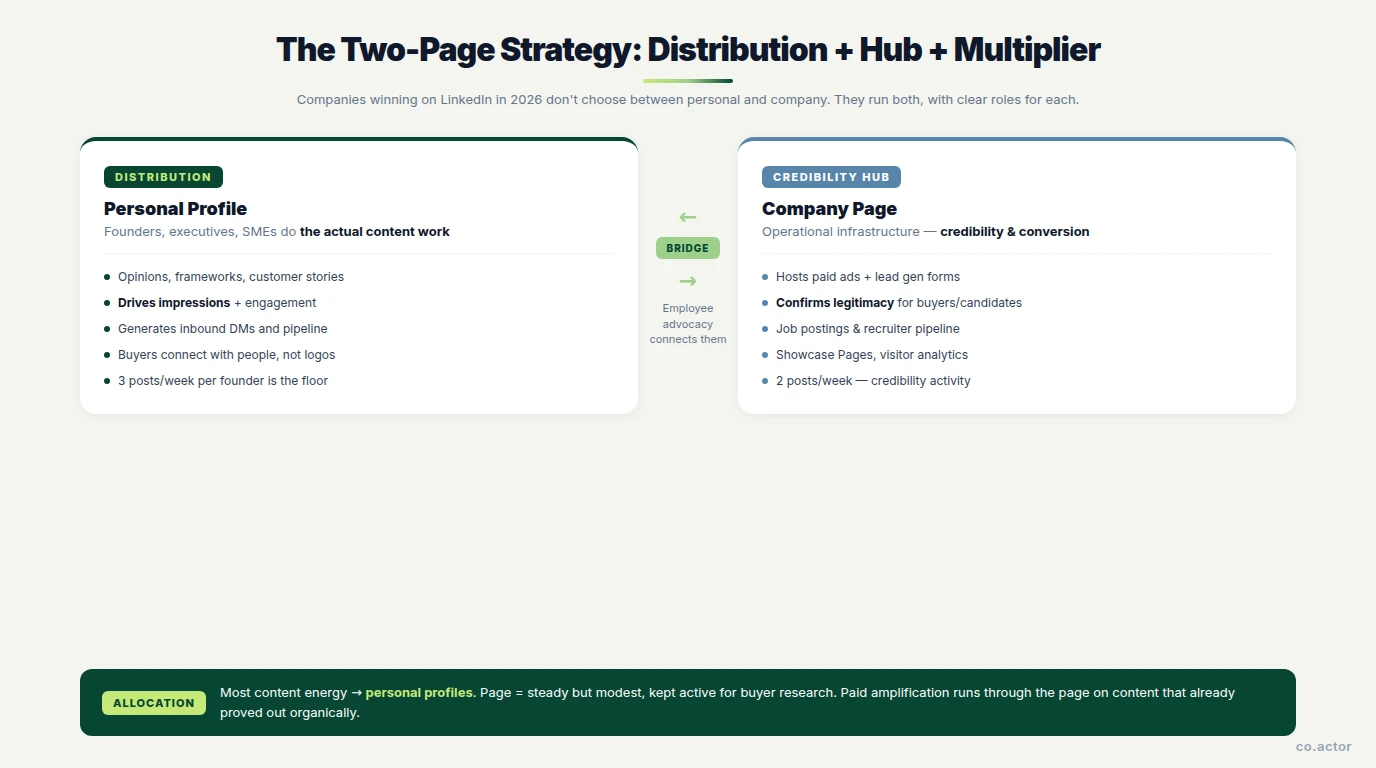
Personal profiles do the distribution work. Founders, executives, and subject matter experts post the actual content — opinions, frameworks, customer stories, lessons learned. Personal profiles drive impressions, engagement, profile visits, and inbound DMs. This is where pipeline gets built. Buyers connect with people, not logos.
The company page does the credibility and infrastructure work. It hosts brand-level content, customer wins, hiring posts, paid ads, and product information. Buyers and candidates land here during research — they want to confirm the company exists, see what it stands for, check the team, and read recent customer evidence. The page doesn't need to drive viral reach. It needs to confirm legitimacy and convert research-mode visitors.
Employee advocacy is the bridge. When the company page publishes something genuinely useful, employees share it from their own profiles. The post then runs through the algorithm under personal accounts, picking up the personal-profile reach multiplier. The original lives on the page. The distribution happens through people.
In Practice, This Looks Like
The CEO posts three times a week from her personal profile — opinion, framework, customer lesson. She gets the lion's share of company-related impressions on LinkedIn.
The company page posts twice a week — a customer case study, a product update or industry insight, a hiring announcement. None of these are designed for viral reach. They're designed to give the page credible activity.
When the page publishes a strong customer story, ten employees share it from their personal profiles with their own framing. Distribution multiplies. Each share gets the personal-profile algorithmic treatment. The company page sits underneath as the canonical source.
Paid ads run through the page. Sponsored Content amplifies the customer stories that already performed organically. Lead gen forms route into the CRM. Hiring posts are amplified through paid distribution to target candidate pools.
This is what "company page strategy" looks like in 2026. The page is a platform, the founders are the channel, and the employees are the multiplier.
Employee Advocacy: The Real Multiplier
If the page is the hub, employee advocacy is the engine.
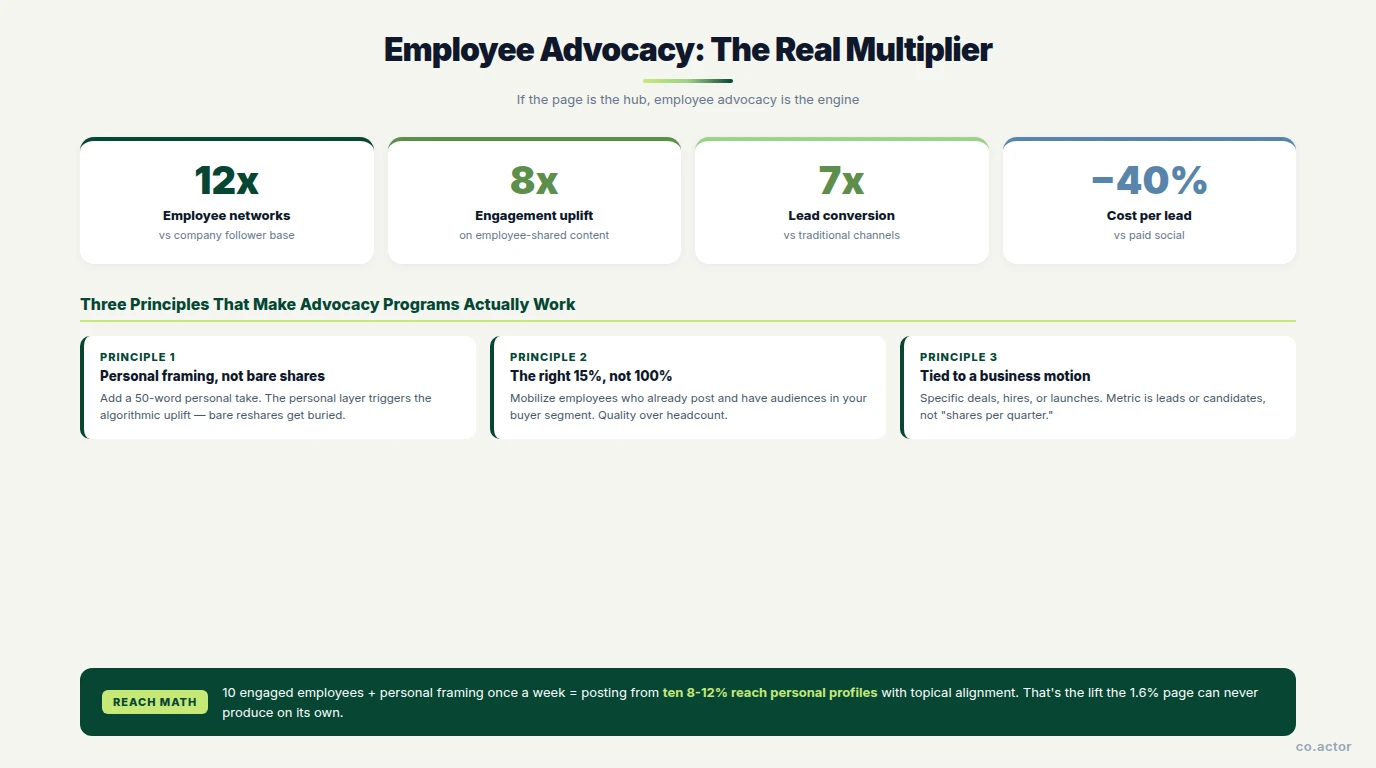
The numbers are striking. Employee networks are roughly 12x larger than company follower bases. Employee-shared content gets up to 8x more engagement than the same content from the brand channel. Leads generated through employee advocacy convert 7x more frequently than traditional leads. Cost per lead through advocacy is 30-50% lower than paid social. Companies running structured advocacy programs generate 5x more web traffic and 25% more leads.
The mechanic is simple. The algorithm trusts personal profiles. When an employee shares a post, the algorithm reads it as a personal recommendation, not a brand broadcast. The employee's first-degree connections see it. Their network's interest signals propagate. The same content that would have hit 1.6% of company page followers now hits a meaningful share of employee networks — networks that, in aggregate, are an order of magnitude larger.
Most companies do employee advocacy badly. They send Slack messages saying "please share the company post." Engagement is tepid because the share carries no personal voice. The employee is a billboard, not an author.
The Advocacy Programs That Work Do Three Things Differently
1. They train employees to add personal framing. Rather than re-sharing the company post verbatim, employees write a short personal take and quote-share or repost-with-thoughts. The personal layer is what triggers the algorithmic uplift. A bare share gets buried; a share with a 50-word personal opinion travels.
2. They focus on the right employees. Not everyone is an effective advocate. The 10-20% of employees who already post on LinkedIn, write reasonably well, and have audiences in the target buyer segment do most of the work. Trying to mobilize 100% of headcount produces noise. Mobilizing the right 15% produces signal.
3. They connect advocacy to a business motion, not a vanity metric. The advocacy program targets specific deals, hiring needs, or product launches. The metric is leads sourced or candidates applied, not "shares per quarter." Without a connected motion, advocacy programs decay within six months.
If you have ten engaged employees willing to share a piece of content with personal framing once a week, your reach math changes completely. You're not posting from a 1.6% reach platform anymore. You're posting from ten 8-12% reach personal profiles, with topical alignment to your market.
Company Page Content Rules: The 70/20/10 Mix
If you've decided to run a company page, here's what to put on it.
The healthy content mix is roughly 70/20/10.
- 70% useful content. Industry frameworks, market data, educational posts that your buyer would want to read even if they never bought from you. The page exists to be useful, not to broadcast. If you removed your logo from the post, would it still be worth reading? If yes, post it. If no, don't.
- 20% evidence. Customer stories, case studies, named results, screenshots of measurable outcomes. Specific over generic. "Acme Co. cut onboarding time from 14 days to 3" beats "we help companies with onboarding." This is the content category buyers are looking for during due diligence.
- 10% direct promotion. Product launches, hiring announcements, event invitations, direct asks. This is the lane where most companies overspend — they treat the page as a billboard. The 70/20/10 split exists because the page only earns the right to promote when most of its content is genuinely useful.
What to Stop Posting
- Generic industry hot takes with no point of view
- "Excited to announce" posts about routine company news
- Reshares of corporate awards and rankings
- Holiday and "Happy National X Day" posts
- AI-generated thought leadership with no specific claim
- Long-form posts that read like press releases
What to Start Posting
- Specific customer outcomes with numbers
- Frameworks the team has built and tested internally
- Honest perspectives on industry shifts (with a position, not a fence)
- Hiring posts that describe the actual problem the new hire will solve
- Behind-the-scenes from the actual work, not the vacation photos
- Product updates that explain what changed and why it matters
The metrics to watch on a company page in 2026 are not impressions. Reach is the least useful metric on a page now — it's structurally low and you can't move it much organically. The metrics that matter are saves (signal of reference value), deep comments (signal of genuine reaction), profile clicks to the page (signal of researched interest), and incoming messages on the company page (signal of buyer intent). See our deep dive on LinkedIn metrics for the full framework.
One More Constraint Most People Missed
In March 2026, LinkedIn cut the company page invitation limit to 50 per month. The old growth tactic — page admins invite their entire connection list to follow the page — is functionally dead.
This means company page follower growth in 2026 has to come from one of three places: organic content discovery (slow, given the reach math), employee shares converting to follows (the realistic path), or paid promotion (the fast path).
If your page strategy was built around invitation-based growth, it has to be rewritten. The page is now grown the same way the personal profile is grown — through the quality of the content and the network effects of people who actually engage with it.
Three Operating Modes for the Page
Once you've decided whether to run a page at all, the next question is how to operate it. Three honest modes in 2026:
- No page. Solo operators, early founders, personal services. The page is a future problem. Invest 100% of energy in the personal profile.
- Page as a hub. Most growing businesses. The page is operational infrastructure — credibility anchor, hiring platform, ads vehicle. Personal profiles of the founder and team do the actual content distribution. Employee advocacy bridges the two.
- Page as the brand. Large enterprises where no single person can or should be the face — Fortune 500s, regulated industries, multi-product platforms. The page does meaningful content work. Even here, executive personal profiles still dramatically outperform.
If you're in mode 2 (most B2B businesses), allocate this way:
- Most of your content production time goes into personal profiles — the founder, executives, key team members.
- The company page gets a steady but modest share — enough to keep it active, credible, and ready for buyer research.
- A small slice goes to cross-amplification systems — employee advocacy, content repurposing, internal sharing rituals.
- Paid amplification budget runs through the page on the content that already performed organically on personal profiles.
The mistake to avoid: putting most of your effort into the company page and treating personal profiles as a side activity. That's the inverted ratio. It's still the most common allocation in B2B marketing in 2026, and it's the reason most company LinkedIn programs are quietly underperforming.
Action Items: A 30-Minute Audit This Week
- Pull your company page reach for the last 90 days. Calculate average impressions per post. If it's below 2% of follower count, your page is in the algorithmic basement — which, in 2026, is the default state.
- Pull the same 90-day window for the founder or top executive's personal profile. Compare the impressions per post. If the personal profile is hitting 5-10x the page's per-post reach, the math is in front of you.
- List the three things only your company page can do for your business. Paid ads? Hiring? Showcase Pages? Be specific. If you struggle to list three, the page is probably consuming more energy than it's returning.
- Identify five employees who could realistically share company content with personal framing once a week. That's your advocacy starting cohort. Twenty is too many at the start. Five is enough to test the multiplier.
- Rewrite your company page content mix to 70/20/10 for the next month. Draft the next four posts before publishing any of them. If you can't fill 70% with genuinely useful content, the strategy needs to be reset upstream.
Frequently Asked Questions
Is a LinkedIn personal profile better than a company page in 2026?
Yes — for content reach. Personal profiles produce 561% more reach than company pages on identical content. They generate 2.75x more impressions, 5x more engagement, and 237% more comments per post. Company pages reach roughly 1.6% of their followers organically. A CEO with 5,000 followers can produce the same engagement as a company page with 300,000 followers.
Why is LinkedIn company page reach so low in 2026?
LinkedIn's 360Brew algorithm treats trust as something that lives between people. Company pages now appear in roughly 5.37% of feed slots, while first-degree personal connections account for over 42% of feed visibility. Organic reach for company pages dropped 60-66% from 2024 to early 2026.
When do you actually need a LinkedIn company page?
You need one for paid ads (required), regular hiring, enterprise B2B sales (buyers research the page during procurement), multi-person leadership teams without a single face, distinct product lines needing Showcase Pages, or regulated industries. Solo creators and early founders usually don't need one.
What is the two-page LinkedIn strategy?
Personal profiles do the distribution work — founders, executives, and SMEs post the actual content. The company page does the credibility and infrastructure work — brand-level content, customer wins, paid ads, hiring posts. Employee advocacy bridges them by sharing page content from personal profiles to capture the personal-profile reach multiplier.
How effective is employee advocacy on LinkedIn?
Highly effective when done right. Employee networks are 12x larger than company follower bases. Employee-shared content gets up to 8x more engagement than the same content from the brand channel. Leads convert 7x more frequently than traditional leads, and cost per lead is 30-50% lower than paid social.
What should a LinkedIn company page post in 2026?
The healthy mix is 70/20/10. 70% useful content (frameworks, market data, education). 20% evidence (customer stories, case studies, named results with numbers). 10% direct promotion (launches, hiring, events). The page only earns the right to promote when most of its content is genuinely useful.
Can I still grow a LinkedIn company page through invitations?
Not at scale. In March 2026, LinkedIn cut the company page invitation limit to 50 per month. Page growth in 2026 comes from organic content discovery (slow), employee shares converting to follows (realistic), or paid promotion (fast).
Build the Two-Page Strategy That Actually Works
Serge Bulaev is the CEO and founder of Co.Actor, a LinkedIn growth platform for B2B founders and their teams. He writes about content systems, profile positioning, and how the LinkedIn algorithm actually rewards modern creators.
Sources
- Meet Lea — LinkedIn Personal Profile vs Company Page (engagement data)
- Ordinal — Declining reach of LinkedIn company pages
- Thunderbit — LinkedIn Employee Advocacy Statistics
- SuperGrow — LinkedIn Employee Advocacy Guide
- LinkedIn Engineering — Engineering the Next Generation of LinkedIn's Feed
- 360Brew: A Decoder-only Foundation Model for Personalized Ranking
Related Reading
- LinkedIn Algorithm 2026: What 360Brew Actually Rewards
- LinkedIn Profile Strategy 2026: Make Your Profile Work With the Algorithm
- LinkedIn Metrics That Actually Matter in 2026: WES, Save Rate, Comment Depth
- The LinkedIn Content Engine: Build a Repeatable System Without Burning Out
- LinkedIn for Founders & CEOs: The Data-Backed Playbook
Written by
