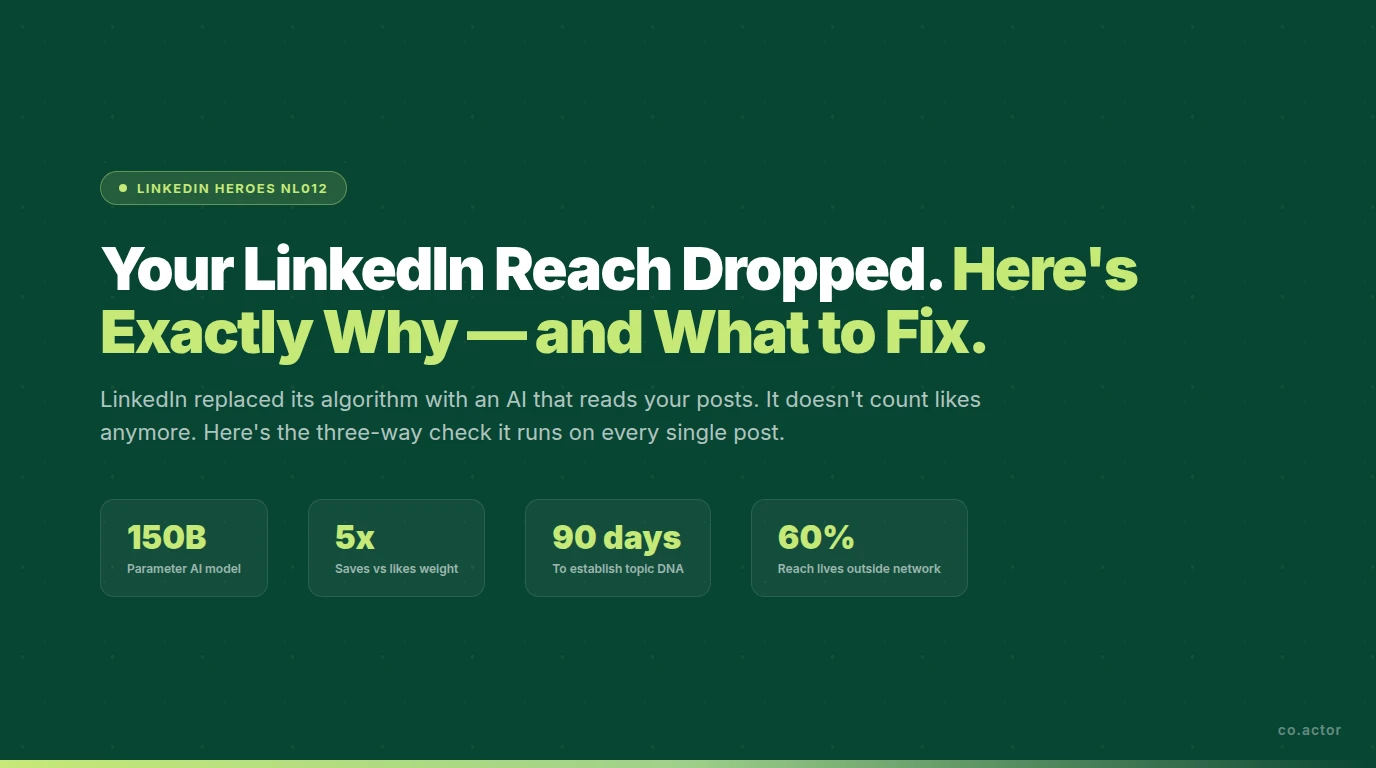
In the last year, most people posting on LinkedIn watched their reach drop with no clear explanation. Fewer impressions. Fewer comments. Posts that used to land sitting at 300 views. The official answer from LinkedIn — "post more authentic content" — explains nothing.
Here is the actual explanation. And more importantly: what to do about it.
TL;DR — What Changed
- LinkedIn replaced its algorithm with an AI that reads your posts — not counts likes. It understands what your content is actually about.
- Every post triggers a three-way check — your profile, your posting history, and the post itself. If they don't match, your reach gets suppressed.
- Saves are worth 5x a like — and saves that happen 24-72 hours after publishing are 4-6x more powerful than immediate ones.
- The first sentence determines how the algorithm classifies your post — not just whether readers click "see more."
- 90 days of consistent on-topic posting is the window to establish authority. Outside that window, the algorithm doesn't know who to send you to.
Why Your Reach Actually Dropped
LinkedIn didn't tweak its algorithm. It replaced it.
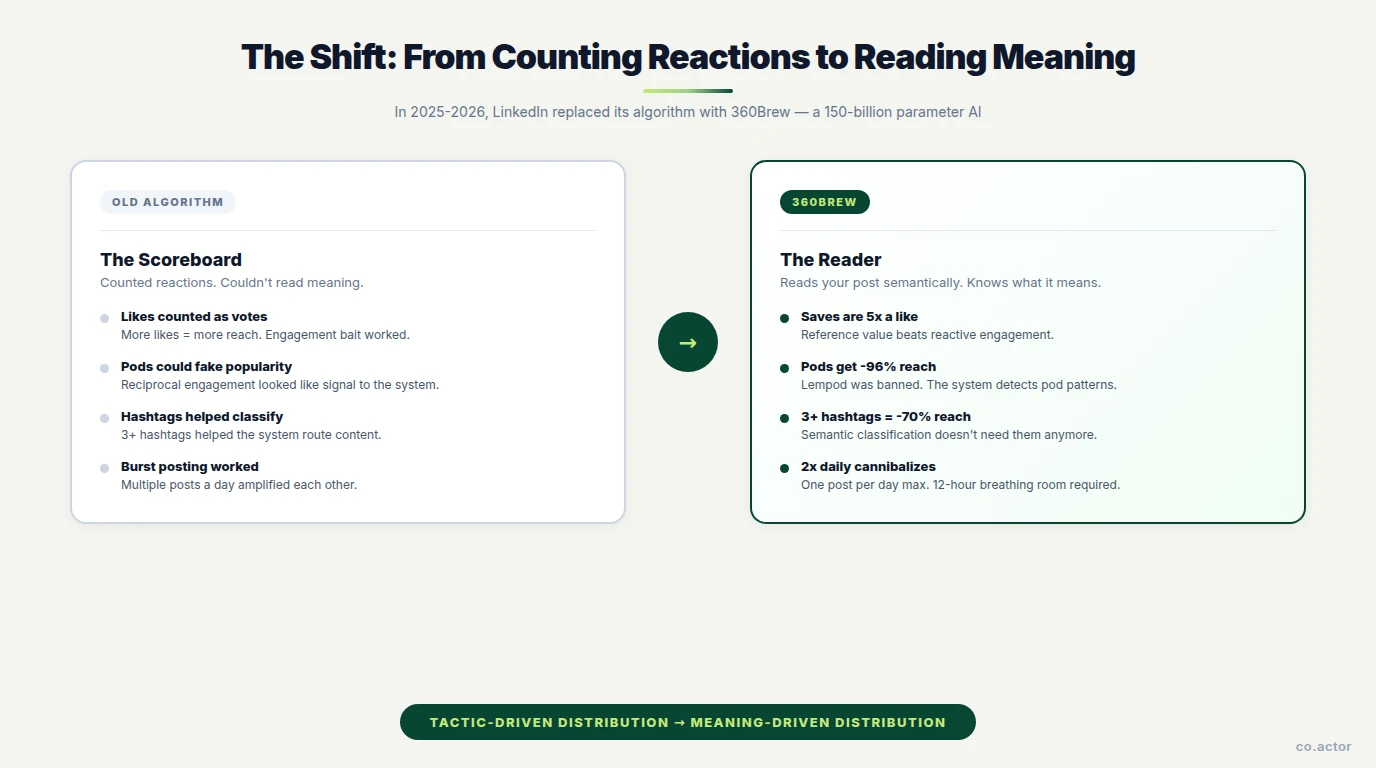
In 2025-2026, LinkedIn deployed an AI system called 360Brew — a 150-billion parameter model that handles feed ranking, job recommendations, search, and ads simultaneously. The technical details are in their engineering papers. What matters is what it changed about how distribution works.
The old algorithm was a scoreboard. Posts accumulated points: likes, comments, shares, clicks. More points meant more reach. The system didn't know what your post was about — it only knew how many people reacted to it. This created a world where engagement bait, reciprocal pod likes, and burst-posting strategies could manufacture the appearance of popularity.
The new system reads.
360Brew processes the actual text of your post and understands what it's about — not by matching keywords, but semantically. A post about "how we reduced churn by 40%" and a post about "why most SaaS companies lose customers in month 3" get recognized as expressions of the same professional topic, even without a single shared word. The algorithm then matches that meaning to the specific professionals who care about it.
This shift — from counting reactions to understanding meaning — is why surface tactics stopped working. And it's why the people who figured it out early are seeing growth while most are still puzzled by the decline.
The Three-Way Check That Happens on Every Post
Here is the mechanism most people miss.
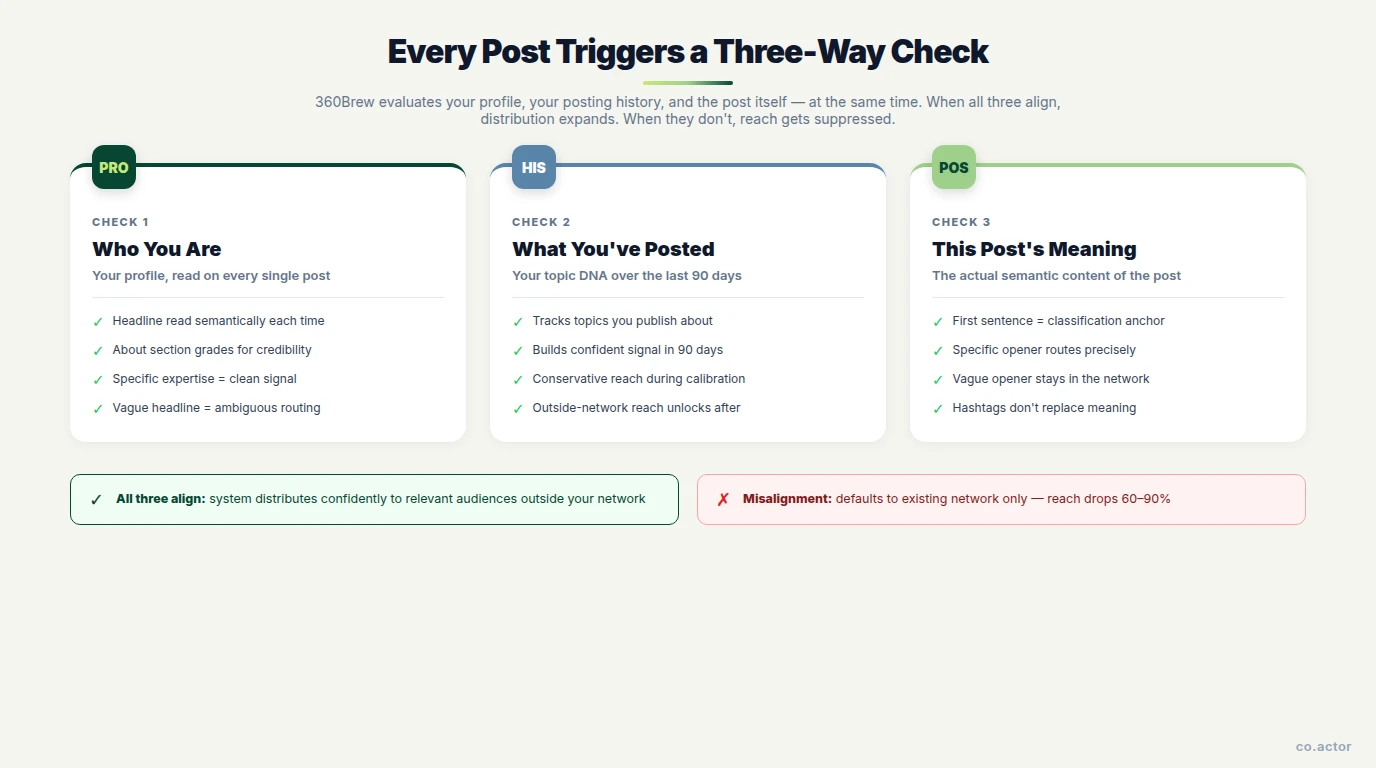
Every time you publish a post, LinkedIn's AI doesn't just read the post. It checks three things simultaneously.
1. Who You Are (Your Profile)
Your headline and About section are read semantically by the algorithm on every post evaluation. Not once when you create your profile — every single time one of your posts is being ranked.
Think of it as the algorithm asking: "Does this person's stated expertise match what they just wrote?" If your headline says "Marketing consultant | B2B growth" and you post consistently about B2B growth strategy, the system routes your content to the people who care about that topic. If your headline says "Passionate about building great teams" — that's a vague signal, and the system has a harder time knowing who to send you to.
2. What You've Been Writing About (Your History)
The algorithm tracks the topics you've posted about over time and builds a picture of your expertise — what LinkedIn's researchers call your topic DNA. This isn't instant. It takes approximately 90 days of consistent posting to form a confident signal.
Until that signal is established, the system distributes conservatively. It shows your posts primarily to your existing network and waits to see what kind of engagement they generate before expanding. After 90 days of consistent on-topic posting, it begins routing you to relevant professionals outside your network — the 60% of your potential reach that lives in interest-based clusters beyond your connections.
3. What This Specific Post Is About (The Content Itself)
The algorithm reads the post semantically. Not the hashtags. Not the formatting. The actual meaning.
And here is the detail that matters: because of how the AI architecture works, the first sentence carries disproportionate weight. It is the semantic anchor — the signal the system uses to classify what your post is about before routing it. A vague opener ("I've been thinking about something lately...") leaves the classification ambiguous. A specific opener ("We cut our sales cycle from 60 days to 22 days. Here's how.") gives the algorithm an unambiguous signal from the first line.
This is why the hook isn't just about getting human readers past "see more." It's about giving the algorithm a clean classification signal at the very start.
When all three align — profile, history, and post — the system distributes with confidence. When they don't, it defaults to conservative reach and waits.
The Hidden Penalty Nobody Talks About
Viveka von Rosen has been on LinkedIn for 20 years. She wrote four books about it. She has 30,000 connections. In 2025, her post views dropped to 30-50. Comments down to 2-5.
The reason wasn't a penalty or a shadow ban. It was misalignment.
She had pivoted her content — from B2B sales and marketing to coaching women over 50. Her profile still described B2B expertise. Her network was built around B2B professionals. Her posting history reflected B2B topics. Her new content pointed in a completely different direction.
The algorithm saw three things pointing three different ways and had no idea where to send her. So it defaulted to conservative distribution — mostly her existing network, which wasn't interested in the new topic.
After she rewrote her profile to match the new focus, pruned 10,000 misaligned connections, and rebuilt her engagement activity around the new topic — performance improved 2-5x.
This case is worth sitting with. Because it's not about posting quality. It's about coherence. Anyone who posts consistently about one topic but whose LinkedIn headline describes something else entirely is paying a distribution penalty on every post — and has no idea.
Profile-Content Alignment audit
What the Algorithm Actually Rewards (The New Hierarchy)
The old hierarchy was simple: likes were visible, comments were better, shares were best. The new hierarchy is different — and counterintuitive.
Saves Are the New Primary Signal
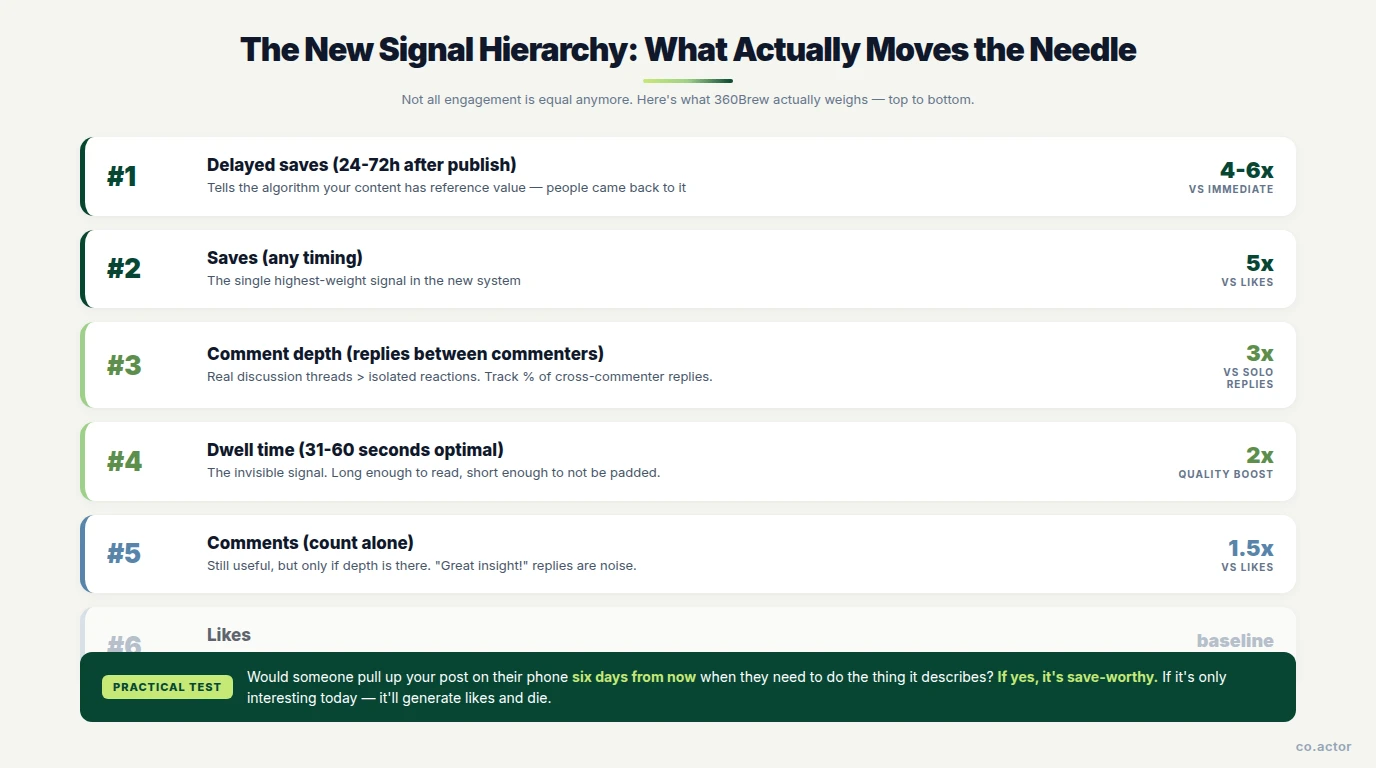
One save carries approximately 5x the algorithmic weight of a like. More importantly: saves that happen 24-72 hours after you publish perform 4-6x better than saves that happen immediately.
Why? Because a delayed save tells the algorithm something a like never could: this content was worth returning to. It has reference value. It's the kind of thing someone comes back to when they actually need it.
This changes what your best-performing content looks like. Opinion pieces that spark conversation in the first hour perform well in the old system. Frameworks, step-by-step guides, decision checklists, and reference material — content someone saves to use later — perform better in the new one.
The practical test: would someone pull up this post on their phone six days from now when they need to do the thing it describes? If yes, it's save-worthy. If it's only interesting today, in this context, right now — it'll generate likes and die.
Comment Depth, Not Comment Count
The algorithm distinguishes between comments and conversations. A thread where multiple people are responding to each other carries significantly more weight than the same number of isolated comments.
This means posts that ask a question people genuinely disagree about — not "agree or disagree?" but real intellectual disagreement — outperform posts that generate a lot of "great insight!" comments. The algorithm is measuring whether your content creates professional discussion, not just reactions.
Useful metric to track: what percentage of comments on your posts are replies to other commenters, not just replies to you? That number tells you whether you're generating real discussion.
Dwell Time — The Signal No One Sees
The algorithm measures how long someone spends on your post, even with no visible engagement. The optimal range: 31-60 seconds. Long enough to indicate real reading. Short enough to suggest the content was dense and valuable, not padded.
This has a direct implication for how you write. Posts that inflate word count to seem comprehensive actually reduce the dwell time signal per word. A tight 600-word post that people read all the way through outperforms a 1,400-word post that people abandon halfway.
Dense. Not long. There's a difference.
What No Longer Works (And Why)
- Likes: The lowest-weight signal in the system. 50 likes with no comments is a weaker distribution signal than 5 substantive comments with thread depth.
- Engagement pods: LinkedIn explicitly designed the new system to make them ineffective. Lempod — the most widely used pod service — has been banned and removed from the Chrome Web Store. The algorithm detects clusters of accounts with predictable mutual engagement patterns. Consequence: -96% reach, 60-90 day recovery period. Not worth it.
- Hashtags: Posts with 3+ hashtags correlate with 70% lower reach in independent analysis of 1.8 million posts. 360Brew reads semantic content directly — it doesn't need hashtag cues to classify your post. More than 2 hashtags now signals content quality problems more than anything else.
- Posting twice a day: Each post needs at least 12 hours of breathing room. Two posts in a day creates algorithmic cannibalization — the second post actively suppresses reach on both. One post per day maximum. Two to three per week is the proven sweet spot for quality-consistent posting.
- Company pages: Personal profiles generate 561% more reach than company pages for the same content. Company page organic reach is approximately 1.6% of followers. Personal profiles reach 8-12%. If you're posting your best thinking to both simultaneously, the personal page should always be the priority.
The 90-Day Play
Most people want to know what to post next week. This section is about the next 90 days — because that's the unit of strategy under 360Brew.
The algorithm needs 90 days of consistent on-topic posting to build a confident topic DNA for an author. Before that window closes, you're still in a calibration phase — the system is watching what you post, who engages, and whether the engagement quality (saves, comment depth) confirms that you're generating genuine value in your claimed area.
During calibration, the system is more conservative with distribution. After it, it begins routing your content proactively to relevant professionals outside your existing network. That's the 60% of your total potential reach that most people never access.
The 90-day play looks like this:
- Pick 2-3 topic clusters and nothing else. Not 5. Not 7. Two or three specific professional domains where you have deep expertise and a clear ICP audience. Everything you post for the next 90 days maps to one of these clusters.
- Align your profile before you start. Your headline needs to describe the same expertise as your topic clusters. Your About section needs to tell the story of why you're credible on these specific topics. Do this first — before posting a single word.
- Post save-worthy content, not scroll-stopping content. Frameworks. Processes. Decision guides. Reference material. Content someone will come back to. This is what builds the save rate that signals quality to the algorithm during the calibration window.
- Respond to every comment in the first 15 minutes. Engagement velocity in the first 2 hours determines whether a post gets extended distribution or dies in stage 1. Responding fast creates the early thread depth the algorithm needs to see.
The Creator Who Benefits Most
There's one counterintuitive winner in this algorithmic shift: new creators.
The old system required engagement history to work. New LinkedIn accounts faced a cold-start problem — no history meant no distribution. The new system can infer professional interests from profile text alone, using its broader understanding of how professional domains relate to each other.
Anyone who writes a specific, well-positioned profile and posts consistently about a defined topic can reach relevant audiences faster under 360Brew than was possible 18 months ago. The playing field has genuinely shifted toward content quality and profile specificity — and away from follower count and network size.
If you've been putting off building a serious LinkedIn presence because you thought you needed to grow a large audience first: you don't. The algorithm is now your distribution engine, not your follower list. Give it a clean signal, and it routes you.
Action Items: Apply This Week
- Read your headline, then read your last 10 posts. Do they describe the same professional expertise? If there's a mismatch, rewrite the headline before your next post. This single fix is likely the highest-leverage action on this list.
- Check your save rate in LinkedIn Analytics. Below 0.5% per post means your content isn't generating reference value. The target is above 1%. If you're below, the content type needs to shift — toward frameworks, guides, and material people come back to.
- Look at your last five posts' comment sections. What percentage of comments are conversations between commenters, not just replies to you? Below 20% means you're generating reactions, not discussion. Ask a more specific, genuinely contested question next time.
- Write your next post's first sentence last. Draft the full post, then write an opening that states the specific insight or result upfront. Not a question. Not a preamble. The actual point — so both readers and the algorithm get the classification signal immediately.
- Pick your 90-day topic clusters now. Two or three specific professional areas. Write them down. Every post for the next 90 days maps to one of them. If an idea doesn't fit, save it for later or cut it.
Frequently Asked Questions
Why did my LinkedIn reach drop in 2025–2026?
LinkedIn replaced its algorithm with an AI system called 360Brew that reads the meaning of your posts instead of counting reactions. Reach drops are usually caused by misalignment between your profile, your posting history, and your post content. When all three don't point in the same direction, the system distributes conservatively.
What is 360Brew and how is it different from the old LinkedIn algorithm?
360Brew is a 150-billion parameter foundation model that LinkedIn deployed to handle feed ranking, search, job recommendations, and ads simultaneously. The old algorithm counted reactions as votes. 360Brew reads your post semantically and routes content based on meaning — matching your professional topic to the specific professionals who care about it.
Are saves more important than likes on LinkedIn now?
Yes. One save carries approximately 5x the algorithmic weight of a like. Saves that happen 24-72 hours after publishing perform 4-6x better than immediate saves — because a delayed save signals reference value. Content people return to (frameworks, decision guides, step-by-step processes) outperforms content people scroll past.
Do hashtags still work on LinkedIn in 2026?
Hashtags lost most of their value in the 360Brew era. Posts with three or more hashtags correlate with 70% lower reach. The algorithm reads semantic content directly and doesn't need hashtag cues. Use one or two specific hashtags maximum, or none at all.
How long does it take to establish topic authority with 360Brew?
Approximately 90 days of consistent on-topic posting. The algorithm tracks the topics you publish about and builds your topic DNA. Until that signal is established, the system distributes conservatively within your existing network. After 90 days, it routes content to relevant professionals outside your network — where 60% of your potential reach lives.
Why do engagement pods no longer work on LinkedIn?
LinkedIn explicitly designed 360Brew to detect engagement pods. The system identifies clusters of accounts with predictable mutual engagement patterns and applies a -96% reach penalty with a 60-90 day recovery period. Lempod was banned and removed from the Chrome Web Store. Pods now actively damage your distribution.
Should I post on my company page or my personal profile?
Personal profiles. Personal profiles generate 561% more reach than company pages for the same content. Company page organic reach is approximately 1.6% of followers, while personal profiles reach 8-12%. The personal page should always be the priority for thought leadership content.
Build Your LinkedIn Algorithm Strategy
Serge Bulaev is the CEO and founder of Co.Actor, a LinkedIn growth platform for B2B founders and their teams. He writes about content systems, personal branding, and how the LinkedIn algorithm actually rewards modern creators.
Sources
- LinkedIn Engineering Blog — Engineering the Next Generation of LinkedIn's Feed
- 360Brew: A Decoder-only Foundation Model for Personalized Ranking — arXiv:2501.16450
- Large Scale Retrieval for the LinkedIn Feed using Causal Language Models — arXiv:2510.14223
- AuthoredUp — LinkedIn 360Brew Analysis (3M+ posts)
- Search Engine Land — LinkedIn Updates Feed Algorithm with LLM-Powered Ranking
- Viveka von Rosen — First-person 360Brew case study
Related Reading
- The LinkedIn Content Engine: Build a Repeatable System Without Burning Out
- How to Use AI for LinkedIn Content Without Sounding Like AI
- The Viral LinkedIn Post Formula: Data-Backed Framework for 2026
- The Personal Brand Playbook: LinkedIn Strategy for B2B Founders
- The LinkedIn Networking Playbook: Build Real Relationships at Scale
Written by
