TL;DR
- 80% of B2B leads originate from LinkedIn — yet most professionals treat networking as random connection collecting instead of a system
- Personalized connection requests get 72% higher acceptance (9.36% vs 5.44% across 16,492 requests) — one specific sentence outperforms any generic template
- LinkedIn DMs achieve 10.3% response rate — 2x email — first-degree connections respond at 16.86%, and multi-step sequences hit 20-30%+
- Comment 2-3 times before connecting — the warm-up period turns cold outreach into warm conversations
- A 3-tier target map of 200-350 people replaces scatter-shot networking with strategic relationship architecture
- The transition from relationship to business never feels like a pitch — it follows a three-phase progression: Engage, Qualify, Present
Content Builds Audience. Relationships Build Network.
There is a gap in virtually every piece of LinkedIn networking advice published in the last five years. Most of it is about content — what to post, when to post, how to get more impressions. As we've covered in our Personal Brand Playbook and LinkedIn for Founders guide, content is the foundation of your LinkedIn presence.
But content builds an audience. It does not build a network.
An audience watches. A network acts. An audience sees your posts in their feed. A network makes introductions, shares deals, sends referrals, and picks up the phone when you call. The difference between a founder with 10,000 followers and zero pipeline versus a founder with 2,000 followers and a full calendar is almost never content quality. It is the relationships behind the follower count.
LinkedIn's own data tells the story: 80% of B2B leads originate from LinkedIn, making it the single most productive relationship-building channel in professional services. (LinkedIn Business) Yet most professionals approach the platform with no system for converting that potential into actual relationships.
This playbook is the system. Five steps, each backed by specific data, from building your target map to converting relationships into pipeline — without ever sending a message that feels like a pitch.
Step 1: Build Your Target Map
Random networking produces random results. The first step in any effective LinkedIn networking strategy is knowing exactly who you want to build relationships with — and organizing them by strategic value.
The Three-Tier Framework
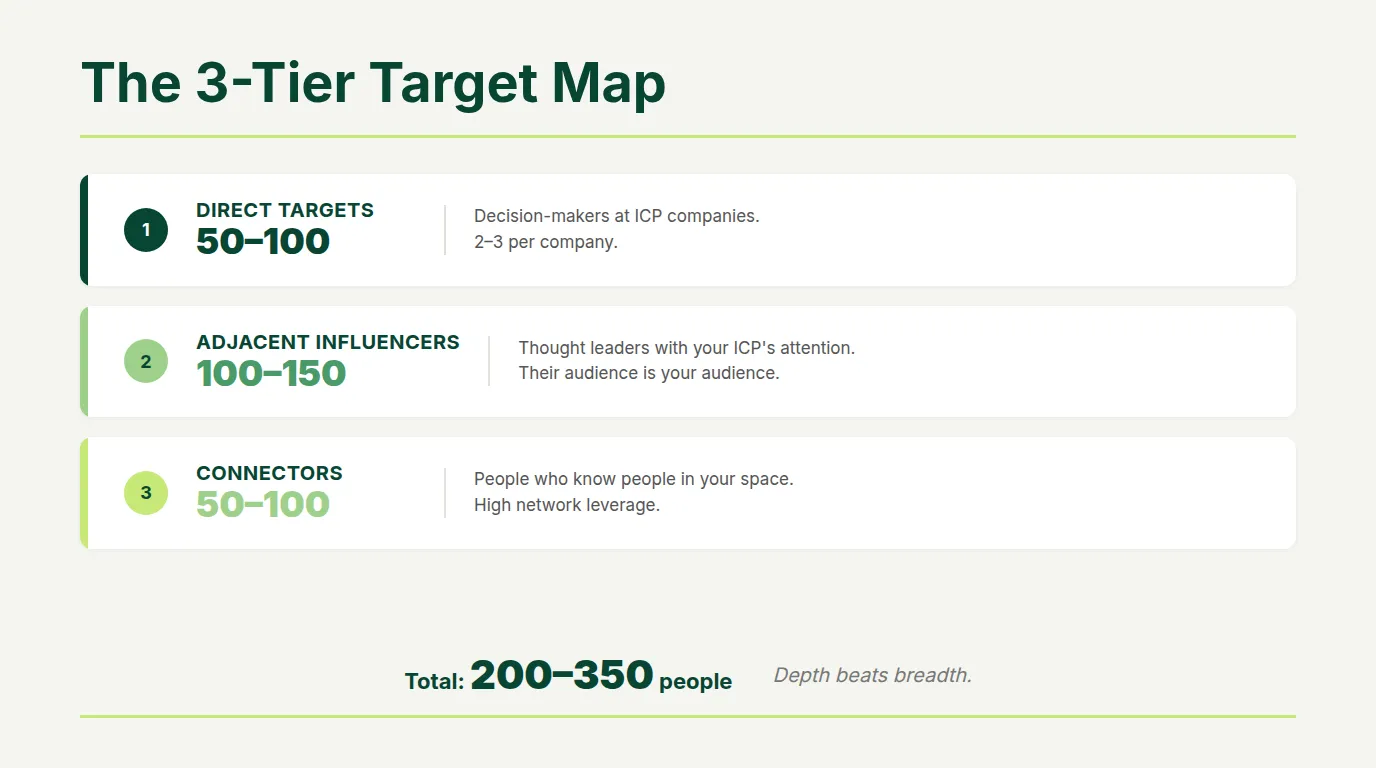
Think of your target map as three concentric circles. Each tier serves a different strategic purpose, and the total number of people across all three tiers should be 200-350. That is a manageable number — large enough to build meaningful pipeline, small enough to maintain genuine relationships.
Tier 1 — Direct Targets (50-100 people). These are the decision-makers at companies you want as clients. They have the budget, the authority, and the problem your product solves. At this tier, you know their name, company, role, and ideally a recent trigger event that makes your solution relevant right now. Every interaction with a Tier 1 contact should be intentional.
Tier 2 — Adjacent Influencers (100-150 people). Industry analysts, consultants, podcast hosts, newsletter writers, community leaders — people who influence your Tier 1 targets but are not themselves buyers. A relationship with one well-connected industry analyst can open doors to twenty Tier 1 conversations. Adjacent influencers are the multiplier layer of your network. As we analyzed in the LinkedIn Sales Playbook, thought leadership visibility from these relationships accelerates trust formation with eventual buyers.
Tier 3 — Connectors (50-100 people). People who bridge networks. They may not be in your industry at all, but they know everyone. Think of the person who always seems to be making introductions — they are a connector. Venture capitalists, executive recruiters, community managers, and serial board members often fall into this category. One strong connector relationship can reshape your entire network topology in a single quarter.
Five Methods for Finding Your Targets
- LinkedIn Search and Sales Navigator. Start with role titles, company size, and industry filters. Sales Navigator's "Lead Recommendations" feature uses your existing connections to surface similar profiles. Boolean search strings like "VP Marketing" AND "SaaS" AND "Series B" narrow the field efficiently. Export to a spreadsheet and assign tiers.
- Trigger Events. Job changes, funding rounds, company expansions, product launches, new hires — these are signals that a prospect's situation has changed. A VP of Sales who just joined a 200-person company has budget to spend and problems to solve. LinkedIn's notifications surface these events daily. Pay attention.
- Customer Networks. Your best current customers know people like themselves. Look at who they engage with on LinkedIn. Check their connections. The people your customers interact with publicly are the warmest Tier 1 targets you will find, because you already have a mutual relationship to reference.
- Competitor Comment Sections. People engaging with your competitors' content have already self-identified as interested in your category. They are researching solutions. Reading and commenting on competitor posts is not just a visibility tactic — it is intelligence gathering. Note who asks questions, who shares frustrations, who tags colleagues.
- Industry Events and Webinar Attendees. Conference speaker lists, webinar registration pages, and LinkedIn event attendees are pre-filtered audiences. Someone who registered for a webinar on "AI in supply chain" has declared their interest in the topic. That is a signal stronger than any demographic filter.
Key Takeaway: A focused target map of 200-350 people, organized by tier, replaces scatter-shot networking with strategic intent. You do not need thousands of connections — you need the right 200.
Step 2: Get on Their Radar Before You Connect
The single biggest mistake in LinkedIn B2B networking is treating the connection request as the first interaction. It should be the third or fourth.
Richard van der Blom's research across 1.8 million LinkedIn posts consistently shows that comments are the highest-leverage networking activity on the platform. A thoughtful comment on someone's post does three things simultaneously: it puts your name and face in front of them, it demonstrates your expertise, and it creates a reason for them to check your profile. (Richard van der Blom)
The rule is simple: comment on a prospect's content 2-3 times before sending a connection request. This transforms a cold outreach into a warm conversation. When your connection request arrives, they recognize your name. They have already read your thinking. The acceptance rate difference is not marginal — it is the difference between being ignored and being welcomed.
The Three Tiers of Comment Quality
Not all comments are created equal. The quality tier of your comment determines whether it builds a relationship or wastes your time.
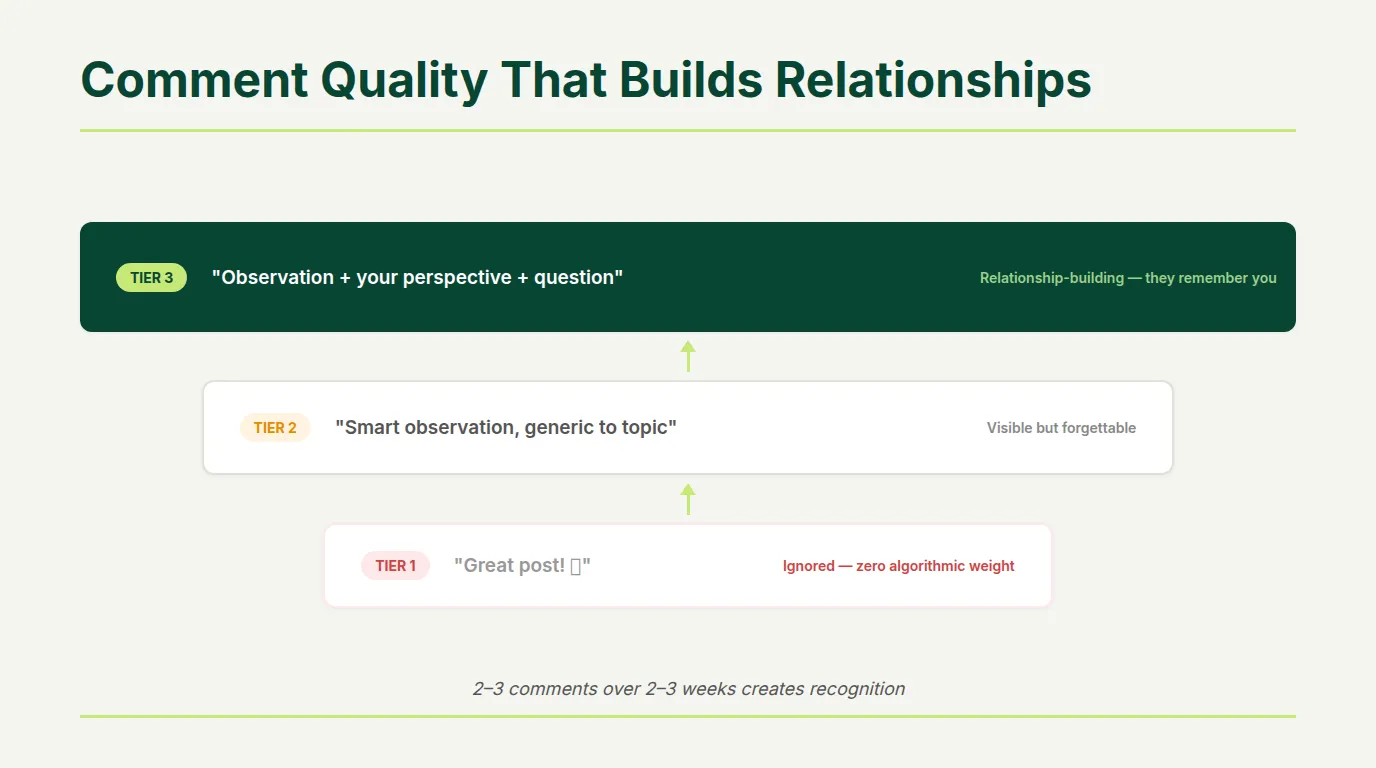
Tier 1 — Ignored. "Great post!" "So true!" "Love this!" "Thanks for sharing!" These comments are invisible. They do not register with the author, they do not appear meaningfully in the feed, and they signal zero expertise. If you are leaving Tier 1 comments, you are spending time without building anything.
Tier 2 — Visible But Forgettable. "I agree — we've seen similar trends in our industry." "Good point about the ROI metrics." These comments show you read the post. They might get a polite "thanks" reply. But they do not create a reason for the author to remember you. They are better than Tier 1 but insufficient for relationship building.
Tier 3 — Relationship-Building. This is where networking happens. A Tier 3 comment has three components:
- A specific observation about their content — something that shows you read carefully and thought about it: "Your point about sales cycles lengthening post-Series B matches something I've been tracking..."
- Your perspective or experience — what you've seen, what you've learned, a data point from your own work: "In our case, we found that adding a technical stakeholder to the demo shortened the cycle by 40%."
- A genuine question — something that invites continued conversation: "Have you seen the same pattern with enterprise vs mid-market deals?"
A Tier 3 comment takes 2-3 minutes to write. It functions as a micro-article — a public demonstration of your expertise that the author and their entire audience can see. Three of these over two weeks, and your connection request carries weight.
This approach connects directly to the Engagement Playbook principles — meaningful engagement compounds over time, and the algorithm rewards depth of interaction over volume.
Key Takeaway: Comment quality determines networking outcomes. Three Tier 3 comments over two weeks transform a cold connection request into a warm introduction. The formula: specific observation + your perspective + genuine question.
Step 3: The Connection Request That Gets Accepted
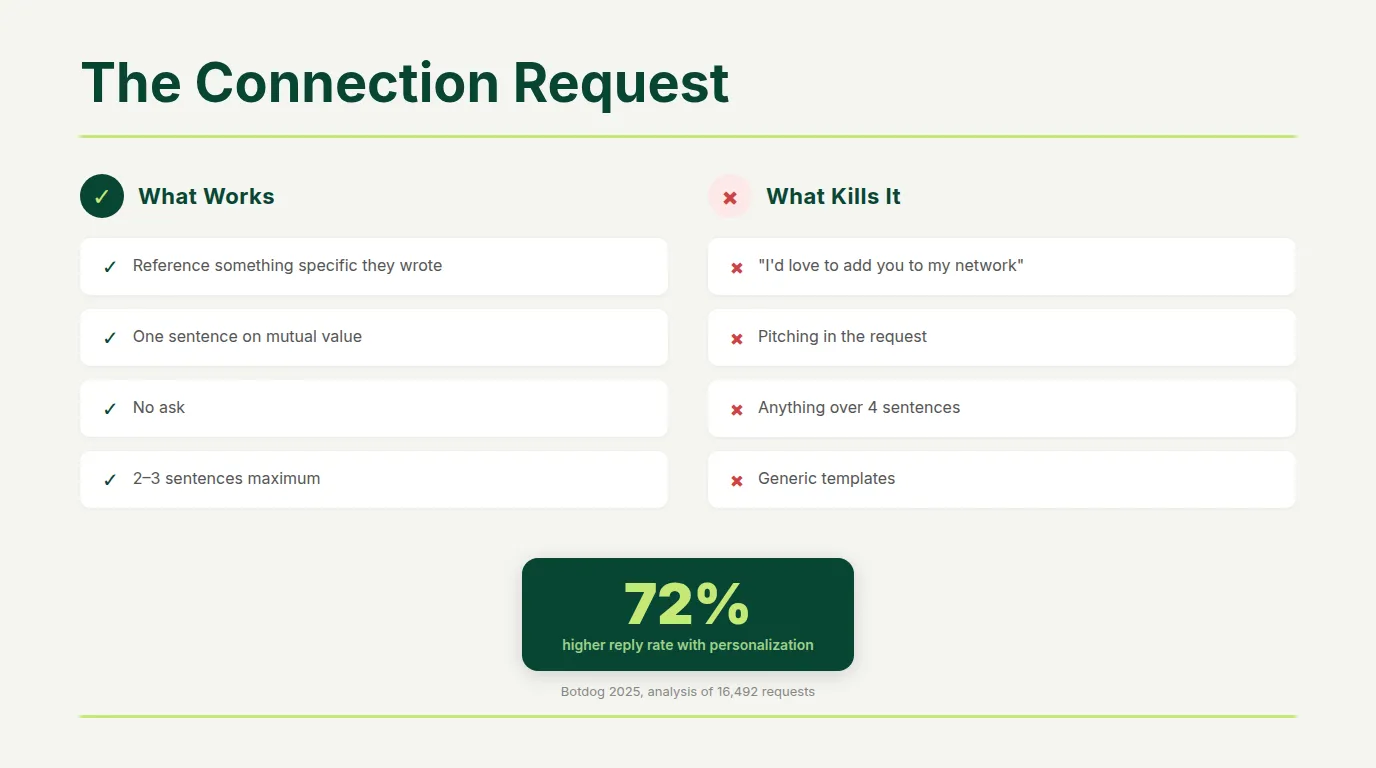
Botdog's 2025 analysis of 16,492 LinkedIn connection requests produced the clearest data available on what works: personalized connection requests achieve a 9.36% reply rate versus 5.44% for blank requests — a 72% improvement. (Botdog, 2025)
That 72% gap is the difference between building pipeline and collecting dormant connections. And the data shows it is not about writing more — it is about writing specifically.
The Anatomy of a High-Performing Connection Request
The best LinkedIn connection requests share three characteristics — and they are all about constraint, not expansion.
Reference something specific. Not "I liked your content" but "Your post on Tuesday about the gap between marketing attribution and actual pipeline had me rethinking our own measurement framework." Specificity proves you are a real person who paid attention. It also explains why you are reaching out right now, not six months ago.
One sentence on why you're connecting. "I'm building in the same space and think we're facing similar challenges" or "We have several mutual connections in the MarTech community and I'd like to be in your network." The why should be genuine and low-pressure. It is an explanation, not a pitch.
No ask. Zero. No "I'd love to get 15 minutes on your calendar." No "We help companies like yours with..." No link to your product. No mention of scheduling a call. The connection request opens a door. That is all it needs to do.
What Kills Connection Requests
- Pitching in the request. This is the number one reason connection requests get ignored or marked as spam. Any mention of your product, service, or a call-to-action turns a networking gesture into a sales intrusion.
- Writing more than 2-3 sentences. LinkedIn's character limit for connection notes is 300 characters. Use it wisely. Long messages signal that you want something. Short messages signal that you are someone worth knowing.
- Being vague. "I see we have mutual interests" tells the recipient nothing. If you cannot name a specific reason for connecting, you are not ready to send the request.
- Mass-sending identical notes. Even slightly personalized templates feel templated. Recipients can tell. The two minutes you save per message cost you the relationship.
Here is a template that works — but only because each instance requires real customization:
"Hi [Name] — your post on [specific topic] resonated. [One sentence about why — your perspective or shared context]. Would be great to be connected."
That is it. Under 300 characters. Specific. Human. No ask. If you've followed Step 2 and commented on their content 2-3 times first, this message lands with recognition rather than suspicion.
Key Takeaway: Personalized connection requests outperform blank ones by 72%. The formula: reference something specific, one sentence on why, zero ask. If you've commented on their content first, the request carries weight.
Step 4: The DM Sequence That Starts Conversations
Once the connection is accepted, most people do one of two things: they immediately pitch, or they do nothing at all. Both approaches waste the relationship you just built.
The data on LinkedIn DMs is remarkably clear. Overall response rate: 10.3% — already 2x the average email response rate of 5.1%. First-degree connections respond at 16.86%. And multi-step sequences — where you send 2-3 messages spaced over 1-2 weeks — achieve 20-30%+ response rates. (Botdog, 2025)
The multi-step approach works because it mirrors how relationships develop in the real world. No one meets a person at a conference, has one conversation, and then asks for a contract. There is a progression. The DM sequence respects that progression.
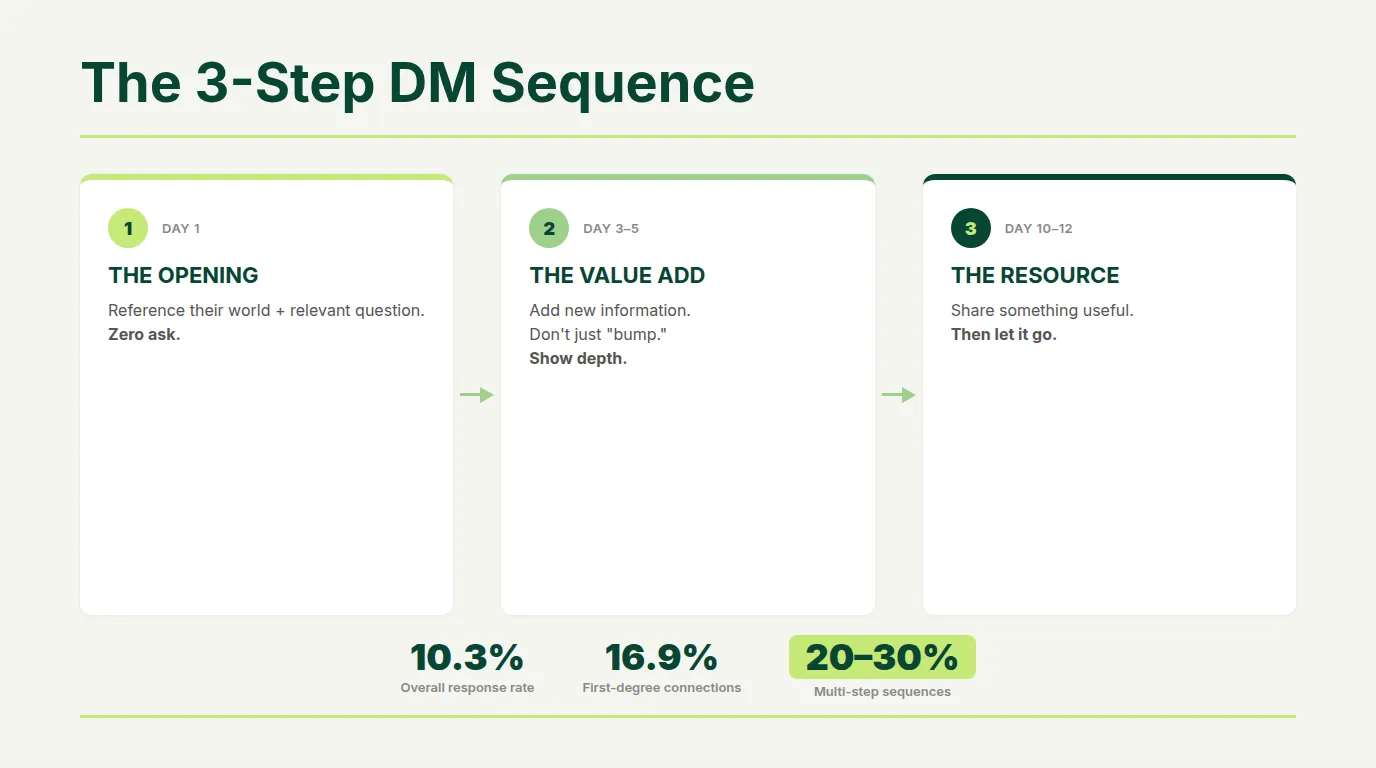
DM #1: Reference Their World, Ask a Question (Day 1)
The first DM should arrive within 24-48 hours of the connection being accepted. It is not a pitch. It is not a "thanks for connecting." It is a genuine message that references their world and opens a conversation.
The structure: acknowledge something specific about their work (a recent post, a company milestone, a shared challenge in the industry) and ask a question that invites a genuine response.
"Thanks for connecting, [Name]. I've been following the discussion about [topic from their recent content]. We're navigating something similar at [your company] — curious how your team is thinking about [specific aspect]?"
This message works because it leads with their context, not yours. The question is about their experience, not your product. And it references something real — which means it requires the same kind of research that made your connection request work.
DM #2: Add New Information (Days 4-6)
If DM #1 gets a response, continue the conversation naturally. If it does not, DM #2 arrives 3-5 days later with a different angle and new value.
The key principle: never repeat the same ask. DM #2 introduces something new — an article, a data point, an industry development, or an insight relevant to their work.
"Saw this research on [relevant topic] and thought of our conversation about [reference DM #1 topic]. The finding about [specific detail] surprised me — runs counter to what most teams assume. Thought you'd find it interesting."
Notice: no pitch. No link to your company. You are sharing value and building the relationship. The act of sending something relevant — without asking for anything — separates you from 95% of LinkedIn messages, which are transactional from the first line.
DM #3: Share a Resource (Days 10-14)
DM #3 arrives roughly one week after DM #2. By this point, you have either established a conversation thread or demonstrated persistent, value-first interest. This message typically includes a resource that is genuinely useful to them — a framework, a benchmark, a tool recommendation, or an invite to a relevant event.
"One more thing that might be relevant — we put together [a benchmark/guide/analysis] on [topic]. No pitch, just data we've been collecting. Happy to share if it's useful for what your team is working on."
If they say yes, you have a reason to continue the conversation. If they don't respond, you have three touchpoints of demonstrated value in their message history. When they encounter your name again — through content, through mutual connections, through a future trigger event — the groundwork is already laid.
This multi-touch approach aligns with what we documented in the LinkedIn Sales Playbook: trust builds through repeated, value-first interactions, not through a single compelling message.
Key Takeaway: Multi-step DM sequences achieve 20-30%+ response rates. The three-message structure — reference their world, add new information, share a resource — builds genuine relationships without ever feeling like outreach.
Step 5: Moving from Relationship to Business
The hardest part of LinkedIn relationship building is the transition from "we have a good rapport" to "let's explore working together." Push too early and you burn the relationship. Wait too long and someone else fills the gap.
The framework that works is a three-phase progression — and the key insight is that you are not driving the timeline. You are reading signals and responding to them.
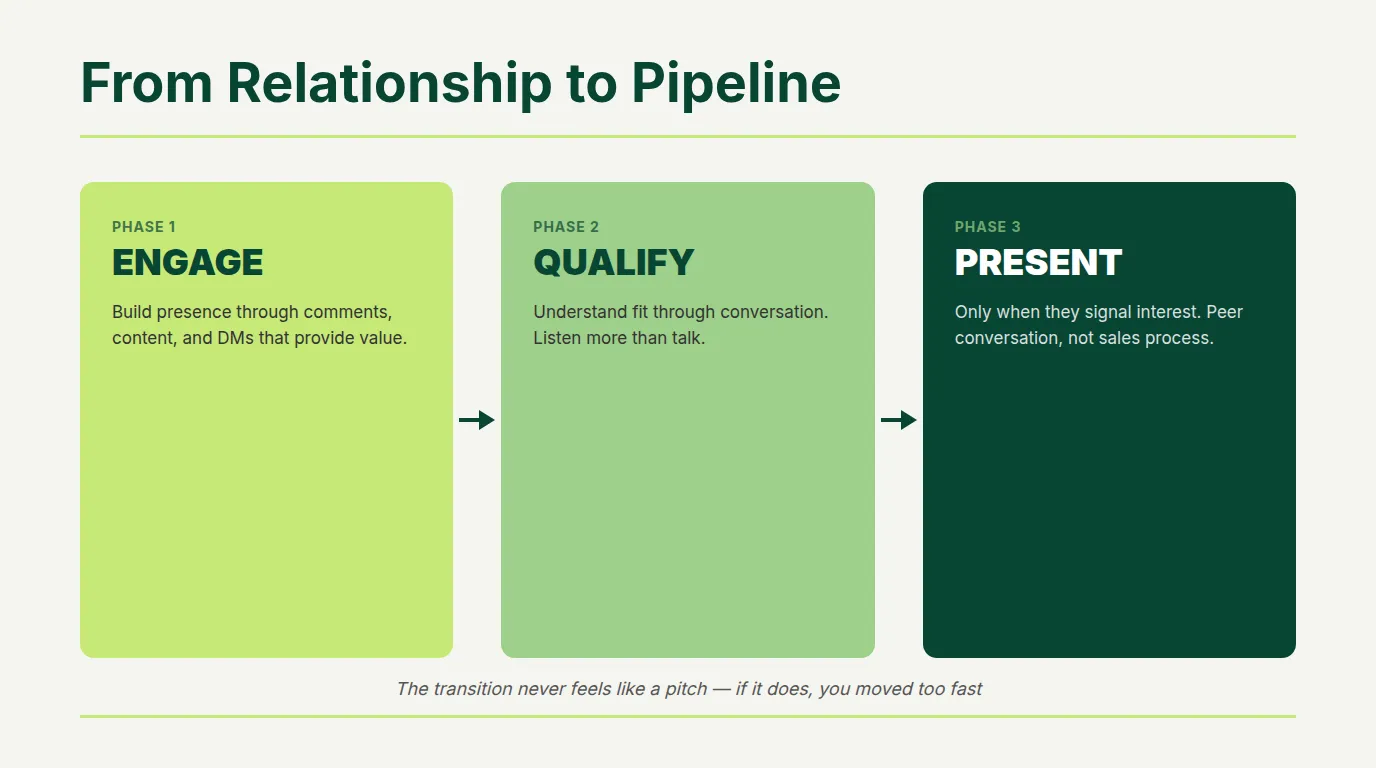
Phase 1: Engage
This is where Steps 1 through 4 live. You are commenting on their content, you have connected, you are exchanging DMs. The relationship is forming. During this phase, you are not selling — you are learning. What are their priorities? What challenges do they mention? What is their company's trajectory?
The Engage phase typically lasts 2-4 weeks. It can be shorter if there is a strong trigger event (they just raised funding, changed roles, or publicly discussed a problem you solve). It should never be skipped entirely.
Phase 2: Qualify
Qualification happens through conversation, not through a discovery call script delivered over DM. You are looking for three signals:
- Problem awareness. They have mentioned a challenge that aligns with what you solve — in their content, in DMs, or in public discussions.
- Timing. Something has changed that makes this relevant now — budget cycle, new initiative, competitive pressure, growth target.
- Authority. They are the decision-maker, or they have direct access to the person who is.
When these three signals converge, the transition to Phase 3 happens naturally. You might say: "Based on what you shared about [specific challenge], this is exactly the area we work in. Would it make sense to have a quick conversation about how we've approached this with similar teams?"
Notice the structure. It references their specific situation (not a generic pain point). It positions the conversation as exploratory ("would it make sense" rather than "I'd love to schedule"). And it draws a line from their stated problem to your expertise — which by this point they have already seen through weeks of your comments and content.
Phase 3: Present
If they agree to a conversation, the hard work is already done. They know your expertise. They trust your judgment. They have seen your thinking in comments, DMs, and content. The conversation is not a cold pitch — it is a warm discussion between two people who already have a relationship.
This is why the approach converts at higher rates than traditional outreach. By the time you present, the prospect has already been through a months-long trust-building process. The call is a formality, not a starting point.
The Referral Path
There is a parallel conversion mechanism that operates alongside direct outreach: referrals. Research shows that 90% of B2B decision-makers say referrals from people they know are effective in influencing purchasing decisions. (Heinz Marketing)
Your Tier 2 (Adjacent Influencers) and Tier 3 (Connectors) contacts are your referral layer. When you build genuine relationships with people who influence your buyers, introductions happen organically. A well-connected industry consultant who trusts your work will mention your name when a client describes a problem you solve. No pitch required. No outreach necessary. The relationship does the selling.
As we explored in the Viral LinkedIn Post Formula, visibility and engagement compound — and so do the network effects of genuine relationship investment.
Key Takeaway: The transition from relationship to business follows three phases — Engage, Qualify, Present. You are not driving the timeline; you are reading signals. When the transition happens naturally, conversion rates far exceed traditional cold outreach.
What Kills LinkedIn Relationships
Understanding what works is only half the equation. The patterns that destroy LinkedIn networking results are equally important — and more common.
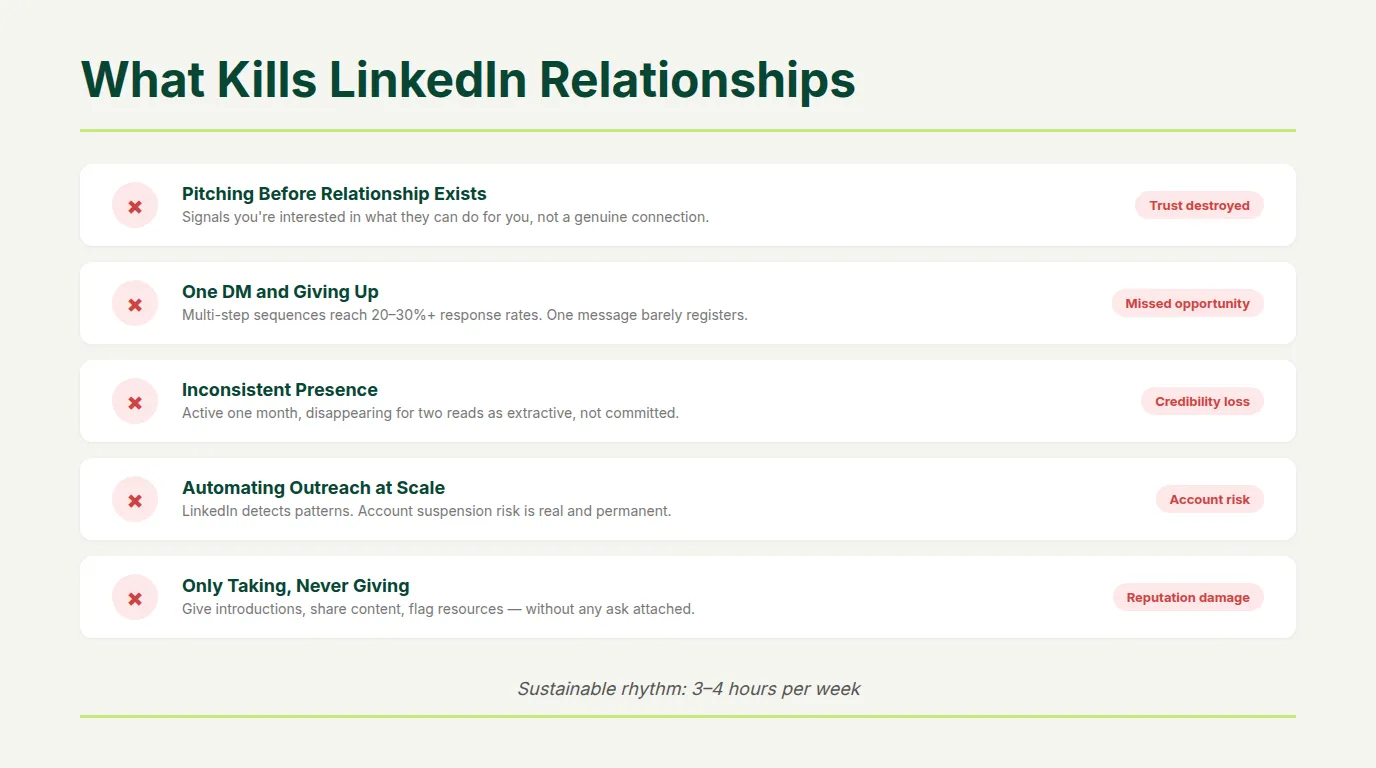
1. Pitching Before the Relationship Exists
This is the most common and most damaging pattern. You accept a connection request, and within minutes you receive a 300-word message about their product, their services, and a Calendly link. It happens so frequently that most senior professionals now expect it — which means they approach new connections with suspicion by default.
The data is clear: pitching in the first message drops response rates to near zero and often results in the connection being removed entirely. Every premature pitch does not just lose one opportunity — it trains the recipient to be more skeptical of the next genuine outreach they receive.
2. One DM and Giving Up
Research consistently shows that 80% of sales require five or more touchpoints, yet the majority of LinkedIn outreach consists of exactly one message. When that message does not get a response, the sender moves on to the next prospect.
Non-response to a first DM is not rejection. It is noise. The recipient was busy, your message arrived during a meeting, they intended to reply and forgot, or they needed more context before engaging. The multi-step sequence exists precisely because a single message rarely captures attention in an environment where professionals receive dozens of notifications daily.
3. Inconsistent Presence
Posting and engaging actively for two weeks, then disappearing for a month, then reappearing with a connection request blast — this pattern signals that you are on LinkedIn only when you need something. People notice. The professionals who build the strongest networks are the ones who appear consistently, even when they are not actively selling.
Consistency does not require volume. Three quality comments per day, one post per week, and responsive DM management is enough to maintain presence. The key is regularity, not frequency.
4. Automating at Scale
Automation tools that send connection requests and DMs at scale are tempting because they promise efficiency. They deliver the opposite. Mass-sent messages are detectable — the same phrasing, the same timing patterns, the same lack of specificity that only genuine research produces.
LinkedIn actively detects and penalizes automation. More importantly, your target audience detects it too. Senior decision-makers who receive obviously automated outreach are not just ignoring your message — they are forming a negative impression of your brand that persists long after they delete the notification.
5. Only Taking, Never Giving
The final pattern is the most subtle and the most corrosive. Some professionals only appear in someone's notifications when they want something — a referral, an introduction, feedback on their product, a testimonial. They never comment on the other person's content, never share their posts, never offer help or resources without a reciprocal expectation.
Networking is a two-way system. The people who receive the most introductions, the most referrals, and the most pipeline from their LinkedIn network are invariably the ones who give the most without keeping score. This is not a moral principle — it is a documented pattern in every study of professional network dynamics.
Key Takeaway: Five patterns kill LinkedIn relationships: premature pitching, giving up after one message, inconsistent presence, mass automation, and transactional behavior. Avoiding these matters as much as following the five-step system.
The Complete Timeline: From Stranger to Pipeline
Here is what the full LinkedIn outreach strategy looks like when all five steps are working together:
| Timeline | Action | Purpose |
|---|---|---|
| Week 0 | Build target map (200-350 people, 3 tiers) | Strategic intent replaces random networking |
| Weeks 1-2 | Comment 2-3 times on each Tier 1 prospect's content | Name recognition, expertise demonstration |
| Week 2-3 | Send personalized connection request | Warm outreach with 72% higher acceptance |
| Week 3 | DM #1 — reference their world + question | Open a genuine conversation |
| Week 4 | DM #2 — add new information | Demonstrate ongoing value |
| Week 5 | DM #3 — share a resource | Deepens the relationship, creates reciprocity |
| Weeks 4-8 | Read qualification signals, continue engaging | Identify timing and fit naturally |
| Weeks 6-10 | Transition to business conversation | Warm call, not cold pitch |
The entire cycle from stranger to business conversation takes 6-10 weeks when executed with discipline. That may sound slow compared to a mass email campaign. But consider the math: a multi-step DM sequence achieves 20-30%+ response rates, and the conversations that result are with people who already trust your expertise. Traditional cold outreach achieves 1-3% response rates with people who view you with suspicion.
Running this system across 50 Tier 1 targets produces 10-15 genuine business conversations per quarter. For most B2B companies, that is a full pipeline — built entirely through relationships.
The Content Multiplier
This networking system does not operate in isolation from your content strategy. Each step reinforces the other. When you post valuable content, your targets see it in their feed — that is passive warm-up happening in the background. When you comment on others' posts, your content gains visibility through the algorithm's engagement signals.
The personal brand you build through consistent content becomes the credibility layer that makes every connection request, every DM, and every transition conversation more effective. The networking system is the active layer. Content is the passive layer. Together, they compound.
Build the Content Engine Behind Your Network
Effective LinkedIn networking requires a consistent content presence — the warm-up layer that makes every connection request and DM more effective. Co.Actor generates 5-10 personalized post ideas every morning, tailored to your voice, your industry, and your target audience.
For individual professionals and employee advocacy teams alike, Co.Actor builds the content engine that powers relationship-driven growth. Users see 3x engagement increase in month one — and that engagement becomes the foundation for every networking conversation.
No credit card required. Full access to all features.
Your Action Items This Week
- Build your initial target map. Open a spreadsheet. Create three tabs — Direct Targets, Adjacent Influencers, Connectors. Aim for 50 people across all three tiers this week. Expand to 200-350 over the next month.
- Identify 5 Tier 1 prospects and start commenting. Find their most recent LinkedIn posts. Leave one Tier 3 comment (observation + perspective + question) on each. Set a reminder to comment again in 3-4 days.
- Audit your last 10 connection requests. Were they personalized? Did they reference something specific? Did they include an ask? If they were blank or templated, rewrite one using the formula in Step 3 and send it today.
- Draft your 3-DM sequence. Write templates for DM #1 (reference + question), DM #2 (new information), and DM #3 (share resource). Customize each one for your top 3 Tier 1 targets. Save them for use after connection acceptance.
- Set a weekly 30-minute networking block. Consistency matters more than volume. Block 30 minutes every Tuesday or Wednesday specifically for commenting on target content and responding to DMs. Treat it like a meeting — non-negotiable.
Frequently Asked Questions
How many LinkedIn connection requests should I send per week?
Quality outperforms volume. A focused strategy of 20-30 highly targeted, personalized connection requests per week outperforms 100+ generic ones. Personalized requests see 72% higher acceptance rates (9.36% vs 5.44%). LinkedIn also limits weekly connection requests to roughly 100-200 depending on account standing, and excessive volume can trigger restrictions.
What is the best LinkedIn DM response rate?
The overall LinkedIn DM response rate is 10.3% — already 2x email at 5.1%. First-degree connections respond at 16.86%. Multi-step DM sequences achieve 20-30%+ response rates. The key is referencing something specific about the recipient and leading with value, not a pitch.
Should I comment on someone's posts before sending a connection request?
Yes. Commenting 2-3 times before connecting establishes familiarity and increases acceptance rates significantly. Richard van der Blom's research on 1.8 million LinkedIn posts confirms that meaningful comments build visibility. The key is Tier 3 comment quality — a specific observation, your perspective, and a genuine question. Generic comments like "Great post!" do nothing.
How do I build a LinkedIn target map for B2B networking?
A target map is 200-350 people in three tiers: Tier 1 is 50-100 direct targets (decision-makers at target companies), Tier 2 is 100-150 adjacent influencers (industry voices who influence your targets), and Tier 3 is 50-100 connectors (people who bridge networks). Use LinkedIn search, Sales Navigator, competitor comment sections, trigger events, and customer networks to populate it.
How long does it take to convert a LinkedIn connection into a business relationship?
The typical timeline is 6-10 weeks from first comment to business conversation. This includes 1-2 weeks of commenting, a connection request, a value-first DM sequence over 2-3 weeks, and then a natural transition. Rushing the timeline — pitching in the connection request or first DM — destroys the relationship before it starts.
What kills LinkedIn networking relationships?
Five patterns consistently destroy LinkedIn relationships: pitching before the relationship exists, sending one message and giving up (80% of sales require 5+ touches), inconsistent presence, mass automation tools, and only taking without ever giving value. Avoiding these mistakes matters as much as following the networking system.
About the Author
Serge Bulaev is the CEO & Founder of Co.Actor, the AI-powered platform that helps professionals and teams build consistent LinkedIn presence. With experience across B2B sales, personal branding, and content-driven growth, Serge writes about the systems behind effective LinkedIn strategy. Connect with him on LinkedIn.
Sources & References
- LinkedIn Business — B2B Marketing Trends — 80% of B2B leads originate from LinkedIn
- Botdog — LinkedIn Connection Request Statistics 2025 — 16,492 requests analyzed, 72% higher acceptance for personalized requests (9.36% vs 5.44%)
- Botdog — LinkedIn Message Response Rate Statistics 2025 — 10.3% overall DM response, 16.86% first-degree, 20-30%+ multi-step sequences
- Richard van der Blom — Algorithm Insights 2025 — 1.8M posts analyzed, comment quality tiers and engagement data
- Heinz Marketing — B2B Referral Research — 90% of B2B decision-makers say referrals from known people influence purchasing decisions
- Edelman-LinkedIn 2024 B2B Thought Leadership Impact Report — Trust and influence data for B2B decision-makers
- LinkedIn Sales Solutions Blog — Sales Navigator data and B2B networking benchmarks
Written by
