TL;DR
The Forward Deployed Marketing Specialist (FDMS) is an embedded operator who runs AI-powered content for an entire executive team — 30 voices, 1 operator, same budget as one agency. The model compounds: Memory gets sharper every week, approval time drops from 20 min to 3 min by week 12, and pipeline attribution is measurable.
I’ve spent fifteen years on the buy side of marketing budgets. I’ve approved agency contracts worth eight figures. I’ve sat through hundreds of quarterly business reviews where an agency presents brand lift data while my CFO asks why pipeline is flat. I know this world from the inside.
The model is broken. Not because agencies are incompetent — the best ones are exceptional at what they do. It’s broken because what they do is structurally disconnected from how B2B revenue actually works in 2026.
This article is my attempt to explain what I see replacing it, why it works, how to build the business case, and — critically — where it fails. If you’re a CMO, a VP of Marketing, or a CEO evaluating your marketing spend, this is worth reading before your next agency renewal.
Why the agency model fails at scale
Let me describe a scenario that every CMO I know has lived through. You hire a PR or content agency. The onboarding takes six weeks. The first deliverables arrive and they’re technically fine — well-written, on-brand, SEO-considered. They also sound like they were written by someone who has never sat through your sales calls, doesn’t know your three biggest competitive losses this quarter, and has never heard a customer explain why they almost didn’t buy.
The signal-to-noise problem compounds with scale. A 300-person company has a CMO, a VP of Sales, a CTO, a Head of Product, and a dozen senior leaders who each have real, specific, differentiated things to say about their domain. The aggregate reach of your leadership team almost certainly exceeds your brand page by a factor of ten. And the trust those individual voices carry — because buyers follow people, not logos — is categorically higher.
The aggregate LinkedIn reach of your leadership team likely exceeds your brand page by 10x. The trust it carries is categorically higher. Most companies never activate it.
What is a Forward Deployed Marketing Specialist?
A Forward Deployed Marketing Specialist (FDMS) is an embedded operator. Not a contractor who joins your Slack. Embedded — in the standups, in the CRM, in the QBRs, in the lost-deal reviews. Their job is to convert the information flow of the business into individual content for each leader, in each leader’s real voice, every day.
The term comes from software engineering, where “forward deployed engineers” (Palantir popularized the concept) work directly on-site at clients. The idea is the same: proximity to the problem produces qualitatively different output. A marketer who has heard your head of sales describe why you lost a $400K deal last Tuesday can write about it in a way that no brief ever could.
What makes the FDMS model viable now is the platform layer. A single human cannot maintain thirty distinct executive voices, monitor market signals in real time, write daily, and manage publishing logistics. But a single human orchestrating a platform designed for exactly that workflow? That works.
Signals
Monitors the market continuously — competitor moves, category shifts, what each executive’s network is engaging with — and surfaces what’s worth a response today.
Memory
Maintains a high-fidelity model of every executive’s voice, vocabulary, standing opinions, and recurring themes. Gets more accurate every week.
Publora
Handles distribution — LinkedIn, X, newsletters — at the right time, right format, with threading and cross-posting managed automatically.
The real economics — a CMO’s breakdown
A mid-market content and PR agency engagement costs $12,000–$18,000 per month. Call it $180,000 per year. For that: a brand blog with four to six posts per month, social media for one or two branded accounts, quarterly thought leadership for one executive, and a monthly impressions report nobody in sales looks at. That’s one voice.
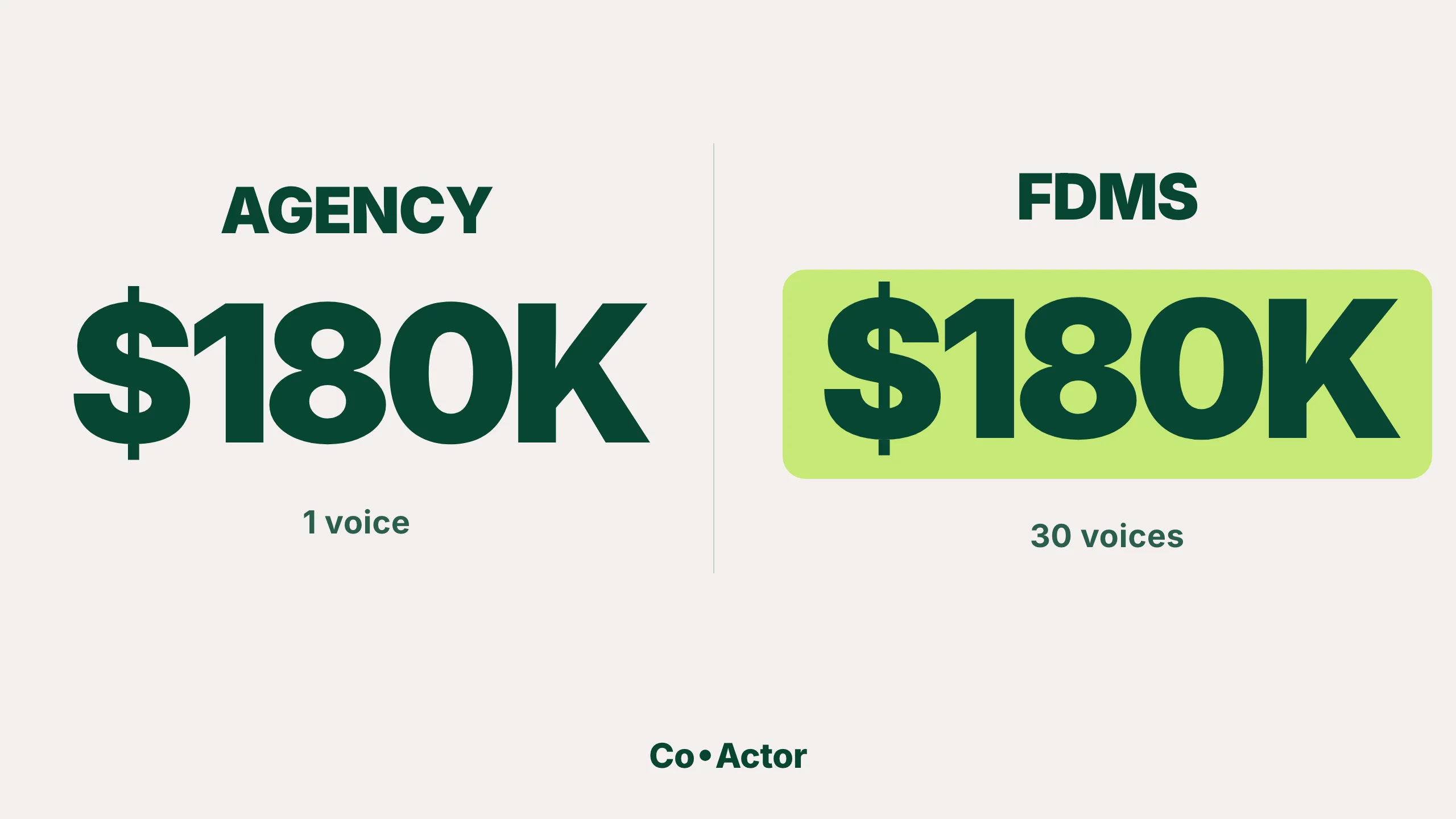
An FDMS at comparable cost covers your entire leadership team. In a company with thirty publishing executives, you’ve just reduced the per-voice cost from $180,000 to $6,000. If each of your thirty executives publishes twice per week and each post reaches 3,000 unique connections, that’s 9.4 million relevant B2B impressions per year — from people your buyers already follow and trust.
The 90-day trust-building curve
The most common objection: “I don’t have time to review drafts every day.” That objection is based on a misunderstanding of how the workflow evolves.
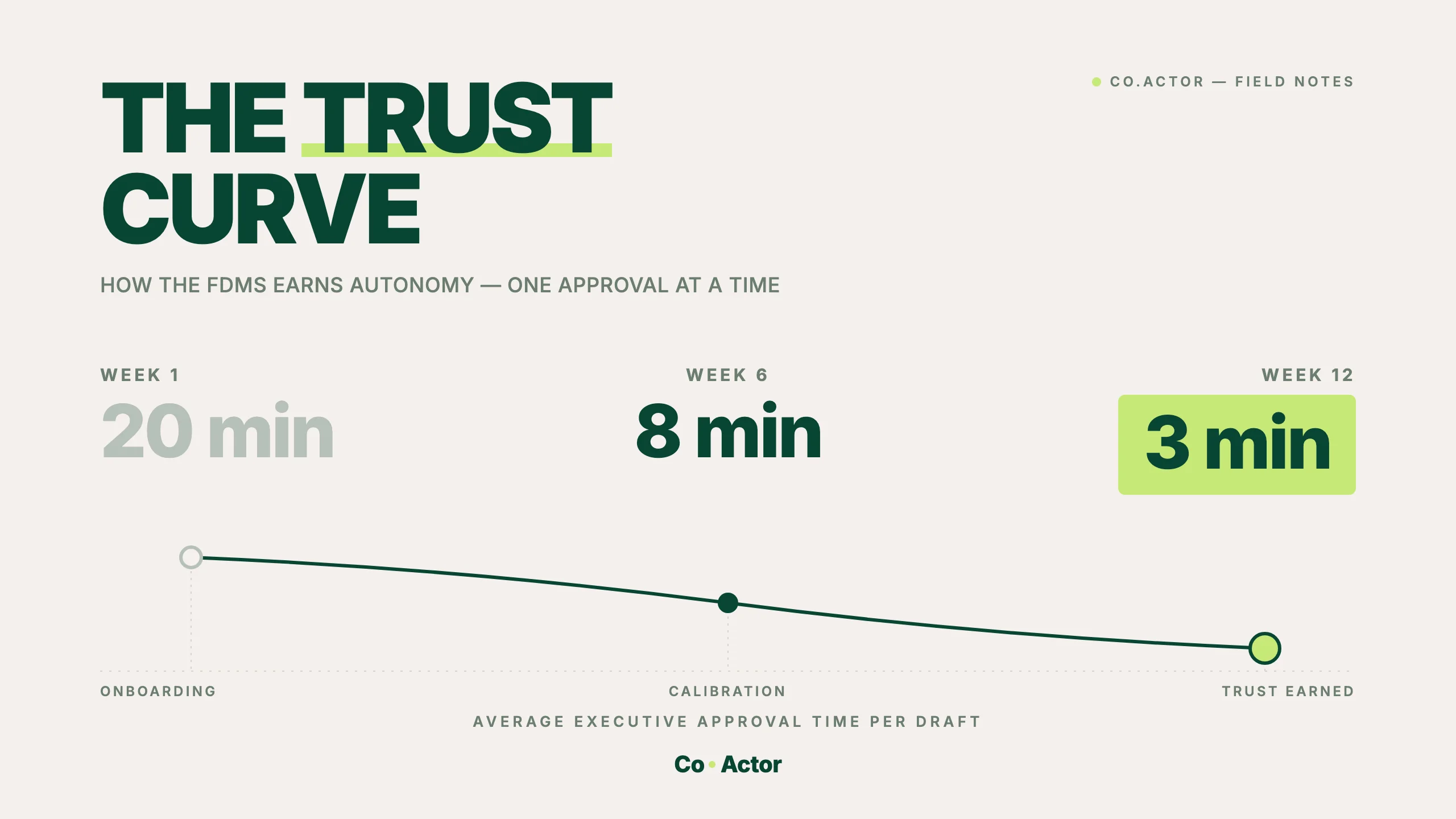
Week one: 20 minutes per draft. Week six: 8 minutes. Week twelve: 3 minutes. The executive’s time investment front-loads in weeks one through four and then drops sharply. Memory doesn’t forget — every correction, every winning post is retained. An FDMS who has been inside a company for eighteen months is operating with a voice model no agency could replicate at any price.
What a day actually looks like at scale
A 1,200-person company, thirty executives publishing weekly. One FDMS.
Scan overnight activity. Tag what’s worth a response and assign to the executive whose voice fits. Takes 20 minutes because Signals pre-ranks by relevance.
Review yesterday’s engagement. Where was the voice off. Push corrections back into Memory.
Walk thirty executives through drafts. By week 12: ninety minutes total, three minutes per person. Most approvals: “Good, ship it.”
Comments across thirty accounts. Decide what gets a real reply, what gets surfaced to the executive, what becomes a follow-up post.
Cross-reference content against CRM. Profile views from ICP after a post? Flag for SDR outreach.
Feed today’s lessons back into Memory. Tomorrow’s drafts start from a better baseline.
Measuring what matters: pipeline attribution
This is where the model either wins or loses the CFO. Every CMO has been burned by vanity metrics. Impressions, reach, brand lift — these translate to zero in a board conversation about revenue.
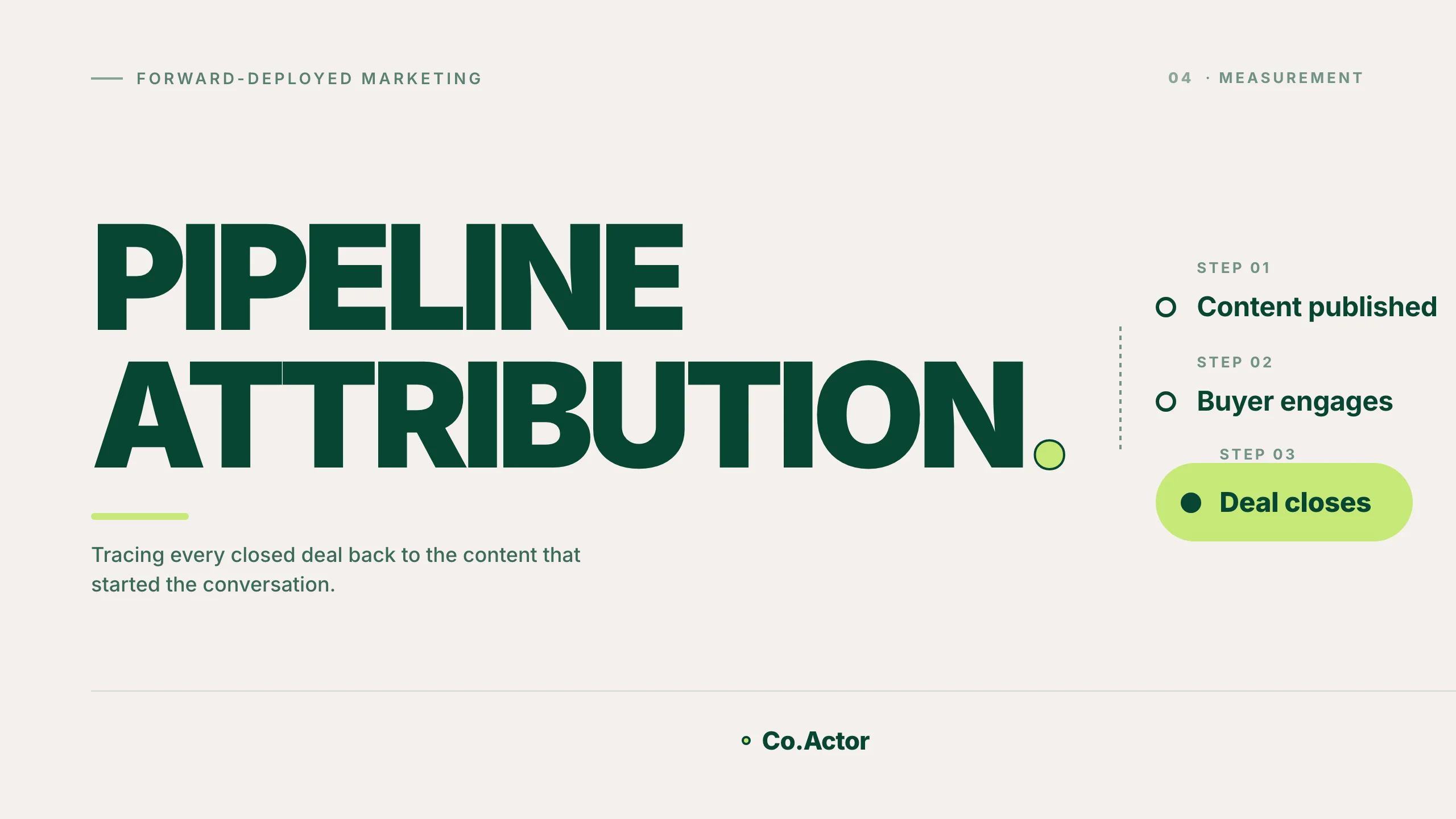
Survey every new customer: “How did you know us before we reached out?” Executive content is usually the answer that never appears in your attribution tools.
How to present this to your board
The pitch is not “we’re hiring a ghostwriter.” The pitch is a marketing infrastructure investment with a defined ROI model. Frame it in three parts:
Your leadership team has a combined LinkedIn network of hundreds of thousands of B2B professionals. Right now, that asset is dormant. If 0.1% requests a demo over the next year, what is that worth at your ACV?
You are currently spending $X on agency content that reaches Y people. The FDMS model produces a minimum 10x increase in ICP reach at comparable cost, because it activates human networks rather than brand channels.
Unlike an agency relationship that resets to zero if you change vendors, the FDMS model builds voice models that become more valuable over time and are not replicable by competitors. After eighteen months, your FDMS knows each executive’s voice better than any agency ever will.
The 90-day rollout playbook
Do not launch with thirty executives. Start anchored.
Select one executive with an existing audience and enough trust to let the FDMS get close. Build one working voice model, prove the economics, document the playbook. This becomes your internal case study.
Add four more executives across sales, product, engineering, operations. Each requires a distinct voice model. This is where the platform dependency becomes clear — you cannot do this at volume with spreadsheets.
Onboard remaining executives in cohorts of five. By day 90: thirty active voices, a functioning approval workflow, three months of data for the board.
Where this model fails
Voice models live in Memory, but institutional knowledge lives in a human. Treat this role as critical infrastructure. Competitive comp, retention incentives, documented handover protocol.
One bad post damages trust more than ten good ones build it. Three minutes of reading is not a burden. Maintain the discipline.
Do not force reluctant executives. A reluctant executive who publishes half-heartedly is worse than one who doesn’t publish at all. Work with willing participants and let results create internal FOMO.
When this model is wrong for your company
- Transactional sales cycle (under 30 days, under $10K ACV). Use paid performance instead.
- Executives not willing to publish opinions. Executive content requires specific, personal, sometimes controversial views.
- Pre-product-market-fit. Constantly shifting messaging invalidates voice models before they compound.
- ICP not on LinkedIn or X. Government, manufacturing trades, healthcare administration — the distribution channels don’t work.
The verdict
The marketing agency model was built for a world where brands were the unit of trust. That world ended sometime around 2021. The FDMS is the organizational response to that shift. The companies that figure this out in the next eighteen months will have a compounding advantage their competitors cannot quickly replicate. Voice models that have been running for two years are not something you can buy. They are built, slowly, through proximity and trust.
A post that ships beats a perfect post that doesn’t. The only content that compounds is the content that goes out.
That is the moat. And it starts on day one.
Written by
