TL;DR
- A CEO with 5,000 followers generates the same engagement as a company page with 300,000 — personal profiles get 5x more engagement than company pages
- 44% of your company's market value is tied to your CEO reputation — this is a financial asset, not a vanity project
- 95% of hidden decision-makers become more receptive to sales outreach after engaging with quality thought leadership from founders
- Hot takes get views, client stories get pipeline — the content that generates the most reach is not the content that generates clients
- AI-generated content underperforms by 40-50% — audiences detect it, the algorithm penalizes it
- Adam Robinson built $4M ARR in year one primarily through LinkedIn storytelling, including 1,600 leads from a single post
- The average post takes 35 minutes — at 4 posts/week, that's 121 hours per year for potentially millions in attributed pipeline
The Algorithm Doesn't Care About Your Logo
If you're a founder or CEO, the rules on LinkedIn for founders are not the same as for everyone else. Your presence doesn't just build your brand. It builds your company's valuation, your talent pipeline, your deal flow, and your investor credibility. All at once.
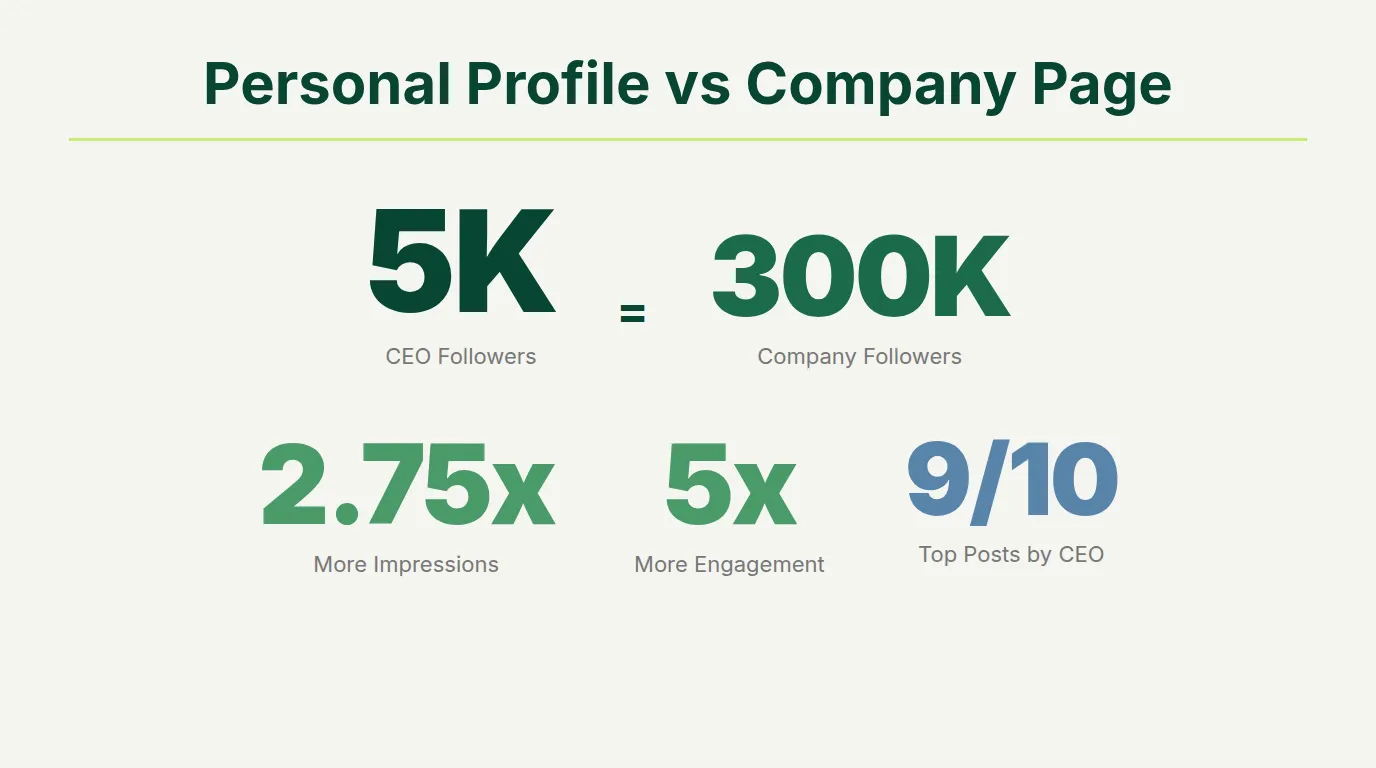
LinkedIn's algorithm has a clear bias. Personal profiles get 2.75x more impressions and 5x more engagement than company pages posting identical content. First-degree connections dominate the feed — and people connect with people, not logos.
DSMN8 analyzed 11,107 LinkedIn posts and found something remarkable: a CEO with approximately 5,000 followers generates the same number of reactions per post as a company page with 300,000 followers. Nine out of ten of the most-engaged posts were authored by the CEO, not the brand. (DSMN8)
This isn't a bug. It's LinkedIn's fundamental design. The platform was built around professional relationships — and relationships are between people. When you post from your personal profile, you're working with the algorithm. When you post only from a company page, you're fighting it.
If your company's organic reach is collapsing, the fix isn't more company page posts. It's moving that time to the CEO's personal profile. The ROI gap is not marginal — it's 5x. This is the single most important principle in any CEO LinkedIn strategy.
Key Takeaway: Organizations seeing organic reach collapse should shift time from company page content to the CEO's profile. A CEO with 5,000 genuine followers outperforms a company page with 300,000. The algorithm rewards people, not logos.
This Is a Financial Asset, Not a Vanity Project
Before we go further — let's establish what's actually at stake for your founder personal brand LinkedIn presence.
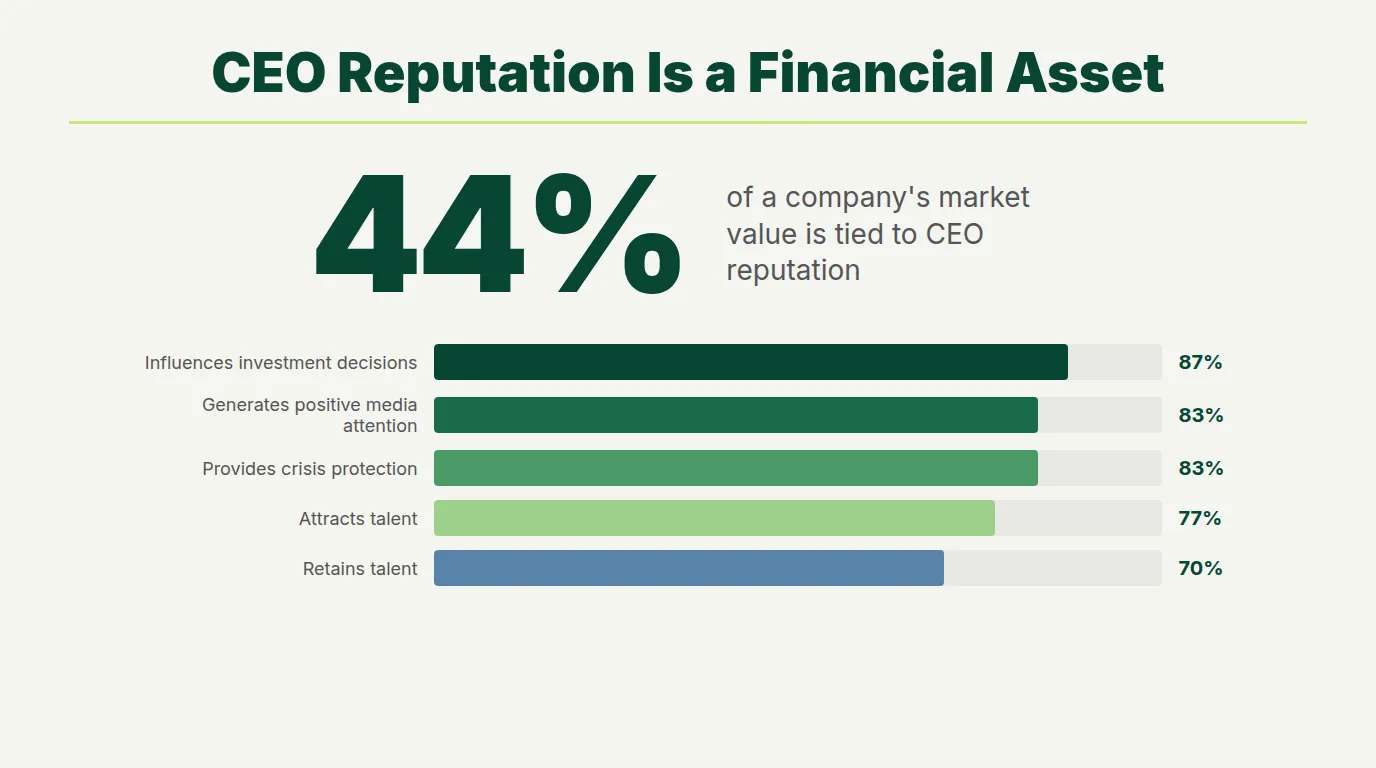
Weber Shandwick's research across global executives found that CEO reputation accounts for 44% of a company's market value. (Weber Shandwick)
That's not impressions. Not followers. Not engagement rate. Market value.
| CEO Reputation Impact | % of Executives Agree |
|---|---|
| Influences investment decisions | 87% |
| Generates positive media attention | 83% |
| Provides crisis protection | 83% |
| Attracts talent | 77% |
| Retains talent | 70% |
This is the business case for building an executive LinkedIn presence. Not "becoming an influencer." A direct line to company valuation, investor confidence, and talent acquisition — all from the same content.
The companies that understand this treat LinkedIn for CEOs as a strategic asset and budget accordingly. The ones that don't treat it as optional — until they're in a fundraise and realize investors have been watching their feed for months.
What the Business Results Look Like
Let's skip the theory and look at documented numbers from founders who've built founder-led growth LinkedIn strategies.
| Founder / Company | Result | How |
|---|---|---|
| Adam Robinson, RB2B | $0 to $4M ARR in year one | Only 1 in 10 posts has a CTA. Brutally honest entrepreneurial stories. One post generated 1,600 leads. |
| Justin Welsh | $12.5M+ revenue, zero employees | Posts 4x/week. Zero paid ads. LinkedIn primary channel. 1,307 referral sales in 2024. |
| Guillaume Moubeche, lemlist | $26M+ ARR, $150M valuation | Documented every milestone and failure. $1,000 initial investment. 500K+ followers at zero cost. |
| Patrick Campbell, ProfitWell | $200M+ exit to Paddle | 10 years of sharing proprietary SaaS metrics. Content was infrastructure, not a side project. |
| TACK | $2M+ pipeline, $1.2M closed | Directly attributable to founder LinkedIn presence. |
| Dreamdata | $1M pipeline | Employee LinkedIn activity triggered by founder-led content. |
Windmill Growth's benchmark across B2B founders with average deal sizes above $25K: clients see 10-20x ROI within 6 months. One B2B SaaS founder generated 11.7 million impressions across 214 posts — all organic, no paid amplification. (Windmill Growth)
The employee multiplier matters too. When a founder posts consistently, team members follow organically. Employee advocacy leads convert 7x more frequently than traditional leads. Employee-shared content generates 800% more engagement and 561% greater reach than company brand accounts. Founder content is the ignition. The team is the engine. (DSMN8)
These aren't edge cases. They're the pattern. As we covered in the Personal Brand Playbook, the math behind building a professional brand on LinkedIn compounds over time — for founders, the returns are even more dramatic.
What High-Performing Founders Actually Post
Here's the insight that surprises most founders.
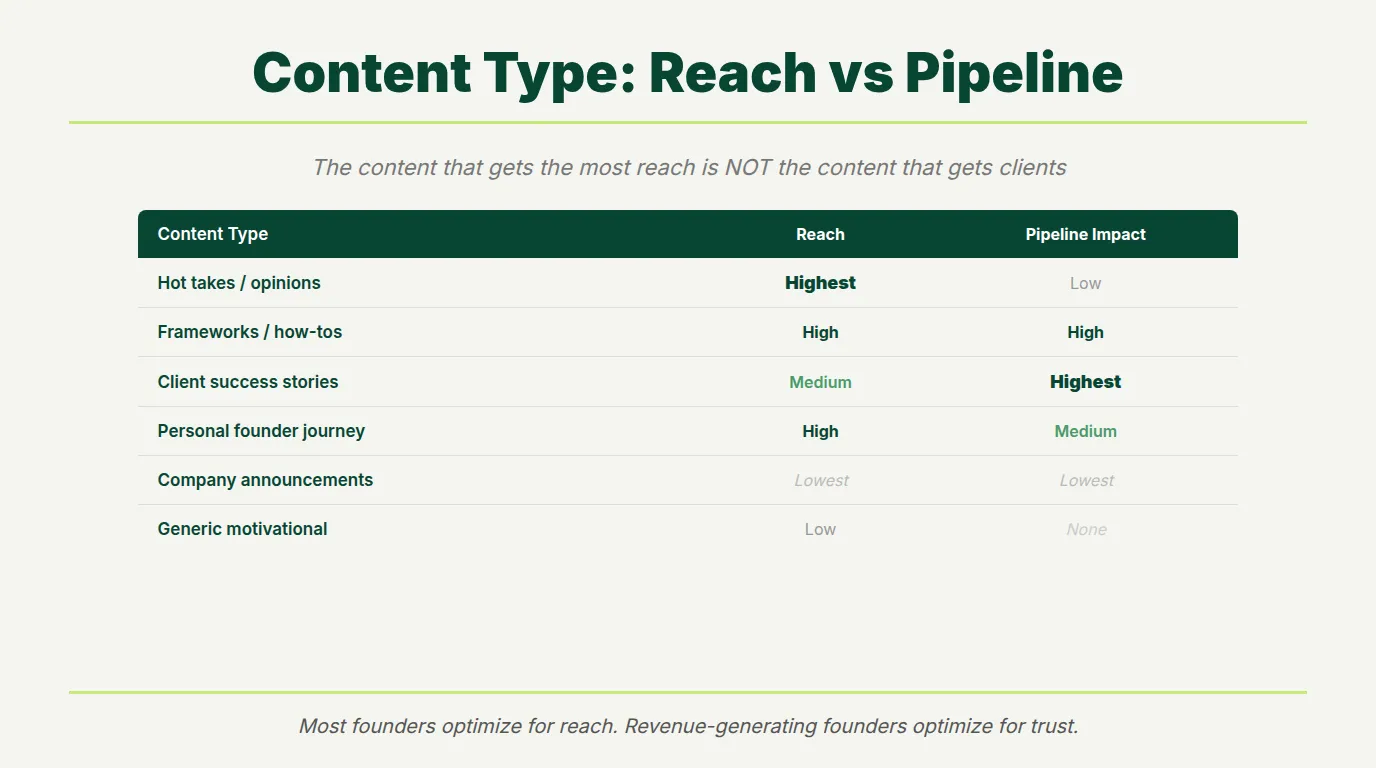
Windmill Growth tracked content performance across 185+ founder clients and found a clear pattern: the content that generates the most reach is not the content that generates clients. (Windmill Growth)
| Content Type | Reach | Pipeline Impact |
|---|---|---|
| Hot takes / controversial opinions | Highest | Low |
| Industry frameworks / how-tos | High | High |
| Client success stories | Medium | Highest |
| Personal founder journey | High | Medium |
| Company announcements | Lowest | Lowest |
| Generic motivational content | Low | None |
Most founders optimize for reach. The founders generating revenue optimize for trust.
The Edelman data confirms this: 55% of decision-makers value content that references strong research and data, 44% value help understanding their business challenges, 43% value concrete guidance and case studies. And 86% of hidden decision-makers want fresh perspectives that challenge their assumptions — not content that validates what they already think. (Edelman-LinkedIn 2024)
One B2B founder tracked his conversations for a quarter: 73% of closed deals mentioned seeing his content before reaching out. Average time from first content view to first inquiry: 4.2 months. The content was working long before anyone raised their hand. This aligns with the LinkedIn Sales Playbook principle that 80% of buyers form preferences before contacting a vendor.
The content mix that works: one POV or opinion post, one how-to or framework, one proof post (client win, lesson learned, real metric). Rotate these three. Keep the ratio roughly 50% educational, 40% personal, 10% broad/viral. (Lara Acosta)
Key Takeaway: Company milestone posts — "We're thrilled to announce..." — generate the lowest reach and lowest pipeline impact in the mix. If this describes your current LinkedIn output, both the algorithm and your prospects are telling you the same thing.
The 5 Founder Archetypes on LinkedIn
The most effective founders don't try to post everything. They find their archetype — the mode that comes naturally — and lean into it.
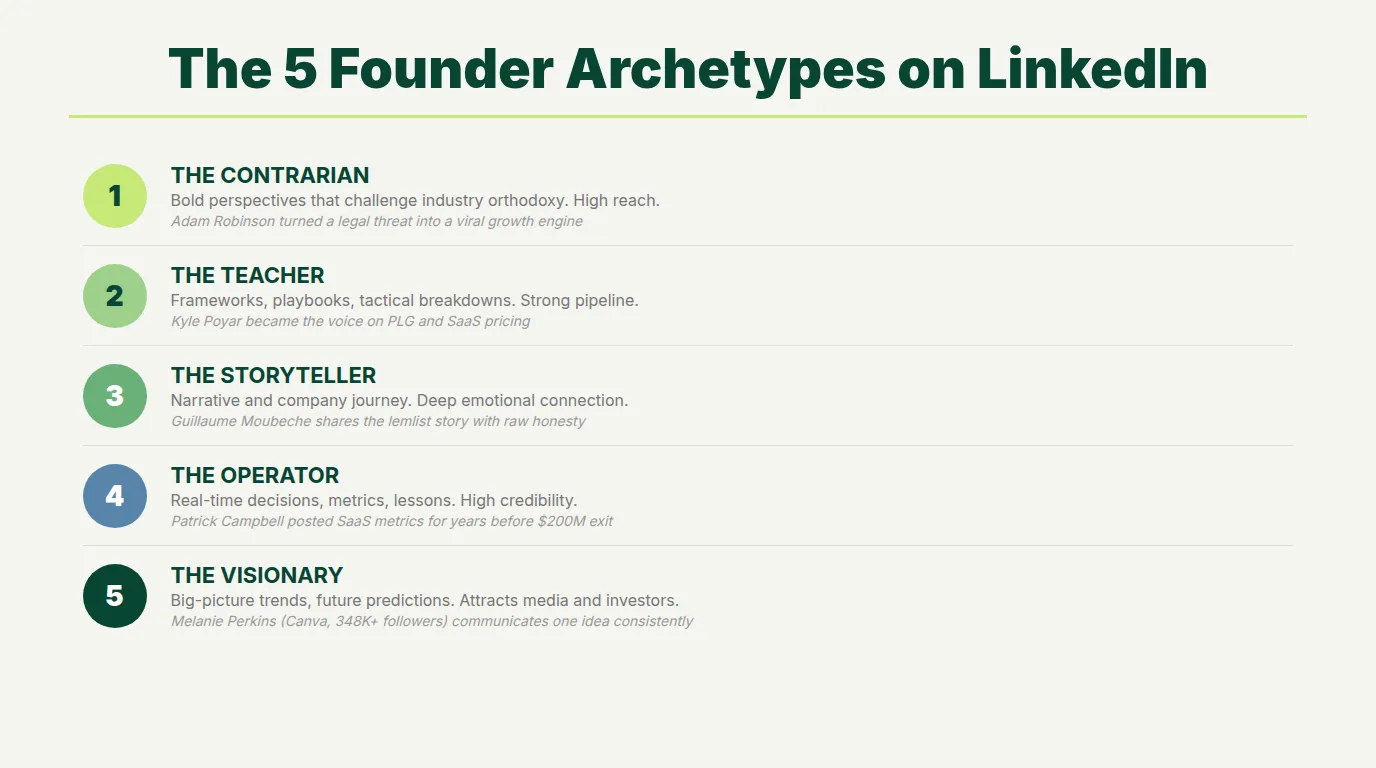
1. The Contrarian
Posts bold perspectives that challenge industry orthodoxy. High reach, requires genuine expertise. Adam Robinson turned a legal threat into a viral growth engine. Risk: if the take isn't grounded in real experience, it reads as attention-seeking.
2. The Teacher
Shares frameworks, playbooks, tactical breakdowns. Sustainable engagement and strong pipeline. Kyle Poyar (OpenView) became the definitive voice on PLG and SaaS pricing through consistent educational content.
3. The Storyteller
Leads with narrative and company journey. Deep emotional connection. Guillaume Moubeche shares the lemlist story — the failures, the pivots, the specific moments — with a specificity that makes it impossible to dismiss.
4. The Operator
Posts about real-time decisions, metrics, and lessons. High credibility with other founders and buyers. Patrick Campbell posted SaaS metrics breakdowns for years before selling ProfitWell for $200M+.
5. The Visionary
Big-picture industry trends, future predictions. Attracts media, speaking, and investors. Melanie Perkins (Canva, 348K+ followers) consistently communicates one idea: design should be accessible to everyone.
Most effective founders combine 2-3 archetypes rather than rigidly staying in one. If you're not sure which is yours — look at what you already talk about in meetings, pitches, and investor calls. That's your archetype. Start there.
The Format Guide for Founders
Content format data from the Sales Playbook applies here with one important nuance: founders have an authenticity advantage that changes the calculus.
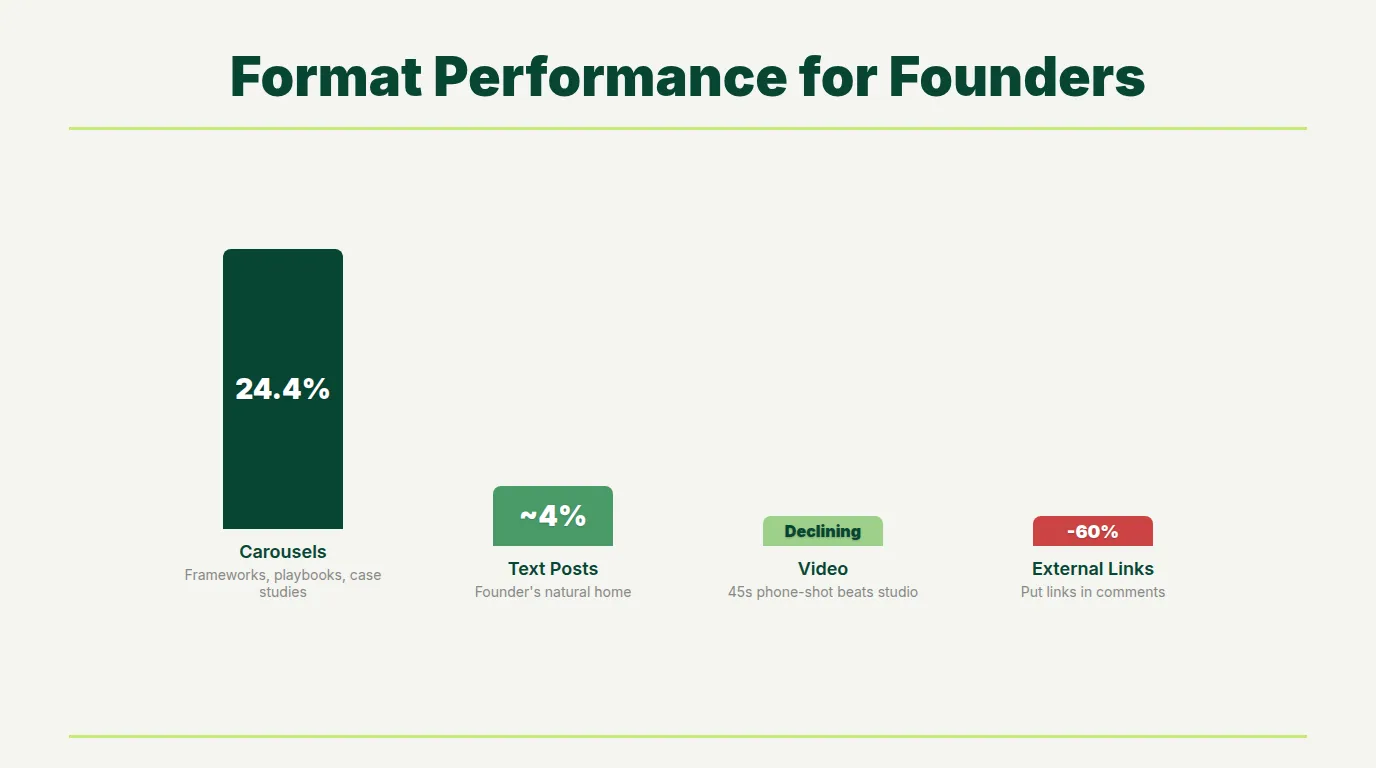
| Format | Engagement | Best For Founders |
|---|---|---|
| Carousels / Documents | 24.42% avg | Frameworks from own experience, step-by-step playbooks, before/after case studies |
| Text posts | ~4% | The founder's natural home. A 200-word opinion from a CEO who lived it outperforms polished carousels. |
| Video | Declining | 45-second phone-shot observations beat studio-produced. Use sparingly — algorithm recalibrated. |
| External links | -60% reach | Never in post body. Put links in comments. |
Posting frequency for founders: 3-5 posts per week is the sustainable sweet spot. Daily posting risks quality degradation. Once per week is too slow to build momentum. Justin Welsh posts 4x per week. The data supports 2-5x per week as the consistent performer. (Richard van der Blom 2025)
The Ghostwriting Question
Let's address this directly because every founder building a CEO LinkedIn strategy thinks about it.
Founder LinkedIn ghostwriting has become a significant industry. Mid-tier services run $1,500-$3,000/month, with premium agencies charging $5,000+. (Windmill Growth)
Does it work? Yes — with conditions.
Content produced with AI-first drafts (then lightly edited) sees engagement rates 40-50% lower than content produced through human-first writing. LinkedIn's algorithm appears to test content authenticity signals — unique phrasing, specific details, personal anecdotes get more distribution.
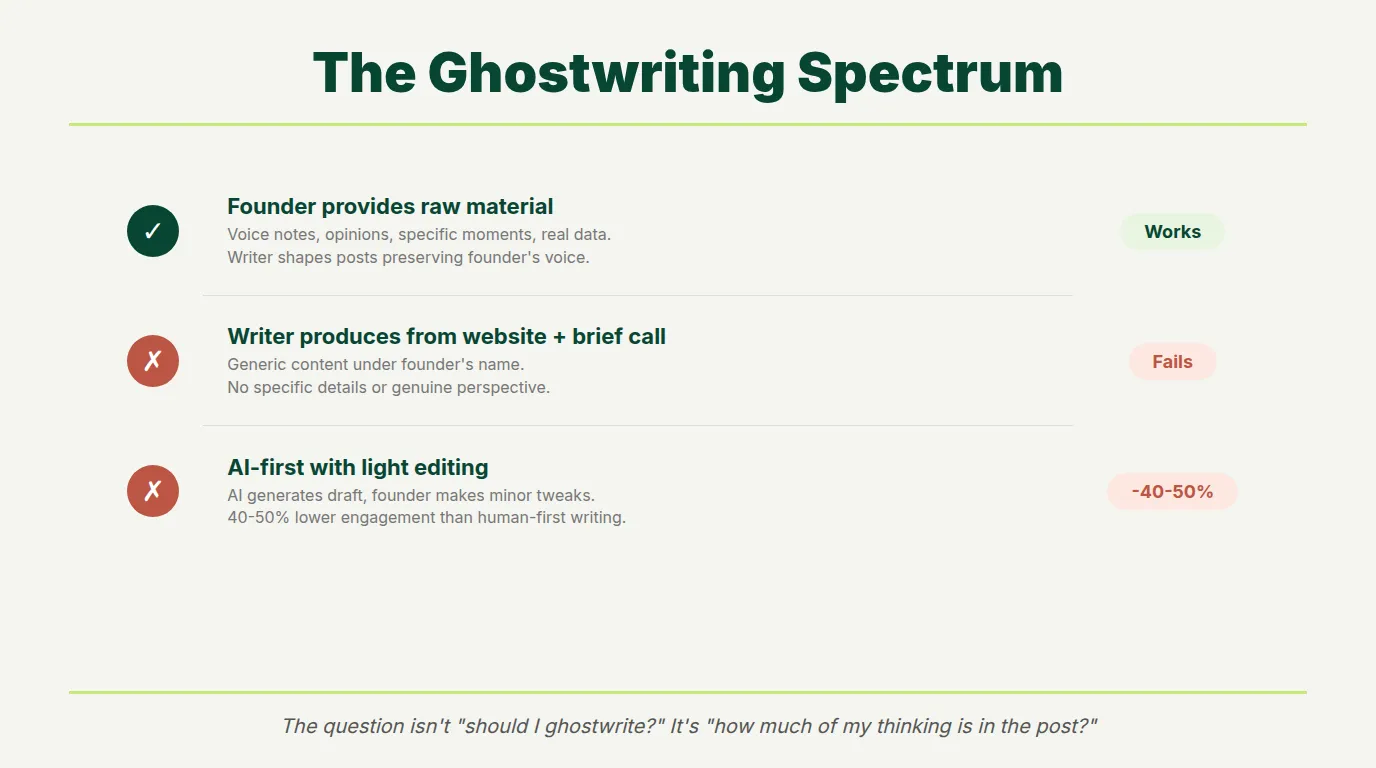
| Ghostwriting Model | How It Works | Result |
|---|---|---|
| Founder provides raw material | Voice notes, opinions, specific moments, real data. Writer shapes into posts preserving founder's voice. | Works — authentic voice, real time savings |
| Writer produces from website + brief call | Generic content under founder's name. No specific details or genuine perspective. | Fails — audiences feel it, pipeline doesn't come |
| AI-first with light editing | AI generates draft, founder makes minor tweaks. | Fails — 40-50% lower engagement |
The tell signs of failed ghostwriting: generic language, polished structure without personality, lack of specific details only the founder would know, absence of the founder's real perspective on their industry.
The honest question isn't "should I ghostwrite?" It's "how much of my actual thinking is in the post?"
The 7 Mistakes Founders Make on LinkedIn
1. Treating LinkedIn like a PR channel
"We're excited to announce..." is not content — it's a press release nobody asked for. Company milestone posts rank at the bottom of both reach and pipeline impact. Your acquisition of a customer is more interesting than your acquisition of a tool.
2. Full delegation without founder input
When a social media manager runs both the company page and the CEO's personal profile, the result is repetitive, corporate content with no discernible point of view. Engagement drops. AI-first content drops it further.
3. Copying other founders
"Let's do what [famous founder] did" is how you produce a worse version of someone else's voice. The founders generating pipeline have found something genuine to say — not a template to replicate.
4. Generic motivational content
"Success requires sacrifice. Here are 5 lessons I learned the hard way." It generates the lowest reach in the content mix and zero pipeline. Stop.
5. Posting sporadically
10 posts in a week, then silence for a month, breaks the algorithm's understanding of your account and your audience's relationship with your content. Consistent 3x per week beats burst strategies every time. As we explained in the Engagement Playbook, consistency is the single biggest factor in LinkedIn growth.
6. Measuring the wrong things
"Posts that generated the most likes rarely generated clients. Posts that generated the most comments and saves did." Optimizing for impressions and likes while ignoring saves, comments, and DMs is how founders spend time on LinkedIn without building business. (Windmill Growth)
7. Going silent during fundraising
Investors have been watching your LinkedIn for months before you pitch. A founder who goes quiet during their raise signals something. It's not a good signal. The right approach: build consistent LinkedIn presence 6-12 months before you plan to raise — not when you open the round. By the time you're pitching, the credibility should already be there.
Key Takeaway: The most damaging mistake isn't any single one — it's the combination of posting company announcements nobody reads, delegating without input, and then wondering why LinkedIn "doesn't work" for founders. The platform works. The approach doesn't.
What Buyers, Investors, and Talent Are Actually Looking For
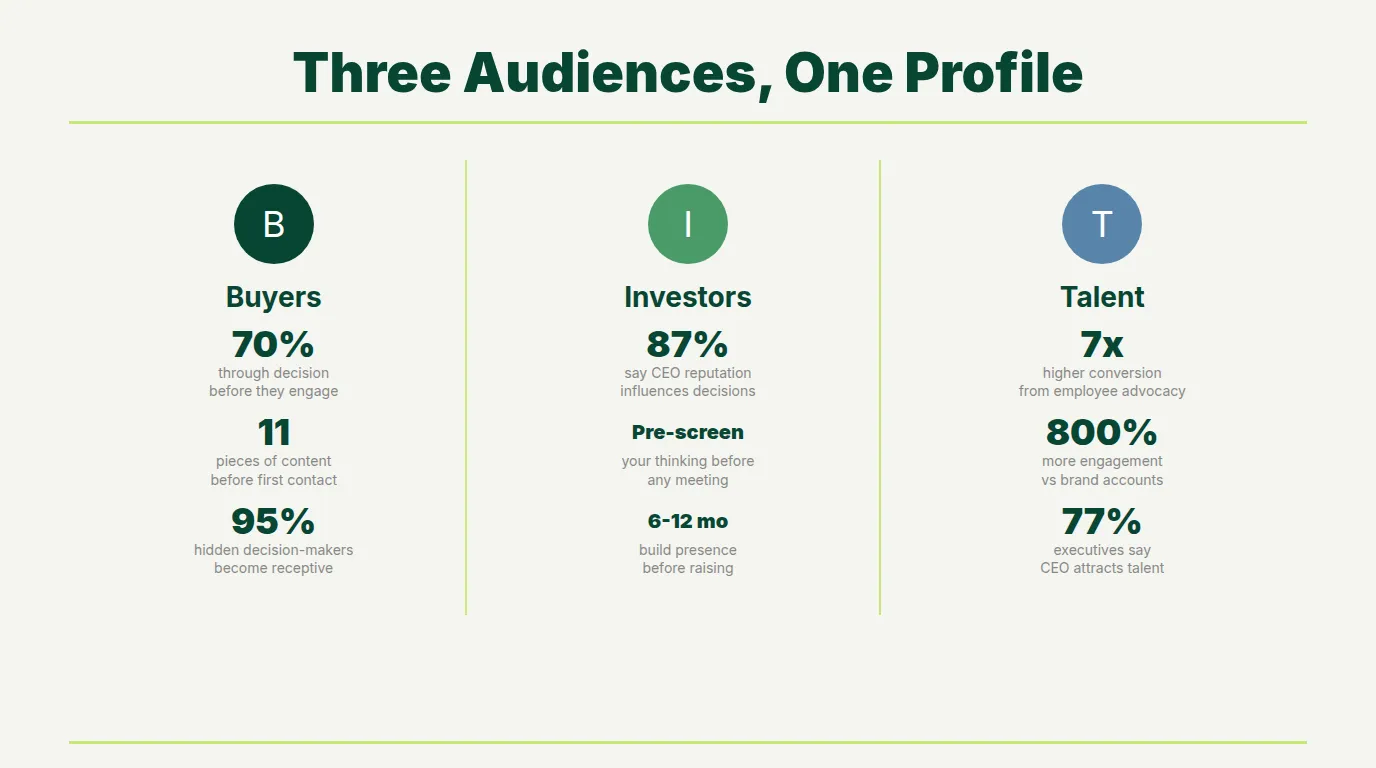
Three audiences use your LinkedIn for very different purposes. Understanding each changes what you post as part of your CEO social media presence.
Buyers
They're 70% through their purchasing decision before they engage. They review 11 pieces of content before contacting a vendor. 73% of decision-makers say thought leadership is more trustworthy than marketing materials. 95% of hidden decision-makers become more receptive to sales outreach after engaging with quality thought leadership. 79% will actively champion RFP proposals from companies with consistently strong thought leadership. Your content isn't marketing — it's the first 70% of your sales process. (Edelman-LinkedIn 2025)
Investors
They conduct pre-screening before any meeting. They evaluate: Can this founder articulate complex ideas clearly? Do they understand their market deeply? Does their thinking evolve? Is their network real? A founder's LinkedIn post is a 200-word window into how they think. Investors read it differently than customers do — they're not evaluating the product, they're evaluating the person behind it.
Talent
They evaluate culture, leadership style, and company trajectory. The most effective hiring-oriented posts don't read like job ads — they tell specific stories about team members, celebrate individual wins, show real working moments. Alex Hormozi's testimony: "The biggest unspoken ROI I get from LinkedIn is recruiting. We can directly headhunt some of the best people in the world, and the response rates are higher than any other platform." (Alex Hormozi)
The Time Problem — and the System
Founders consistently report the average post takes 30-40 minutes to create. At 4 posts per week, that's roughly 120 hours annually. At any senior executive's hourly rate, the time cost is real — and it's the primary reason LinkedIn gets deprioritized. (Windmill Growth)
With a system, experienced creators get this to 7-10 minutes per post.
The Minimum Viable Founder LinkedIn Presence
- 2-3 posts per week, consistent timing
- One opinion/POV, one how-to, one proof post — rotate
- Put links in comments, not posts
- Respond to substantive comments in the first hour
Batch Content Creation (The Most Efficient Approach)
- Block 2-3 hours one morning per week
- Scan what you discussed in meetings that week — that's your content
- Draft all posts in one session (no context-switching)
- Schedule through LinkedIn's native scheduler or a tool
- Done until next week
The key insight: founders don't run out of ideas. They run out of time to convert ideas into posts. The conversion is the constraint — and it's solvable.
The Uncomfortable Truth
Here's what separates the founders generating millions in pipeline from those posting into silence.
It's not posting frequency. It's not format choice. It's not even the quality of the writing.
It's specificity.
The content that builds trust — with buyers, investors, and talent — contains details only you would know. The specific number. The actual mistake. The conversation you had last Tuesday that changed how you think about your market. The thing you got completely wrong in year two.
Generic insight is everywhere on LinkedIn. Founders who share the specific, verifiable, occasionally uncomfortable reality of building their company have a monopoly on something the algorithm can't replicate and audiences can't ignore.
Patrick Campbell built a $200M exit on ten years of posting SaaS metrics nobody else was willing to share. Adam Robinson turned a legal threat into 1,600 leads because he told the truth about what happened. Justin Welsh built $12.5M in revenue by being more specific about what actually worked than anyone else in his space.
Katelyn Bourgoin applied buyer psychology to her own content creation. Built a 280,000+ audience and grew her Why We Buy newsletter to 80,000+ subscribers without paid ads — generating $1M+ revenue in 2024 alone. Her philosophy: "Trust is the currency of business. And creating content personally is the best way to build trust at scale." (Katelyn Bourgoin)
Rand Fishkin built Moz to $50M+ revenue over 17 years with his personal brand intertwined with the company. When he left, the separation required $60,000 in legal fees. His experience is a reminder: build a personal brand, but structure it so you can eventually separate from the company if needed. (Rand Fishkin)
Key Takeaway: The pattern isn't "post more." It's "share what you actually know." Specificity is the only sustainable competitive advantage on LinkedIn — and founders have more of it than anyone.
Turn Your Thinking Into LinkedIn Content — Without the Daily Grind
If you have the ideas but not the time to turn them into posts — Co.Actor was built for exactly this. It learns how YOU write. Not generic AI — your actual tone, phrases, and perspective.
5-10 post ideas every morning. Perfect for individual founders and employee advocacy programs. Users see 3x engagement increase in month one.
No credit card required. Full access to all features.
Your Action Items This Week
- Check your last 5 LinkedIn posts. What type were they? Company announcements, generic motivational content, or genuine perspective from your experience? If they fall in the first two categories — change the next one.
- Identify your archetype. What do you already talk about in pitches and investor calls? That's where your content voice lives. Write one post in that mode this week.
- Start the 5,000 follower experiment. Post one opinion piece — a genuine take on something happening in your industry — and compare its engagement to your last company announcement. The gap will tell you everything.
- Build the minimal system. Block 90 minutes on one morning this week. Draft 3 posts. Schedule them. That's your new baseline.
- Read your own LinkedIn as a buyer would. Does it immediately communicate what you do, who you help, and why you're credible? Or does it read like a resume from 2019?
Frequently Asked Questions
How much time should a CEO spend on LinkedIn per week?
The average post takes 30-40 minutes. At 3-4 posts per week, that's 2-3 hours weekly. With a batch system — blocking 2-3 hours one morning per week to draft and schedule all posts — experienced founders reduce per-post time to 7-10 minutes. Windmill Growth's data shows this time investment can generate 10-20x return within 6 months for B2B founders.
Should founders hire a ghostwriter for LinkedIn?
Ghostwriting works when the founder provides raw material — voice notes, opinions, specific moments, real data — and a writer shapes it while preserving the founder's voice. AI-first content sees 40-50% lower engagement. The key question isn't "should I ghostwrite?" but "how much of my actual thinking is in the post?"
Does a CEO's LinkedIn presence affect company valuation?
Yes. Weber Shandwick found CEO reputation accounts for 44% of market value. 87% of executives say it influences investment decisions, 83% say it generates media attention and crisis protection, and 77% say it attracts talent.
What should a founder post on LinkedIn?
The proven content mix: one POV or opinion post, one how-to or framework, one proof post (client win, lesson learned, real metric). Keep the ratio roughly 50% educational, 40% personal, 10% broad/viral. Company announcements generate the lowest reach and pipeline impact.
Is a personal profile better than a company page on LinkedIn?
Personal profiles get 2.75x more impressions and 5x more engagement than company pages. A CEO with 5,000 followers generates the same reactions as a company page with 300,000 followers. The algorithm rewards people over logos.
How long before LinkedIn content generates pipeline for founders?
B2B founders with deal sizes above $25K see 10-20x ROI within 6 months. One founder found 73% of closed deals mentioned seeing his content first, with an average 4.2 months from first view to first inquiry.
What are the most common LinkedIn mistakes founders make?
The 7 biggest: treating LinkedIn like a PR channel, full delegation without input, copying other founders, generic motivational content, posting sporadically, measuring likes instead of saves and DMs, and going silent during fundraising.
Should founders use AI to write LinkedIn posts?
AI-generated content underperforms by 40-50%. LinkedIn's algorithm tests authenticity signals — unique phrasing, specific details, personal anecdotes get more distribution. AI works best as a starting point that the founder substantially rewrites with their own voice and experiences.
Sources & References
- DSMN8 — Analysis of 11,107 Employee LinkedIn Posts — CEO vs company page engagement data
- Weber Shandwick — CEO Reputation Research — 44% market value, talent and investor impact
- Edelman-LinkedIn 2025 B2B Thought Leadership Impact Report — Hidden decision-maker data
- Edelman-LinkedIn 2024 B2B Thought Leadership Impact Report — Trust data, purchase influence
- Windmill Growth — LinkedIn Ghostwriting Industry Report 2025-2026 — Content performance by type, ghostwriting market data, client ROI
- Richard van der Blom — Algorithm Insights 2025 — Format performance, 1.8M posts analyzed
- Adam Robinson — RB2B Case Study — $0 to $4M ARR, 1,600 leads from one post
- Justin Welsh — Annual Income Reports — $12.5M revenue, zero ads
- Guillaume Moubeche — lemlist/Lempire — $26M ARR, $150M valuation
- Patrick Campbell — ProfitWell — Content-led $200M+ acquisition
- Lara Acosta — Personal Branding Framework — Content mix ratios
- Alex Hormozi — LinkedIn and Recruiting — Talent pipeline via LinkedIn
- Katelyn Bourgoin — Why We Buy — 280K+ audience, $1M+ revenue
- Rand Fishkin — SparkToro — Personal brand separation cautionary tale
Written by
