TL;DR
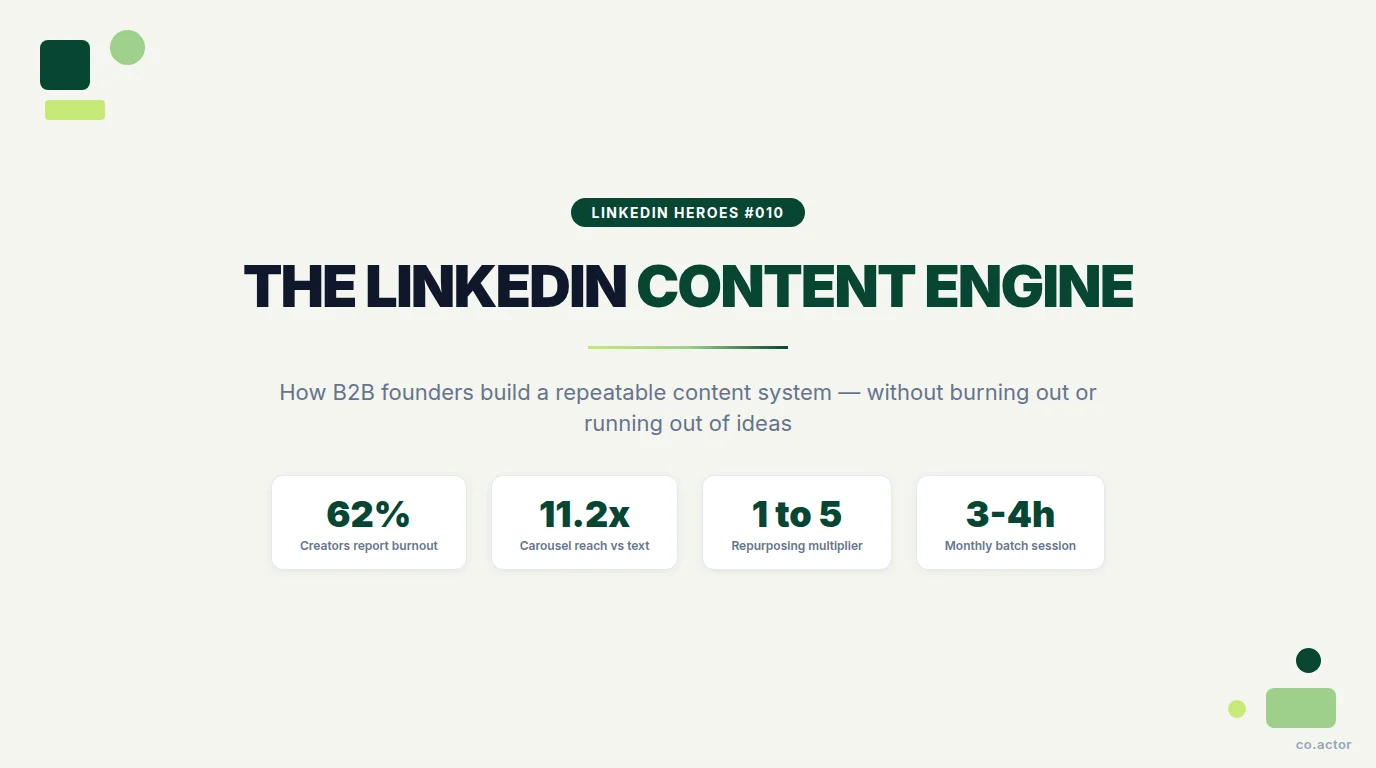
- 62% of digital creators report high or extreme burnout — the daily creation trap is real, and it's why most founders quit LinkedIn
- Consistency beats frequency — posting 2-3x/week every week outperforms daily posting for a month then disappearing
- Carousels generate 11.2x more impressions than text-only — format choice matters more than most founders realize
- One pillar piece becomes 5 posts — the repurposing system is how top creators produce volume without burning out
- 3 phases, not daily creation — Ideation, Creation, Polish. Separate them, batch them, and content becomes sustainable
- The algorithm rewards topical consistency — posting randomly about different topics signals nothing; 3-5 topics build subject-matter authority
Step 1: Escape the Volume Trap
Here's the pattern we see constantly: a founder starts taking LinkedIn seriously. Posts every day for six weeks. Gets some traction. Then life gets busy, inspiration runs dry, and they disappear for two months. Come back. Repeat. Never build the compounding momentum that actually drives results.
It's not a motivation problem. It's not even a talent problem. It's a systems problem.
According to Richard van der Blom's 2025 Algorithm Insights Report (1.8 million posts analyzed), overall views are down 50%, engagement is down 25%, and follower growth is down 59% across the platform. And yet the top creators — the ones who consistently drive pipeline from LinkedIn — are still growing. (Algorithm Insights Report 2025)
The difference isn't volume. It's consistency and system.
The research is clear: posting 2-3 times per week consistently outperforms posting daily for a month and then disappearing. (Buffer, 2M+ posts analyzed) Not just in engagement — in actual audience trust and compounding reach. The algorithm treats consistent creators as subject-matter authorities. It rewards them with broader distribution over time. Creators who post in bursts and disappear get treated as noise.
The volume trap creates a vicious cycle: post too much, burn out, go dark, feel guilty, overcompensate with another burst, burn out again. Each cycle makes it harder to return.
The exit is a system, not more willpower.The founders who consistently show up on LinkedIn — week after week, quarter after quarter — don't do it because they have more time or more ideas. They do it because they built a content engine.
Step 2: Build Your Content Pillars
Before you write a single post, you need to decide what you're going to be known for.
The 2025 LinkedIn algorithm has made this more important than ever. Posts that target highly specific industries or roles consistently outperform generic content. The platform rewards creators who post consistently about particular topics — building a subject-matter expert signal over time. Random topic hopping, however interesting each individual post might be, signals nothing to the algorithm or to your audience. (Trust Insights: Unofficial LinkedIn Algorithm Guide Q1 2026)
The framework: 3-5 content pillars. Topics that sit at the intersection of three things:
- What you know deeply — real expertise, not surface-level takes
- What your ICP actively cares about — the problems they're trying to solve
- Where you have a genuine point of view — not just information, your perspective on it
Example for a B2B SaaS founder selling to marketing leaders:
- Pillar 1: Go-to-market strategy for mid-market SaaS
- Pillar 2: Marketing operations and measurement
- Pillar 3: Behind-the-scenes of building the company
Every post you write maps to one of these pillars. Over time, your audience knows exactly what they're getting from you. The algorithm knows who to show you to. And you never stare at a blank screen wondering what to post.
Step 3: Build Your Content Bank
The other reason founders run out of ideas is that they try to generate ideas and create content at the same time.
These are different cognitive tasks. Ideation is divergent thinking — open, associative, non-judgmental. Writing is convergent thinking — focused, structured, critical. Doing both simultaneously slows both down and leads to the blank-screen paralysis that kills consistency.
The solution is a content bank: a running document where you capture raw material continuously, completely separately from when you sit down to write.
Seven Sources That Keep a Content Bank Full
- Customer conversations. Every sales call, onboarding session, and support ticket contains post ideas. The question your prospect asked twice last week? That's a post.
- Your own opinions. What do you disagree with in your industry? Strong opinions backed by experience are the highest-performing content type for B2B founders. (Edelman + LinkedIn B2B Thought Leadership Study 2025)
- Lessons from the week. What did you learn that surprised you? What didn't work? What decision are you wrestling with?
- Industry data and research. New study, new report, new data point. Don't just share the link — add your interpretation.
- Questions your audience asks. Comments on your posts, LinkedIn messages, emails. Every question someone asks is evidence that others have the same question.
- Analogies and frameworks. How would you explain your core insight to someone outside your industry? Frameworks that organize complexity are among the most saved content types on LinkedIn.
- Content from other platforms. An email to a client, a Slack message where you explained something well, a section of a proposal. Raw material is everywhere.
The bank isn't a calendar. You're not scheduling what goes in. You're just capturing everything with potential, so that when you sit down to create, you're not starting from zero.
Step 4: The Batch Session
Here's the number that explains why most LinkedIn content strategies fail: 62% of digital creators report high or extreme burnout.
The culprit is almost always the same: daily creation. Sitting down every morning to figure out what to post, write it, edit it, format it, and publish it. Even when individual posts take 30 minutes, the mental overhead of context-switching into content mode every day adds up to something that feels like a second job.
The fix is batching.
One focused session per month — roughly 3-4 hours — produces enough content for 4-5 weeks of consistent posting. Not because you're writing faster, but because creative work scales in a session. When you're already in ideation mode, ideas connect. When you're already in writing mode, the words flow faster. Switching costs disappear. (Buffer: Content Batching)
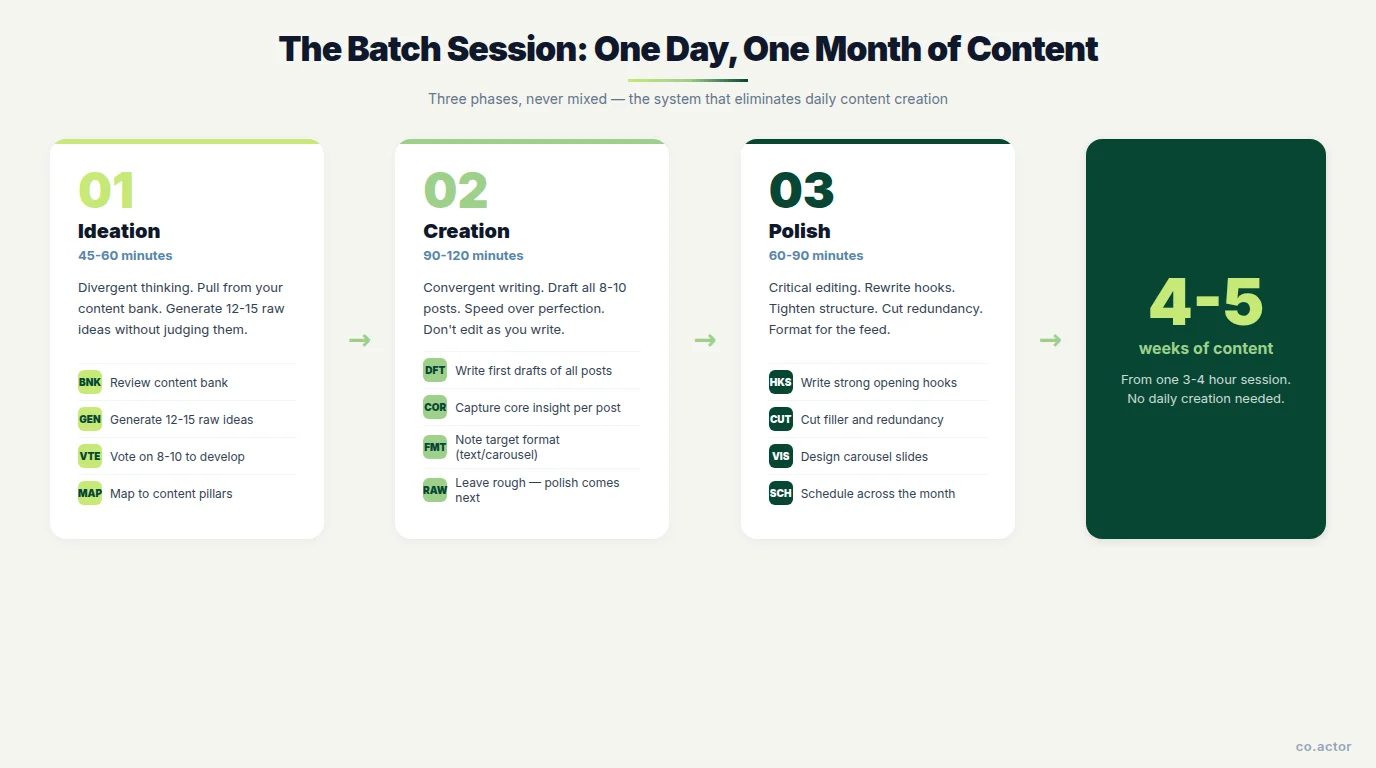
The session has three phases — and critically, you never mix them:
Phase 1 — Ideation (45-60 minutes)
Pull from your content bank. Identify 12-15 raw ideas that have potential. Don't evaluate them yet — generate. At the end of this phase, vote on 8-10 to develop.
Phase 2 — Creation (90-120 minutes)
Write first drafts of all 8-10 posts. Don't edit as you write. Don't worry about hooks yet. Get the core idea out of your head and onto the page. Speed is the goal — perfectionism at this stage kills the session.
Phase 3 — Polish (60-90 minutes)
Now edit. Rewrite hooks. Tighten structure. Cut what's redundant. Format for the feed. This is where quality happens — after the ideas are already out.
The separation is the key insight.When you draft and edit simultaneously, you never get into flow in either mode. When you batch by phase, both modes work better.
Step 5: The Repurposing System
The most underused lever in LinkedIn content strategy: repurposing.
46% of marketers say repurposing content is more effective than creating new content from scratch. (Yarnit: Content Repurposing Guide 2025) Yet most founders treat every post as a one-time creation — write it, publish it, move on.
The repurposing system treats every piece of content as source material that generates multiple assets. The framework: one pillar piece becomes five posts.
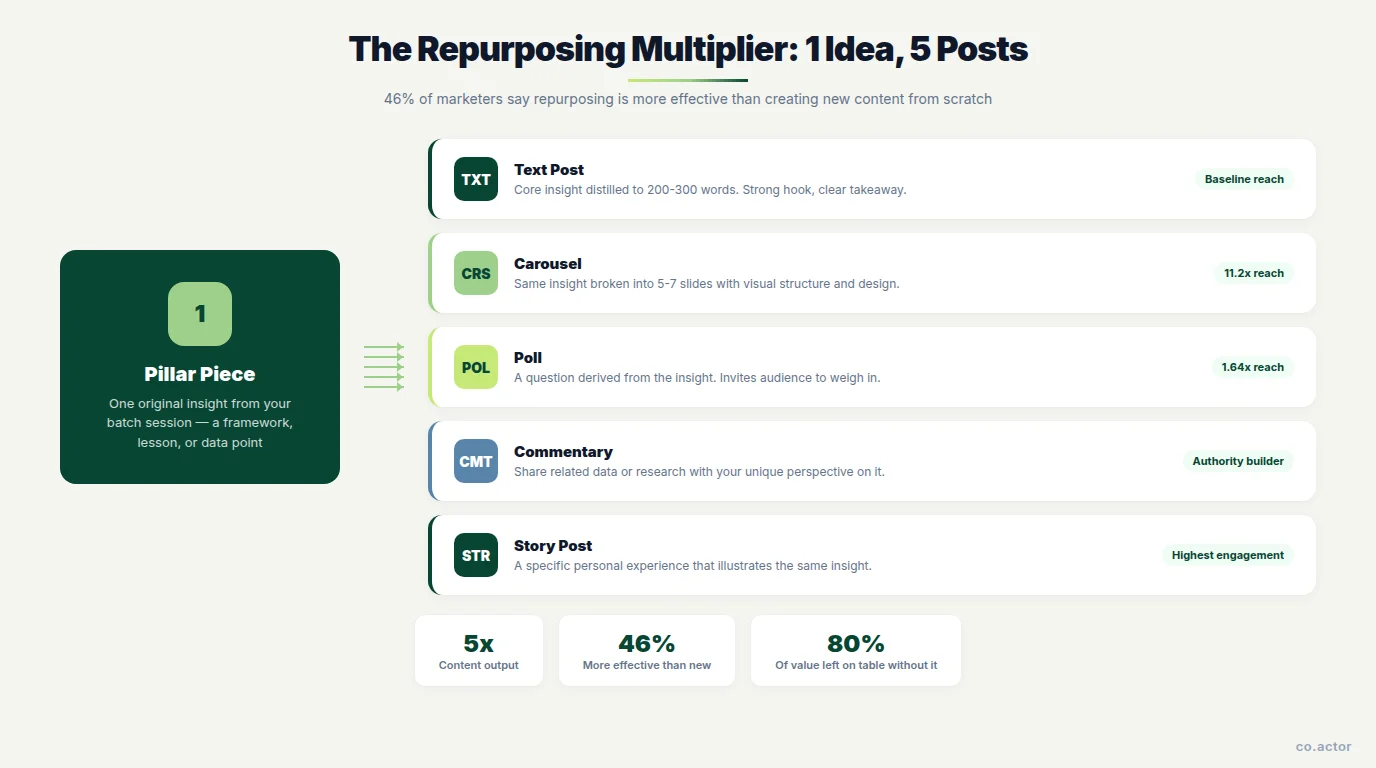
A long-form newsletter section (like this one) becomes:
- Text post — the core insight, distilled to 200-300 words
- Carousel — the same insight broken into 5-7 slides with visual structure
- Poll — a question derived from the insight that invites your audience to weigh in
- Commentary post — share a related piece of data or research with your take on it
- Story post — a specific experience that illustrates the same insight personally
Same core idea. Five different posts. Five different format preferences among your audience. And carousels alone generate 11.2x more impressions than text-only posts — so repurposing a text insight into a carousel isn't just efficient, it's algorithmically smart. (Postiv.ai: LinkedIn Content Strategy 2025-2026, 2M+ posts)
Step 6: The Format Mix
Not all content formats are equal in 2025. The algorithm has clear preferences, and ignoring them means writing good content that gets suppressed before it finds its audience.
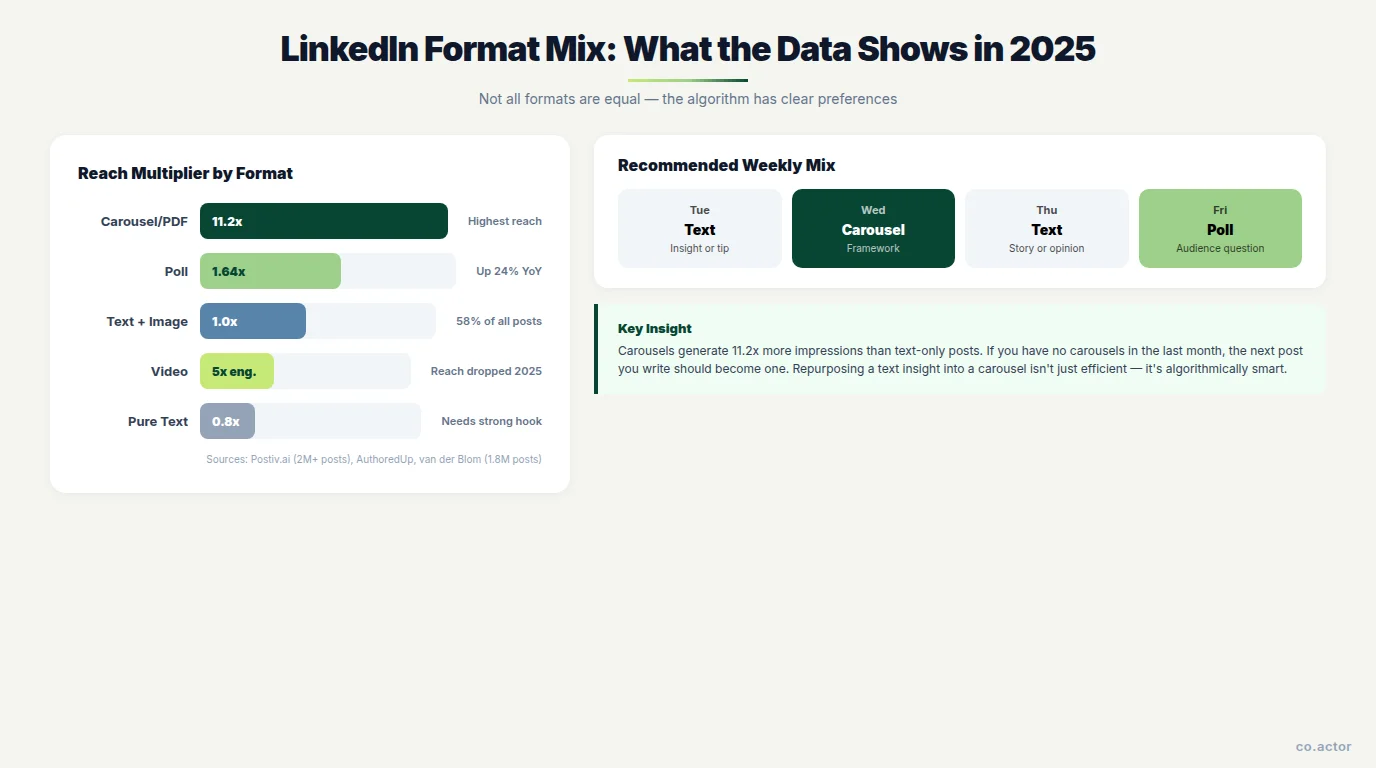
What the data shows: (AuthoredUp: Best Performing Content on LinkedIn 2025)
- Carousels/PDFs — 11.2x more impressions than text-only. The highest-reach format on the platform. Use for frameworks, step-by-step breakdowns, and data visualizations.
- Polls — 1.64x reach multiplier (up 24% from the prior year). Use for genuine questions where you're curious about your audience's perspective.
- Text + image — the most common format (58% of all content), stable performance, optimal at 700-900 characters.
- Video — 5x more engagement when it lands, but reach dropped significantly in 2025. Worth testing, not worth making the centerpiece.
- Pure text — works when the writing is exceptional and the hook is strong. Doesn't scale as a primary format.
A practical weekly mix: 2 text posts + 1 carousel + 1 poll. Covers the high-reach formats, doesn't overload the creation burden, and gives the algorithm what it rewards.
What Kills the Content Engine
Random topic hopping
Posting about sales on Monday, company culture on Wednesday, and AI trends on Friday builds no audience and no algorithm signal. Your followers don't know what to expect. The algorithm doesn't know who to show you to. Three topics, consistently, over 90 days is worth more than 30 random topics over the same period.
Creating every day
The math doesn't work. Daily creation is daily context-switching, daily blank screens, daily decision fatigue. The founders who last on LinkedIn do not create every day. They batch create monthly and distribute consistently.
Editing while drafting
The number-one reason batch sessions fail. Writing and editing are different brain states. Switching between them in real time means you never get into flow in either. Draft everything first. Then go back and edit.
No repurposing system
Most founders leave 80% of their content value on the table. They write a post, it performs well, and they never touch that insight again. Every strong post you've published is raw material for a carousel, a poll, a story version, a data-backed version.
Optimizing for vanity metrics
Impressions and follower count are not pipeline. The goal of a B2B founder's LinkedIn content is to generate conversations with relevant buyers — not to go viral. A post that gets 500 views and three DMs from qualified prospects outperforms a post that gets 50,000 views and zero business conversations. Build the engine for the right metric.
Action Items: Apply This Week
- Define your 3 content pillars — write them down. What are the three topics you want to be known for among your ICP? Everything you post should map to one of them.
- Start your content bank — open a doc and capture 10 ideas from the last month. Customer questions, opinions, lessons, data points. Don't edit, just capture.
- Audit your last 10 posts by format — how many text-only vs. carousels vs. polls? If you have no carousels in the last month, the next post you write should become one.
- Schedule your first batch session — block 3-4 hours in the next two weeks. Put it in the calendar now, before you finish reading this.
- Pick one strong post from the last 3 months and repurpose it — turn it into a carousel or a poll. One post, different format. See what happens to the reach.
Frequently Asked Questions
How often should B2B founders post on LinkedIn?
2-3 times per week, consistently. Buffer's analysis of 2M+ posts confirms that consistent posting outperforms daily bursts followed by silence. The algorithm treats consistent creators as subject-matter authorities. A practical weekly mix: 2 text posts + 1 carousel + 1 poll.
What are content pillars for LinkedIn?
Content pillars are the 3-5 recurring topics your brand talks about. They sit at the intersection of what you know deeply, what your ideal customer cares about, and where you have a genuine point of view. Every post should map to one pillar. This builds subject-matter authority with both your audience and the algorithm.
How do you batch create LinkedIn content?
A batch session has three phases, never mixed: Ideation (45-60 min) — generate 12-15 raw ideas, vote on 8-10. Creation (90-120 min) — write first drafts without editing. Polish (60-90 min) — rewrite hooks, tighten structure, format for the feed. One 3-4 hour session produces 4-5 weeks of content.
What LinkedIn content format gets the most reach?
Carousels/PDFs generate 11.2x more impressions than text-only posts. Polls have a 1.64x reach multiplier (up 24% YoY). Text + image is the most common format (58% of posts). A recommended weekly mix: 2 text posts + 1 carousel + 1 poll.
How do you repurpose LinkedIn content?
Use the one-to-five framework: take one pillar piece and turn it into 5 posts — a text post, a carousel, a poll, a commentary post, and a story post. 46% of marketers say repurposing is more effective than creating new content.
Why do most LinkedIn content strategies fail?
Five common reasons: (1) Random topic hopping signals nothing to the algorithm. (2) Creating daily instead of batching monthly. (3) Editing while drafting kills creative flow. (4) No repurposing system leaves 80% of value on the table. (5) Optimizing for vanity metrics instead of business conversations.
Need help building your content engine?At Co.actor, we build LinkedIn content systems for B2B founders and their teams. We don't replace their voice — we build the infrastructure so the right content gets in front of the right people consistently, without the founder burning out or disappearing for months at a time.Let's talk →
About the Author
Serge Bulaev is the CEO and Founder of Co.Actor, an AI-powered LinkedIn growth platform for B2B teams. He has helped 50+ companies build sustainable LinkedIn content systems that drive pipeline without burning out their founders. Connect with him on LinkedIn.
Sources & References
- Richard van der Blom — Algorithm Insights Report 2025 (1.8M posts)
- Buffer — How Often to Post on LinkedIn (2M+ posts)
- Postiv.ai — LinkedIn Content Strategy 2025-2026 (2M+ posts)
- AuthoredUp — Best Performing Content on LinkedIn 2025
- Edelman + LinkedIn — B2B Thought Leadership Impact Study 2025
- Yarnit — Complete Guide to Content Repurposing 2025
- Buffer — Content Batching Experiment
- Trust Insights — Unofficial LinkedIn Algorithm Guide Q1 2026
Related Reading
Written by
