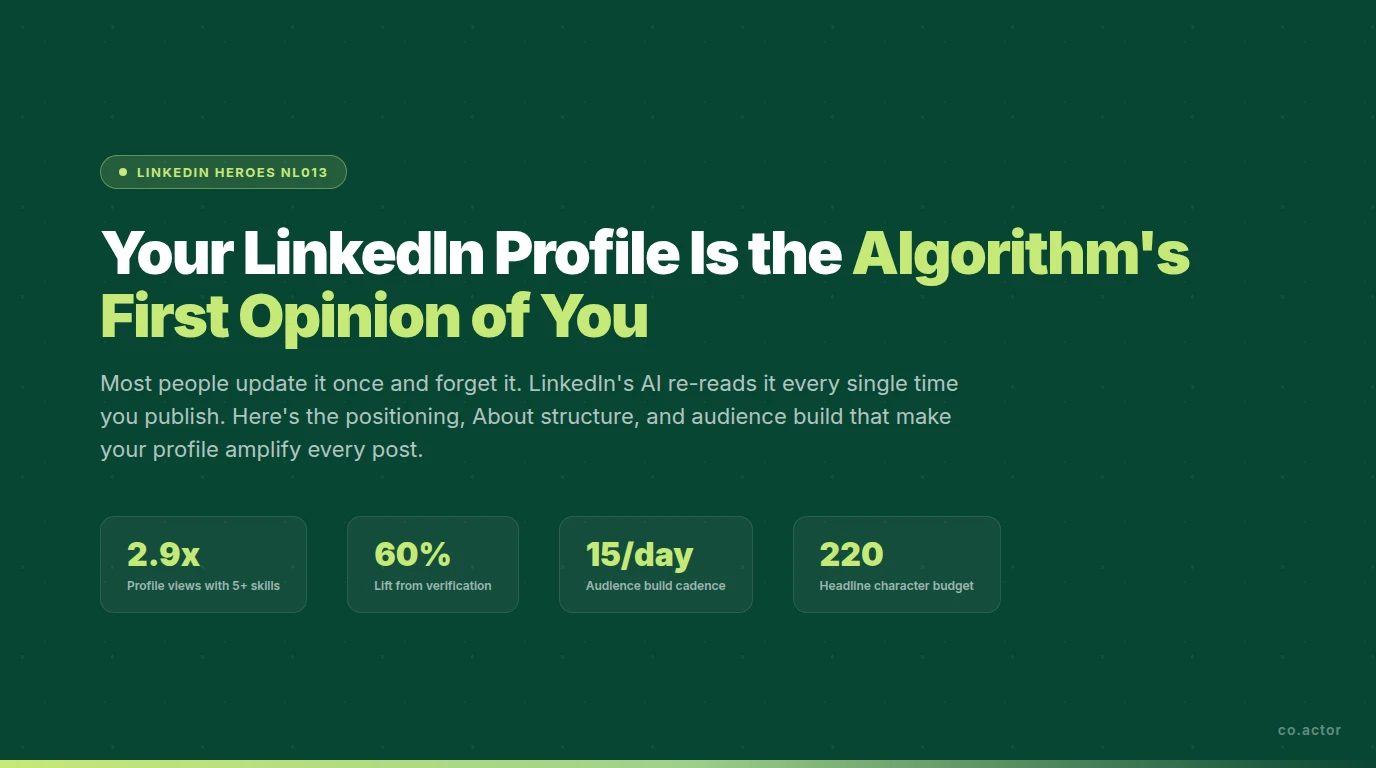
Most people treat their LinkedIn profile as a résumé. Something static. Something you touch when you switch jobs or need recruiter attention. What it actually is: the first thing the algorithm checks every time you post. And for most people, it's actively working against their distribution without them knowing.
Last article we covered why LinkedIn's 360Brew AI reads your content instead of counting likes, and the three signals that determine whether a post gets distributed or dies at 300 views. One of those three signals was your profile. We mentioned it briefly. This article goes deep on it — because out of the three levers in the algorithm's check, your profile is the one that's fully in your control right now, before you write another word.
TL;DR — What This Article Covers
- 360Brew re-reads your headline and About section on every post evaluation — not once when you create your profile.
- "Passionate about helping teams grow" is invisible to the algorithm — vague positioning means the system can't classify your expertise.
- Your connection acceptance rate is an algorithmic signal — below 50%, LinkedIn flags your account as potential spam.
- The right 100 connections outperform the wrong 10,000 — build your audience before you launch content.
- Private messages are a distribution lever — DM history influences whose feed your posts appear in.
Why Your Profile Isn't a Résumé
Here is what actually happens when you publish a post.
LinkedIn's AI doesn't just read the post. It runs a simultaneous cross-check: who is this person, what have they been posting about, and does this post match? The profile — specifically your headline and About section — provides the answer to the first question.
Think of it this way: the algorithm needs to route your post to the right people. To do that, it needs to understand what your professional expertise is and who cares about it. Your profile is the signal it uses to make that judgment — on every post, every time.
If your headline says "Marketing consultant | B2B growth" and you post consistently about B2B growth strategy, the system has a clear signal. It routes your content to people who follow B2B growth topics — the 60% of your total potential reach that lives in interest-based clusters beyond your existing connections.
If your headline says "Passionate about building great teams | Helping businesses reach their potential" — the algorithm has almost nothing to work with. It can't confidently classify you into any professional topic cluster. So it defaults to showing your posts primarily to your existing network and waiting. Reach stays small. Growth stalls. And the usual advice to "post more consistently" doesn't fix it, because the underlying problem is classification, not frequency.
The Positioning Problem
The most common version of this problem looks like this.
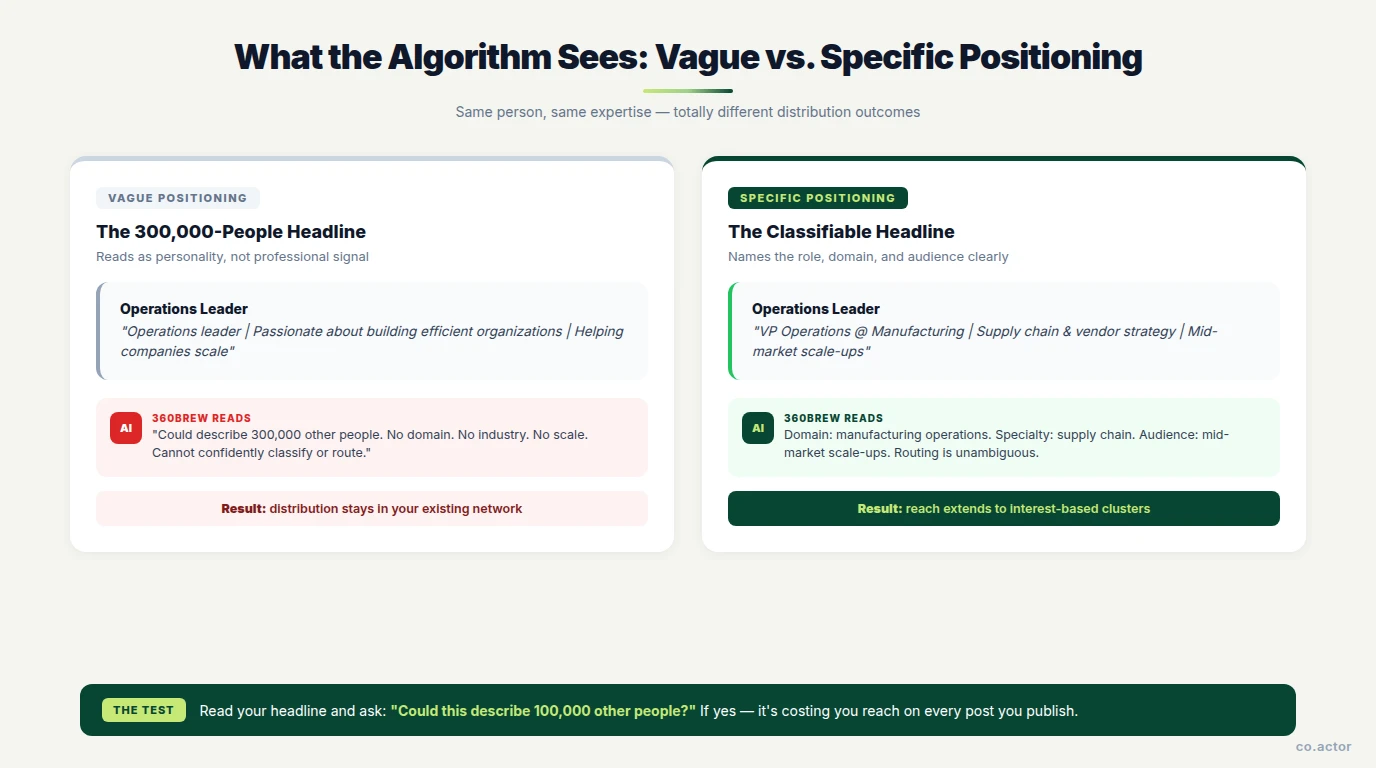
Someone has spent eight years in operations. They've built processes, cut costs, managed global vendors, turned around supply chains. Deep, specific expertise. But their LinkedIn headline says: "Operations leader | Passionate about building efficient organizations | Helping companies scale."
That headline describes roughly 300,000 people on LinkedIn.
The algorithm can't tell what kind of operations, what kind of companies, what level of scale. So when they post about vendor consolidation tactics for mid-market manufacturing — genuinely useful, genuinely specific — the algorithm has no confident profile signal to anchor on. Distribution lands mostly in front of existing connections, not the operations professionals who'd actually find the post valuable.
Contrast this: "VP Operations @ Manufacturing | Supply chain & vendor strategy | Mid-market scale-ups."
Same person. Same expertise. The algorithm now knows the domain, the industry, the audience. Distribution improves before a single word in the post changes.
This is the positioning principle: your headline isn't marketing copy for yourself. It's a classification label for the algorithm. Make it specific enough that a machine can parse it — and specific enough that a relevant reader, scanning through comments, immediately understands what you do.
The Headline Test
The Headline That Works With the Algorithm
Your LinkedIn headline has 220 characters. The first 60 are what people see next to your name in the feed, in comments, and in search results. Those 60 characters work harder than anything else on your profile.
Format That Distributes
[Role] at [Company] — [what you specifically work on or who you serve]
or:
[Role] | [Core expertise] | [Specific audience or outcome]
The best headlines name the role, name the domain, and either name the audience or the specific problem being solved. "Head of Product @ Fintech | B2B SaaS roadmaps | Turning ambiguous requirements into shipped features" — clear, classifiable, credible.
What Suppresses Distribution
- "Passionate about..." — a personality statement, not a professional signal. The algorithm can't route "passion."
- "Helping [vague group] achieve [vague outcome]" — marketing language that communicates nothing specific to a classification system.
- "Thought leader," "visionary," "strategist" without context — these are modifiers with no substance.
- A list of five different things with no hierarchy — the algorithm needs to know your primary topic, not everything you've ever touched.
The Acceptance Rate Signal Most People Don't Know About
When you send connection requests, your acceptance rate is tracked. Below 50%, LinkedIn's system begins treating your account as a potential spammer. This isn't just a connection metric — it affects how your content is handled across the platform.
Advertising-style headlines reduce acceptance rate significantly. People scan your headline before deciding to accept a connection request. "🚀 I help 100+ companies generate 10X more leads through LinkedIn" reads as a pitch. A clear role-and-expertise headline reads as a professional worth connecting with.
The practical effect: a misleading or overly promotional headline doesn't just fail to attract the right audience. It actively signals spam risk to the algorithm, depressing distribution on every post.
The About Section: Structure That Works
Most About sections are career summaries. List of past roles, vague mission statement, generic "let's connect." They read like a corporate bio and provide almost no useful signal to the algorithm or to readers.
The structure that actually works is different. Five paragraphs. Each doing a specific job.
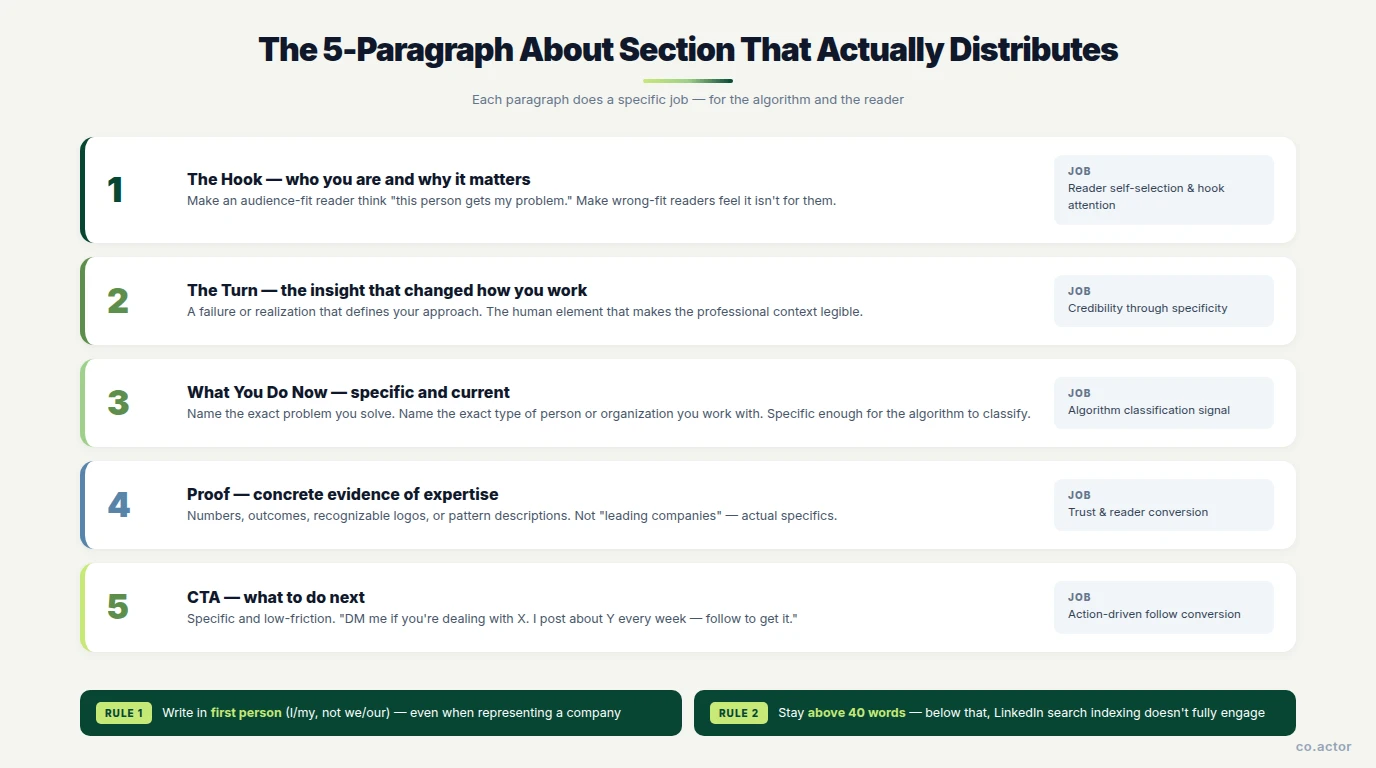
1. Hook — Who You Are and Why It Matters
Not: "I am a results-driven marketing executive with 15 years of experience driving growth across multiple verticals."
Yes: "I've watched exactly three types of B2B companies fail to grow: those who can't generate pipeline, those who can't close it, and those who can't keep the customers they close. I've spent 15 years solving all three — usually after someone else has tried and given up."
The hook should make someone who fits your audience think: this person gets my problem. It should make someone who doesn't fit feel immediately that this profile isn't for them. Both outcomes are correct.
2. The Turn — The Insight That Changed How You Work
The moment, failure, or realization that defines why you approach things the way you do now. This is the human element that makes the professional context legible. "After building two products that nobody used, I stopped asking 'what should we build?' and started asking 'what problem are we actually solving?'"
3. What You Do Now — Specific and Current
Name the exact problem you solve. Name the exact type of person or organization you work with. "I work with Series A-B SaaS companies to rebuild their customer success motion after their first major churn spike." Specific enough to exclude the wrong readers. Specific enough for the algorithm to classify.
4. Proof — Concrete Evidence of Expertise
Not "worked with leading companies across industries." Worked with whom, on what, with what measurable result. Numbers, outcomes, logos the reader will recognize. If you can't name specifics, describe the pattern: "most of my clients have cut their sales cycle in half within 90 days."
5. CTA — What to Do Next
Specific and low-friction. "DM me if you're dealing with [specific problem]. I post about [topic] every week — follow to get it." The CTA should tell the algorithm what action your profile is trying to drive, and tell readers exactly what to expect if they follow.
Two rules that matter technically: write in first person (I/my, not we/our, even when representing a company), and keep the section above 40 words — below that, LinkedIn's search indexing doesn't fully engage.
Build Your Audience Before You Post
This is the part of profile strategy that nobody teaches, but changes everything about how content performs.
The algorithm's first distribution stage — the quality check that determines whether your post gets extended reach — shows your content to 2-5% of your existing network. Who those people are determines the quality of your early engagement signal. If your network is primarily former colleagues from a different field, alumni from a decade ago, and random connections accumulated over years — your Stage 1 audience is misaligned with your content topic.
Low early engagement = the algorithm reads the post as low-interest content and cuts distribution. You get 200 impressions and wonder why.
The fix: build the right audience before you launch your content.
The 15-a-Day System
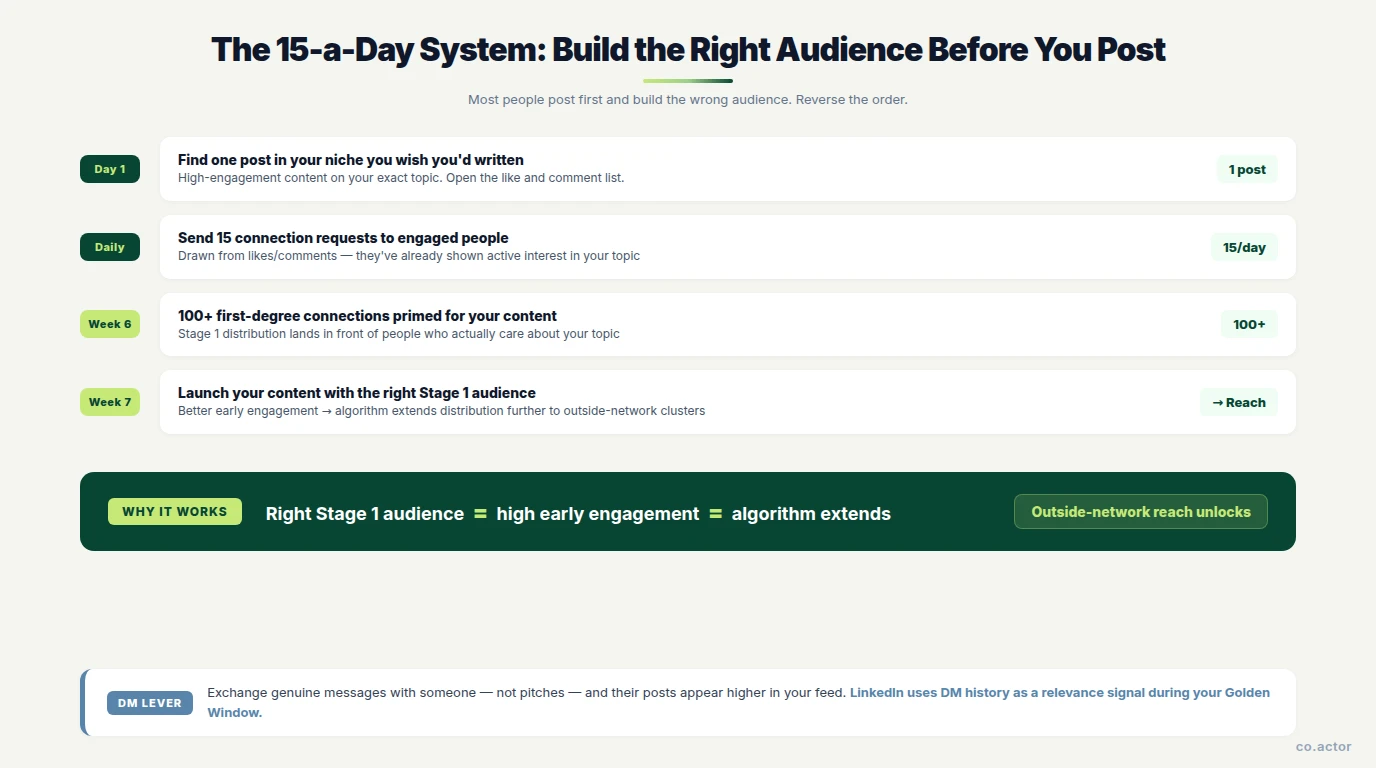
Find a post in your niche that you wish you'd written — something that performed well and addresses exactly the topic you want to own. Look at who liked and commented on it. Those people have already demonstrated active interest in your topic.
Send connection requests to 15 of them per day.
That's not a large number. It's a number you can sustain indefinitely without triggering LinkedIn's spam detection. In six to seven weeks, you have 100+ first-degree connections who are already primed for your content. When your first post goes out, Stage 1 distribution lands in front of people who actually care — which means better early engagement, which means the algorithm extends distribution further.
This is audience curation before content creation. Most people reverse the order — they post first, build the wrong audience, see poor results, and conclude that LinkedIn doesn't work for them. The platform works fine. The audience was wrong from the start.
The DM Lever
Exchange a genuine message with someone — a real response to something they shared, a specific question about their work, not a pitch — and their posts appear higher in your feed. Yours appear higher in theirs.
LinkedIn's algorithm uses DM history as a relevance signal. People you've messaged are more likely to see your posts during your critical early distribution window. This makes them more likely to engage when it counts.
This isn't a growth hack. It's a normal thing that professional relationships do — they create mutual attention. The algorithm just reflects that.
The Signals That Take Five Minutes
Beyond headline and About, five profile elements that most people ignore — each with measurable impact.
Skills
Profiles with five or more relevant skills receive 2.9x more profile views and 4.7x more direct messages. Your top three skills appear prominently on your profile. Choose them to match the topics you post about — not to list everything you've ever done. Update them when your content focus shifts.
Verification
LinkedIn identity and workplace verification increases profile views by approximately 60%. It takes about ten minutes and costs nothing. The verified badge signals legitimacy to readers and contributes to profile credibility signals the algorithm considers. Most people haven't done it. Do it this week.
Creator Mode
Activating Creator Mode switches your profile from "Connect" to "Follow," reducing friction for people who want to read your content without needing a direct connection. It also gives access to LinkedIn Newsletter, amplifies content distribution, and lets you pin up to five topic tags to your profile — additional classification signals for the algorithm.
Featured Section
Update this every quarter. Your three best-performing posts from the last 90 days. A PDF framework or checklist if you have one. A link to your newsletter, a case study, or a lead magnet. Most Featured sections are graveyard displays of content from two years ago. The algorithm can read what's featured. Make sure it reflects your current expertise, not your previous phase.
Current Experience
If your current role entry is empty or generic, you're leaving a semantic gap in your profile. 360Brew reads your Experience section as part of the professional context check that runs on every post. An empty or mismatched current role weakens the profile signal. Fill it. Make the description specific — outcomes and responsibilities in your actual domain, not a copied job description.
The 90-Day Profile Audit
Your profile needs to evolve with your content focus. Run this audit every quarter — or immediately if your recent posts have been underperforming despite consistent quality.
- Alignment check: Read your headline. Then read your last ten posts. Does the same professional expertise show up in both? If a stranger read your headline and then your posts, would they feel consistent, or surprised?
- Headline: Does it contain the two or three specific topics you've been posting about most? If not, rewrite it before your next post.
- About section: Does it tell the story of why you're credible on these topics? Is the current-work paragraph still accurate? Is there a concrete CTA?
- Experience: Is your current role filled in with specific, relevant content — not a blank or a placeholder?
- Featured: Does it show your three strongest posts from the last quarter? Or does it show things you published two years ago?
- Skills: Do your top three skills match your current content topics? When did you last update them?
- Verification: Done? If not, do it before anything else.
- Creator Mode: On?
One more check worth doing: look at who accepted your last twenty connection requests. Are they people who are likely to engage with your topic? If most of your recent connections came from outside your target domain — sales outreach acceptances, alumni connections, random industry acquaintances — you may need to be more deliberate about who you're adding to your first-degree network, because they're the people your posts land in front of first.
Action Items: Apply This Week
- Run the alignment check right now. Open your headline. Open your last five posts. Do they describe the same professional expertise? If there's a gap, fix the headline before you write another word. This single action is the highest-leverage thing on this list.
- Rewrite your headline if it contains "passionate," "helping," or a vague descriptor. Use the formula: role + core expertise area + specific audience or outcome. Make it classifiable by a machine and legible to a reader in two seconds.
- Start the 15-a-day system today. Find one post in your niche that you wish you'd written. Open the engagement list. Send 15 connection requests to people who liked or commented. Repeat daily for the next six weeks. This is your audience before your content.
- Message five people you haven't messaged before. Not a pitch — a real professional exchange. A question, a response to something they shared, a specific observation. You're building DM history that will raise your posts in their feed during your Golden Window.
- Turn on verification and Creator Mode if you haven't. Ten minutes, free, measurable impact. There is no good reason to skip this.
Frequently Asked Questions
Why does LinkedIn's algorithm re-read your profile every time you post?
LinkedIn's 360Brew AI runs a three-way check on every post: who you are (your profile), what you've been writing about (your topic DNA), and what this specific post is about. The headline and About section are read semantically each time — not once at sign-up — because they tell the algorithm what professional topic to classify your post under and which audience to route it to.
What is the best LinkedIn headline format in 2026?
Use one of two formats: "[Role] at [Company] — [what you specifically work on or who you serve]" or "[Role] | [Core expertise] | [Specific audience or outcome]." The headline has 220 characters, but the first 60 are what people see in the feed. Avoid "passionate about," "helping," "thought leader" — these are personality statements, not classifiable signals.
How should I structure my LinkedIn About section?
Five paragraphs, each doing a specific job: (1) Hook — who you are and why it matters; (2) Turn — the insight that changed how you work; (3) What You Do Now — specific and current; (4) Proof — concrete evidence with numbers; (5) CTA — what readers should do next. Write in first person and keep above 40 words.
Does LinkedIn track connection acceptance rate?
Yes. When your acceptance rate falls below 50%, LinkedIn's system treats your account as potential spam. This dampens content distribution platform-wide. Advertising-style or vague headlines reduce acceptance rate. A clear role-and-expertise headline protects your account-level signals.
What is the 15-a-day system for building a LinkedIn audience?
Find a high-engagement post in your niche on the exact topic you want to own. Send 15 connection requests per day to people who liked or commented. In six to seven weeks, you have 100+ first-degree connections primed for your content. Stage 1 distribution then lands in front of people who care — generating the early engagement that unlocks outside-network reach.
Do LinkedIn DMs affect content distribution?
Yes. LinkedIn's algorithm uses DM history as a relevance signal. When you exchange genuine messages with someone, their posts appear higher in your feed and yours appear higher in theirs. People you've messaged are more likely to see your posts during your critical early distribution window.
Should I turn on LinkedIn Creator Mode and verification?
Yes to both. Creator Mode switches your profile from "Connect" to "Follow" and lets you pin five topic tags as classification signals. Verification increases profile views by approximately 60% and signals legitimacy to the algorithm. Both take ten minutes total and cost nothing.
Build a Profile That Functions as a Distribution System
Serge Bulaev is the CEO and founder of Co.Actor, a LinkedIn growth platform for B2B founders and their teams. He writes about content systems, profile positioning, and how the LinkedIn algorithm actually rewards modern creators.
Sources
- LinkedIn Engineering Blog — Engineering the Next Generation of LinkedIn's Feed
- 360Brew: A Decoder-only Foundation Model for Personalized Ranking
- Large Scale Retrieval for the LinkedIn Feed using Causal Language Models
- Richard van der Blom — Algorithm Insights Report 2025 (1.8M posts)
- AuthoredUp — LinkedIn 360Brew Analysis (3M+ posts)
- SocialInsider — LinkedIn Benchmarks 2025
Related Reading
- LinkedIn Algorithm 2026: What 360Brew Actually Rewards
- The LinkedIn Content Engine: Build a Repeatable System Without Burning Out
- How to Use AI for LinkedIn Content Without Sounding Like AI
- The Personal Brand Playbook: LinkedIn Strategy for B2B Founders
- The LinkedIn Networking Playbook: Build Real Relationships at Scale
Written by
