Most LinkedIn creators spend 6 to 12 hours per week writing. Most of that time is wasted — not on the writing itself, but on context-switching, idea generation, and starting from scratch every time. With the right system, the same volume of content takes 90 minutes per week. The difference is workflow, not talent.
This guide is the four-part system that turns LinkedIn writing from a daily struggle into a weekly batch — idea capture, batch writing, repurposing, and scheduled distribution. Built for B2B founders, executives, and anyone running an employee advocacy program where multiple people post under their own names. The system works whether you write everything yourself or use AI assistance.
TL;DR — The 4-System Framework
- Idea capture — 30 seconds per idea, dump into one running doc all week.
- Batch writing — one 90-minute session per week produces 5 posts.
- 1→5 repurposing — every long post becomes 5 platform variants over 2 weeks.
- Scheduled distribution — never miss a day, never log into LinkedIn to publish.
Total time: 90 minutes/week. Output: 5 posts/week, 20+ ideas in the queue.
Why LinkedIn Writing Eats So Many Hours (and What to Cut)
Most creators don't have a writing problem. They have a workflow problem. When you measure where the hours actually go, three categories eat 70-80% of the total:
- Context switching — opening LinkedIn, scrolling, getting distracted, switching back to writing. 15-30 minutes lost per session.
- Starting from scratch — staring at a blank page trying to remember what to write about. 10-20 minutes per post.
- Formatting and polishing — rewriting the hook 4 times, fiddling with line breaks, adding emoji and removing them. 10-15 minutes per post.
The actual writing — converting a clear idea into clear prose — takes 10-15 minutes. Everything else is overhead. The four-system framework attacks each overhead category directly.
System #1: Idea Capture (30 Seconds Per Idea)
The biggest single time-saver is killing the blank-page problem. You don't generate ideas at 9pm when you sit down to write. You generate them throughout the day — during a call, while reading something, while reacting to a customer. The window between "I have an idea" and "I forget it" is about 4 hours. If you don't capture in that window, the idea is gone.
How to Set Up Idea Capture
One document. Always open. Format whatever you want — bullets, sentences, fragments. Examples of what to capture:
- Customer questions. Anything a prospect or customer asks twice is content.
- Contrarian thoughts. Whenever you think "actually, most people get this wrong" — capture it. That's a hook.
- Data points. A number that surprised you. A stat from a meeting. A metric you just learned.
- Frustrations. Something that annoyed you about your industry today. Frustrations are the foundation of opinion posts.
- Quotes. Something a colleague or competitor said that made you stop.
30 seconds per capture, no formatting required. By Friday you have 20-40 raw ideas. The capture document is the single highest-leverage habit in this entire system — without it, batch writing doesn't work.
System #2: Batch Writing (90 Minutes Produces 5 Posts)
Block 90 minutes once a week. Calendar it. Defend it from meetings. This is where 5 posts get written for the coming week.
The 90-Minute Batch Flow
- Minutes 0-10: Pick 5 ideas from the capture doc. Don't overthink. The 5 with strongest hooks, contrarian angles, or specific numbers.
- Minutes 10-70: Draft 5 posts. 12 minutes per post — set a timer. Don't edit while drafting; just get the structure down.
- Minutes 70-85: Edit pass 1 — voice. Read each post out loud. Cut anything that doesn't sound like you talking.
- Minutes 85-90: Edit pass 2 — banned phrases. Search for "game-changer," "leverage," "delve into," "transformative" — replace each.
The key shift is doing all 5 posts in one session. Context-switching cost is roughly 15-20 minutes per session, so 5 daily writing sessions cost 75-100 minutes just on context-switching — more than the entire batch session. Batching kills this overhead entirely.
If You're Using AI Assistance
The batch flow gets faster with voice-trained AI: 5 ideas → AI drafts 5 posts in your voice → you edit each for 10 minutes. Total time drops to 50-70 minutes. The catch is "voice-trained" — generic AI produces drafts that need so much rewriting they don't save time. Voice-trained AI (Co.Actor's per-employee model, or Claude/ChatGPT with a Writing DNA file) cuts edit time to a real 10 minutes per post. See how to use AI for LinkedIn content without sounding like AI for the methodology.
System #3: 1→5 Repurposing (One Idea, Five Posts)
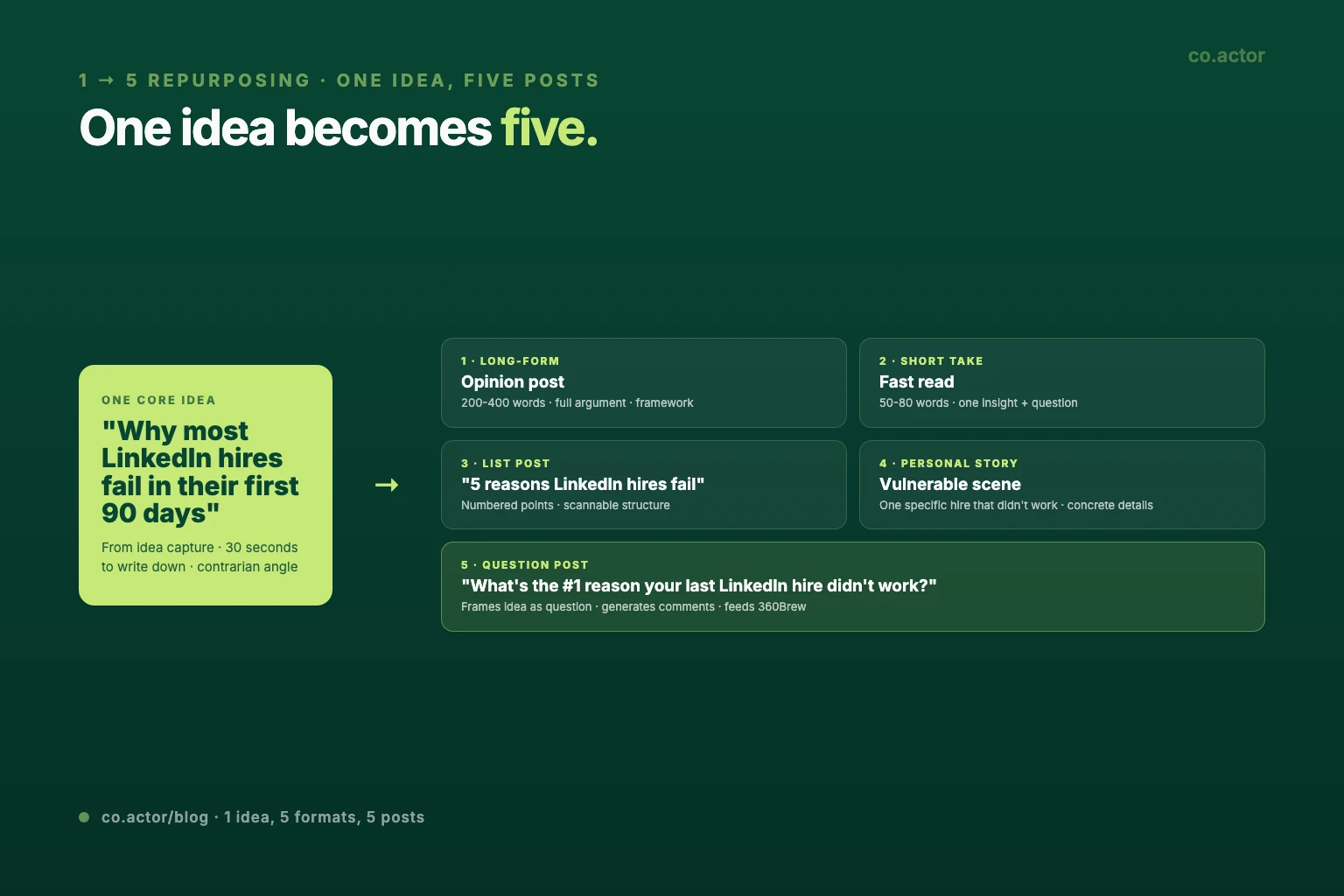
Every strong LinkedIn idea can be expressed in at least 5 different post formats. Repurposing means publishing the same core insight in different shapes across 2-4 weeks — multiplying the work-to-output ratio without losing quality.
The Five Formats Per Idea
- Long-form opinion post. 200-400 words. The "main" version of the idea with your full argument.
- Short take. 50-80 words. One sentence + one sentence + one question. The fast read.
- List or numbered post. "5 things I learned about X" — same core insight broken into discrete points.
- Personal story. Same idea wrapped in a specific scene from your work or life. Vulnerable and concrete.
- Question post. Frame the idea as a question to the audience. Generates comments more than other formats.
One batch of 5 posts becomes 5 ideas × 5 formats = 25 potential posts over a quarter. You won't publish all 25 — but you'll have a queue 10-15 posts deep at any time, which solves the "what do I post tomorrow" problem permanently.
System #4: Scheduled Distribution (Never Log In to Publish)
The final time leak is publishing itself. If you have to log into LinkedIn to publish each post, you'll get pulled into the feed, lose 20 minutes scrolling, and forget half the time. Scheduling tools handle the publishing so you don't need to touch LinkedIn except to engage with comments.
The Posting Cadence
3-5 posts per week is the consistency sweet spot for B2B LinkedIn in 2026. Daily can work for full-time creators but is hard to sustain at quality. Once a week or less doesn't build algorithmic momentum on the 360Brew algorithm — see how 360Brew reranks your feed for context.
The typical batch produces:
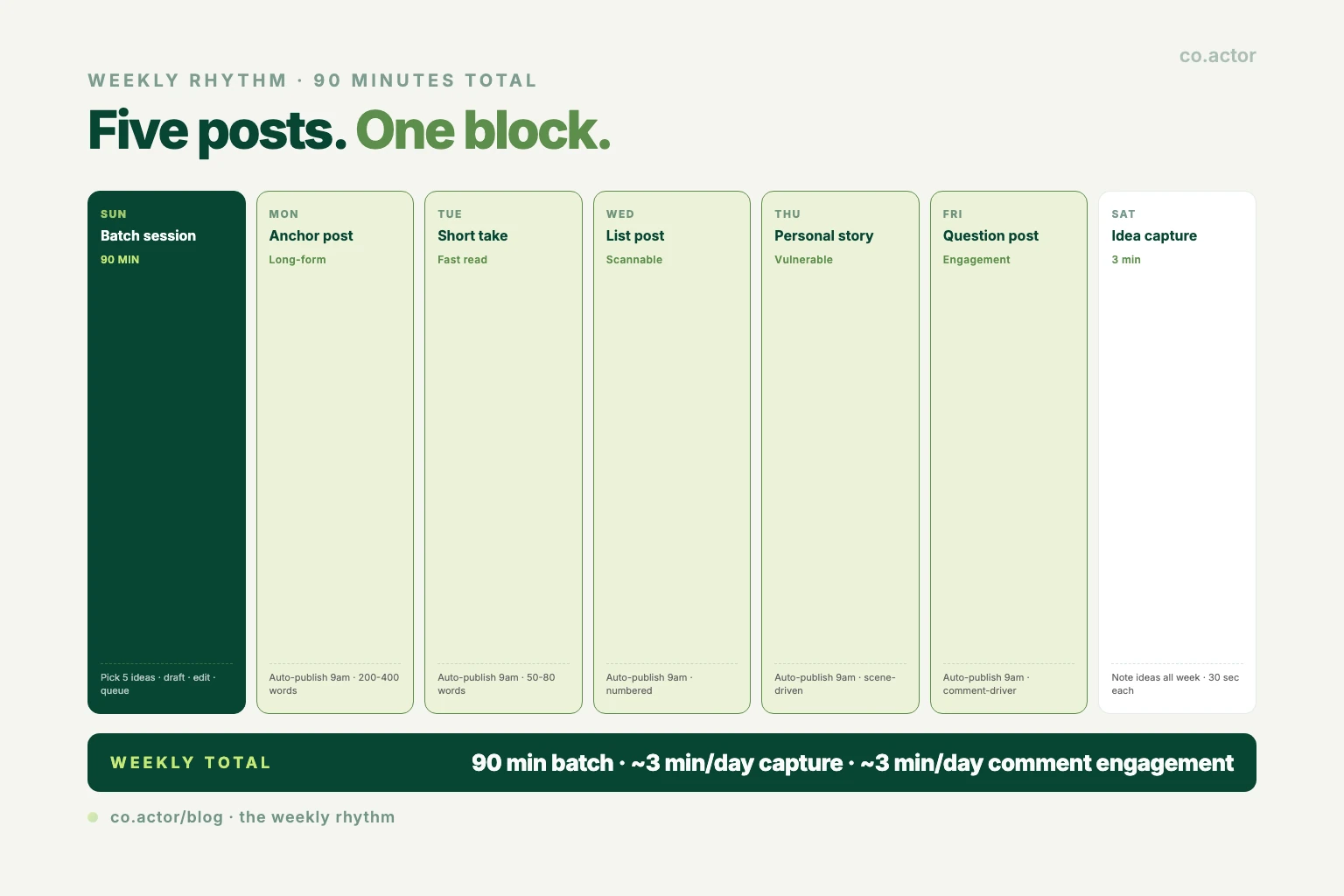
- Monday: Long-form opinion or framework. The "anchor" post of the week.
- Tuesday: Short take or hook-driven post.
- Wednesday: List, numbered post, or framework breakdown.
- Thursday: Personal story or vulnerable post.
- Friday: Question post or weekend lead-in.
Each scheduled in advance via Co.Actor, Buffer, AuthoredUp, or any LinkedIn scheduler. You only open LinkedIn to respond to comments, which takes 15-20 minutes total across the week.
The Weekly Rhythm: 90 Minutes Total
Once the four systems are in place, the weekly time budget compresses dramatically:
- Daily idea capture: ~3 minutes/day = 21 minutes/week.
- Weekly batch session: 90 minutes.
- Comment engagement: ~3 minutes/day = 21 minutes/week.
- Total: ~2.3 hours/week for 5 posts that take 60-80 minutes per post in unstructured workflows (300-400 minutes).
The 90-minute batch session is the only block that needs to be guarded. Idea capture and comment engagement are background activities that overlap with the rest of your day. Once the rhythm is internalized — usually after 4-6 weeks — the system runs on autopilot.
Special Section: How Teams Apply This System
The four systems scale to teams but the implementation changes. For a 10-person employee advocacy program:
- Shared idea bank. One company-wide capture doc where any team member can drop ideas. Marketing or content lead reviews weekly.
- Voice-trained AI per employee. Each team member's AI generates content in their voice — so 10 people produce 10 distinct posts, not 10 versions of the same template. Co.Actor handles this natively.
- Batched team session. One 90-minute session per quarter where the team co-writes content. Pair-write, swap drafts, share angles.
- Approval workflow. Marketing reviews team posts before publishing — 5-10 minutes per post, scaled across the team.
- Aggregated analytics. Roll up which employees drive most pipeline. Reinvest into top performers.
For more on running LinkedIn as a team channel, see the LinkedIn content engine and LinkedIn for founders.
Common Mistakes That Break the System
- Skipping idea capture. Without the running doc, batch sessions devolve into "what should I write about." Lost cause.
- Editing while drafting. Kills the batch flow. Get all 5 drafts out, then edit.
- Polishing each post for 30+ minutes. Diminishing returns. The marginal 10 minutes rarely improves engagement.
- Posting daily without a buffer. One bad day kills the streak. Always keep 3-5 posts in queue.
- Generic AI without voice training. Cuts time but tanks engagement. Voice-trained AI or no AI.
- Treating LinkedIn as broadcast. No comment engagement → no algorithmic compounding. 15-20 minutes/week minimum.
Frequently Asked Questions
How can I create consistent LinkedIn content without spending hours writing?
Four-part system: idea capture (30 sec/idea, all week), batch writing (90 min produces 5 posts), 1→5 repurposing (each idea becomes 5 formats), scheduled distribution. Total time: ~2.3 hours/week for 5 posts.
How long should it take to write a LinkedIn post?
10-15 minutes per post in a batch session. 90 minutes produces 5 ready-to-publish posts. Without a system, the same 5 take 4-6 hours due to context-switching and starting from scratch each time.
What's the difference between batch writing and daily writing?
Batch produces a week of content in one session. Daily writes one post each day. Batch wins on total time (90 min < 5×30 min), quality (compare and pick strongest), and missed-day resilience (queue absorbs sick days).
How do I never run out of LinkedIn content ideas?
Idea capture document, always open. Drop everything interesting in 30 seconds. By Friday you have 20-40 raw ideas; pick 5 best in the batch session.
Can AI write consistent LinkedIn content for me?
Yes — but only voice-trained AI. Generic AI underperforms by 30-50% in engagement. Voice-trained AI (Co.Actor, Claude/GPT with Writing DNA) produces consistent + personalized content.
How many LinkedIn posts should I publish per week?
3-5 per week is the consistency sweet spot for B2B in 2026. Daily is hard to sustain at quality; once a week doesn't build 360Brew momentum. A 90-minute batch produces a full week of 5 posts.
Should I write LinkedIn content myself or hire a ghostwriter?
Hybrid works best. You generate the raw idea, opinion, and story; AI or ghostwriter handles structure and polish. Pure ghostwriting often voice-mismatches; pure self-writing eats hours. Co.Actor automates this hybrid workflow per employee.
Automate the System Across Your Team
Co.Actor turns this four-part framework into one workflow per employee — voice-trained AI drafting, batch composition, shared content calendar, scheduled distribution, aggregated analytics. 10 employees, one 90-minute weekly batch, consistent voice-aligned posts. Try Co.Actor free.
Serge Bulaev is CEO and Founder of Co.Actor. He writes about LinkedIn content systems, team advocacy programs, and how to scale personal-brand content without burning out.
Related Reading
Written by
