Staring at the LinkedIn composer is one of the small recurring miseries of being a founder. You know you should post. You know your audience is here. You know the algorithm rewards consistency. And then you sit there, blink at the cursor, and decide it can wait until tomorrow.
The fix is not motivation. The fix is structure. This article gives you 30 LinkedIn post ideas for founders, organized into six categories that cover everything you actually need: product, story, market, team, frameworks, and conversation. Every idea includes a hook, a structure, and a real example you can adapt to your own business.
You don't need to post all 30. You need to pick three categories that match how you think, rotate them weekly, and stop second-guessing yourself.
TL;DR — What This Article Covers
- 30 founder post ideas in six categories. Building in Public, Founder Story, Industry Commentary, Team & Culture, Lessons & Frameworks, Engagement Starters.
- Don't try to use all 30. Pick three categories, rotate weekly, and let the others sit.
- Specificity wins in 2026. The 360Brew algorithm rewards posts with named customers, real numbers, and concrete decisions. Generic leadership thoughts go nowhere.
- Each idea is a structure, not a script. Hook, body, close — the shape that earns saves, comments, and replies.
- Three posts a week is the sweet spot. Enough for the algorithm to learn your topic. Not so much that you burn out by Q2.
Why 30 Ideas (And Not 100)
Most "100 LinkedIn post ideas" lists are noise. By the time you reach idea #47, you're reading near-duplicates of #12, and the only people getting value out of the list are SEO writers padding word count.
30 ideas is the natural ceiling for a founder. Six categories, five repeatable formats per category, cycled across a year. With three posts a week, you'd hit each format 5-6 times annually — enough repetition to refine your voice, varied enough that nobody recognizes the pattern. More than 30 produces redundancy. Fewer than 30 leaves gaps.
The other reason 30 works: the 360Brew algorithm rewards topic DNA built over 90 days. If you post the same five formats forever, the algorithm flattens your audience. If you rotate six categories with different angles, the algorithm reads you as a multi-dimensional voice in your space and pulls more network signals to expand your reach.
How to Use This List
Three rules.
- Pick three categories. Skip the others. Most founders end up with Building in Public + Founder Story + one of {Industry Commentary, Lessons & Frameworks}. That mix covers product, person, and point of view — the three things buyers want to see from a founder.
- Rotate weekly, not daily. One category per posting day, in the same order each week. Your audience learns the rhythm. The algorithm learns your topic spread. You stop deciding what to post and start deciding what to write inside the format you already chose.
- Use the ideas as scaffolding, not scripts. Each idea below comes with a structural template. Bring your own customer, your own number, your own moment. The structure protects you from blank-screen paralysis. The substance has to be yours.
If you want the full system around this — when to post, how to batch, how to repurpose — read The LinkedIn Content Engine after this. This article gives you the ideas. That one gives you the workflow.
Six Categories at a Glance
Here's the map.
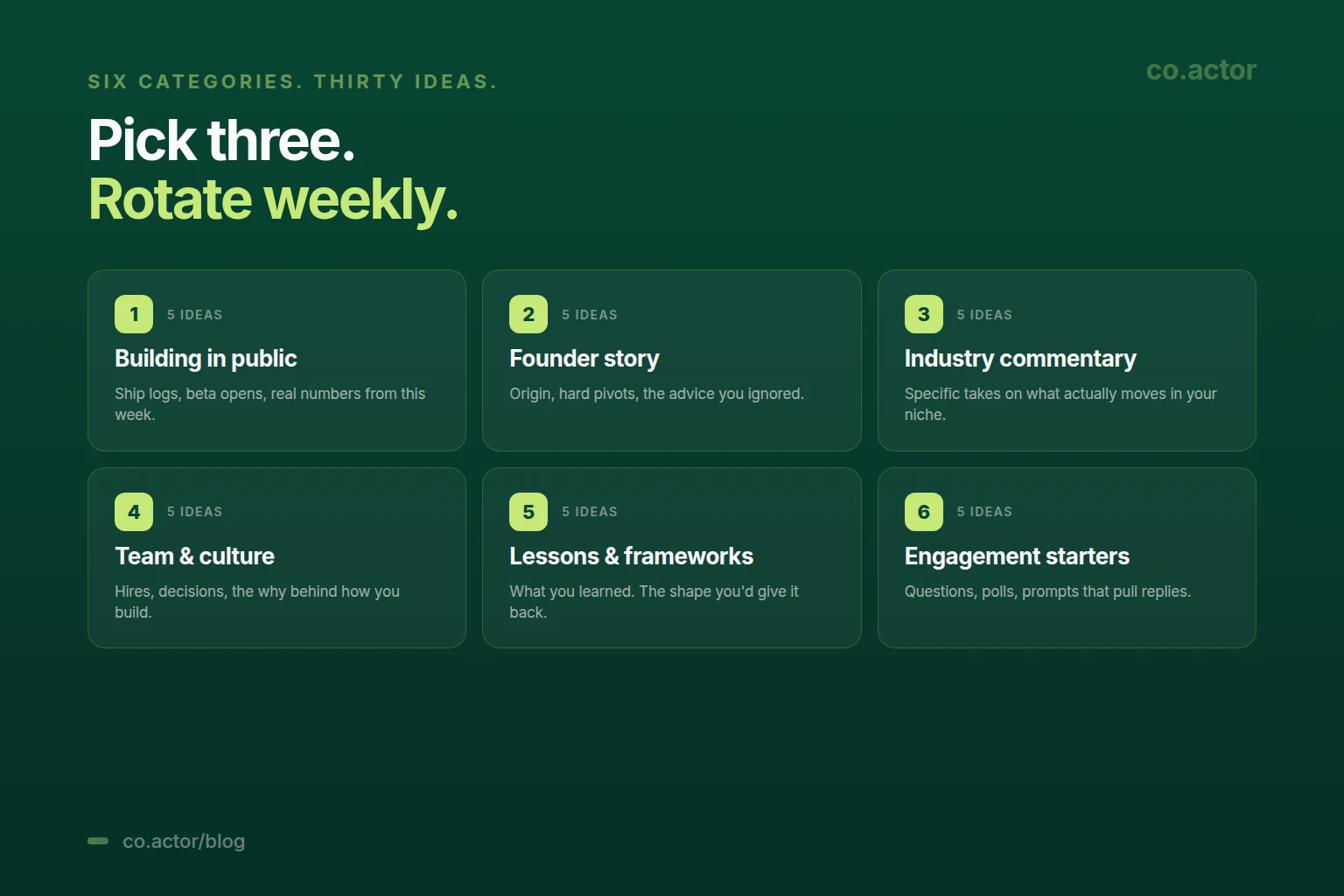
- Building in Public. Posts about your product. Ship logs, beta launches, real numbers, technical decisions, things you almost built wrong.
- Founder Story. Posts about you. Origin, mistakes, routines, advice you ignored, opinions you hold against the industry consensus.
- Industry Commentary. Posts about your market. Trends, predictions, explainers, comparisons, what you learned from a specific company or person.
- Team & Culture. Posts about your people. New hires, team wins, hiring philosophy, day in the life, values translated into actual decisions.
- Lessons & Frameworks. Posts that teach. Your operating frameworks, books that changed your thinking, lessons you'd give yourself, counterintuitive truths, templates worth sharing.
- Engagement Starters. Posts that pull replies. Questions, polls, scenarios, unpopular-opinion prompts, public appreciation.
Now the 30 ideas, with examples.
Building in Public — 5 Ideas
The category that built half the well-known SaaS founders on LinkedIn. It works because the audience gets to watch a real thing get built in real time, with real numbers and real decisions. It fails when you sanitize it into a launch announcement.
1. The Feature Ship Log
Hook: "We shipped X last Tuesday. Here's what changed for the customers who already use it."
The structure is dead simple. Name the feature. Describe the user pain it solves. Drop one early metric or piece of feedback from a real customer. Close with what's next. The post works because it's specific, dated, and earns trust by showing you ship.
2. The "We Almost Built This Wrong" Story
Hook: "We were three weeks into building feature X. Then a single customer call killed it."
This is the most underrated post type for founders. You describe the wrong path, the moment of clarity, and what you built instead. The audience learns you actually listen to customers — the most attractive trait in a founder. Bonus: it gives you cover to talk about your product without sounding like a billboard.
3. The Customer Request You Said No To
Hook: "Last month we said no to our biggest paying customer. Here's why we were right."
Saying no signals product clarity, which buyers notice more than feature lists. Describe the request, your reasoning, and the principle behind it. Don't shame the customer — frame it as a difficult call you made carefully. Founders who can articulate what they don't build are easier to trust than founders who say yes to everything.
4. The Metric You're Proud Of
Hook: "X% of our users do Y in their first session. Took us 18 months to get there."
One real metric beats a thousand vanity claims. Pick a specific user behavior or business outcome that took real work to move, name the number, and explain what changed in product or onboarding to get there. The number is the hook; the lesson is the value.
5. The Tool Stack Reveal
Hook: "Here's the full tool stack we use to run a 12-person company. Total cost: under $500/month."
Tool stack posts are some of the most-saved content on LinkedIn — every founder is curious about how other founders set up their stack. List the tools, the function each serves, the cost, and (where useful) what you switched away from and why. Avoid affiliate links; the post earns trust because it reads as honest.
Founder Story — 5 Ideas
The category that builds personal brand. People follow founders for the human, not the company. These posts make you legible as a person, which is what makes the company legible as a brand.
6. The "Why I Started This" Origin Story
Hook: "I left my job at X to start this in 2023. Three months in, I almost quit."
Every founder has an origin story; almost none of them tell it well on LinkedIn. The trick is to skip the heroic version and write the conflicted one. The job you left and what was wrong with it. The first week of the company and how scared you were. The moment you decided to keep going. Specifics over inspiration.
7. The Mistake That Cost You
Hook: "I once hired a VP based on their resume and ignored every red flag from the interview. It cost us six months and $400K."
Mistake posts work because the audience instantly recognizes the situation. Be specific about the mistake, the cost (time, money, opportunity), and the rule you adopted afterward. Skip the false-modest "lessons learned" wrap-up. The lesson should be implicit in the story.
8. The Routine That Keeps You Sane
Hook: "I block 6:30-8:00 AM every weekday before opening Slack. Five years in, it's the only routine that's stuck."
Founder routines are evergreen — there's always demand for "how do you actually run your day." The post works when it's idiosyncratic and honest. The walk you take. The Sunday planning ritual. The phone-in-another-room rule. Skip productivity hacks you read on Twitter; describe what actually works for you.
9. The Advice You Ignored (And Regret)
Hook: "Three advisors told me to raise more in my seed round. I didn't listen. They were right."
The structure: name the advice, explain why you ignored it at the time, describe what happened, and admit they were right. The post works because it shows judgment in retrospect — buyers and investors both reward founders who can name their own blind spots. Don't fake it. If you genuinely don't have a regret you'd publish, skip the format.
10. The Unpopular Opinion
Hook: "Unpopular opinion: most founders should not be on Twitter."
Strong opinions earn the strongest engagement on LinkedIn. The catch is they have to be opinions you actually hold and can defend — not contrarian for the sake of clicks. Pick a position you'd argue at a dinner with peers. Frame it cleanly. Defend it with one or two specific reasons. Let the comments come.
Industry Commentary — 5 Ideas
The category that positions you as a thinker in your space. Done badly, it reads as warm hot takes. Done well, it builds the kind of authority that makes inbound deals happen.
11. The Trend Take
Hook: "Everyone's talking about X. Here's what they're missing."
Pick a trending topic in your industry. Identify the consensus take. Then offer a sharper take with specific evidence — a customer pattern, a data point, a counter-example. The post works because the audience is already primed by the trend; you give them a more useful frame than the generic version they've seen ten times.
12. The "Here's How This Actually Works" Explainer
Hook: "Most people misunderstand X. Here's what's actually happening under the hood."
Take a concept from your industry that's commonly misused, explain it correctly, and ground the explanation in something concrete. The explainer post works for technical and non-technical audiences. The format is: name the misconception, give the actual mechanism, give one example.
13. The Prediction
Hook: "By the end of 2026, X will look completely different. Here's why."
Predictions are double-edged. The upside: you stake a position, which is rare and respected. The downside: you'll be wrong sometimes, in public. Make predictions specific enough to be falsifiable and write them with the confidence you actually have, not more. A specific 60%-confident prediction reads stronger than a vague 95%-confident one.
14. The Comparison or Contrast
Hook: "Tool A and Tool B look similar on the surface. They're built for completely different jobs."
Comparison posts get high save rates because the reader is often researching the exact decision you're framing. Be honest, name strengths on both sides, and orient around the buyer's actual job-to-be-done rather than feature parity. Works for tools, frameworks, business models, hiring approaches — anything where readers face a choice.
15. The "What I Learned From X" Post
Hook: "I spent the weekend reading about how Stripe scaled from 5 to 50 engineers. Three lessons I'm using this quarter."
Pick a company, founder, or operator you genuinely admire. Pull out two or three specific patterns. Translate them into something concrete you're applying. The post works because the implicit message is "I study my craft seriously and steal from the best" — both attractive founder traits.
Team & Culture — 5 Ideas
The category that recruits people. Posts about team and culture fail when they read like HR copy and win when they're specific about real decisions and real people.
16. The New Hire Welcome
Hook: "Welcoming X to the team. They're going to lead Y, and here's why we're so glad they said yes."
The standard new-hire post is generic ("excited to welcome…"). The strong version is specific: what role, what problem the role solves for the company, why this person is the right fit, one specific thing they've already done that the team noticed. Tag the person; let their network discover them through your channel.
17. The Team Win
Hook: "The team shipped X this week. The credit goes to A, B, and C — here's what each of them did."
Public credit costs nothing and pays back enormously. Name three people, describe one specific thing each contributed, and avoid the temptation to take a victory lap yourself. The post recruits future hires (people want to work where credit gets given) and reinforces the culture you say you have.
18. The Hiring Philosophy Post
Hook: "We've turned down strong-on-paper candidates because of one thing. Here's what we screen for that nobody else does."
Hiring posts attract candidates and signal culture in one move. Describe the trait or behavior you weight unusually heavily, why you weight it, and how you screen for it. Avoid generic claims like "we hire for culture fit." The post should describe a screen that's specific enough that a candidate could prepare for it.
19. The "Day in the Life" Snapshot
Hook: "Tuesday morning at our office: 9:30 standup, 10:15 customer call, 11:30 product review. Here's what each looked like."
Day-in-the-life posts work when they're concrete and short on glamour. Skip the highlight reel; describe the actual rhythm. The audience wants to see real work, not curated work. Bonus points if the post reveals a meeting cadence or ritual that's mildly distinctive.
20. The Values in Action Story
Hook: "One of our values is 'the customer's problem is the team's problem.' Here's what that looked like at 2 AM last Thursday."
Values posts that work tell a story where a stated value got tested in a real situation and the team made a costly choice that lined up with it. The story is the post. The value is the framing. Skip posts where the value didn't actually cost you anything to honor.
Lessons & Frameworks — 5 Ideas
The category that gets the highest save rates on LinkedIn. Frameworks travel because they're useful — readers save them and come back. Saves are the highest-weighted signal in the 2026 algorithm.
21. The Framework You Use
Hook: "Here's the framework we use to decide which features to build. Three questions, in this order."
Take a recurring decision in your business. Write the framework you use to make it, in 3-5 steps or questions. Add an example of the framework being applied to a real decision. The framework post is the highest-leverage content type for SaaS founders — it positions you as an operator and gets saved by other operators.
22. The Book/Podcast/Article That Changed How You Think
Hook: "I read X three years ago. It changed how I run product reviews. Here's the specific shift."
Don't review the book. Describe the one idea that changed your behavior and how your behavior changed. The post works because it's evidence that you read for application, not signaling. Skip "this book changed my life" posts that don't name a specific change.
23. The "X Things I'd Tell Myself Y Years Ago"
Hook: "Five things I'd tell myself in 2023, when I was three months into building the company."
The format is well-worn but still works because every reader who's earlier on the path imagines themselves in the position. Five points, each specific, each something you genuinely believe with retrospect. Avoid clichés like "trust the process" — pick advice you'd actually give a friend at a dinner.
24. The Counterintuitive Lesson
Hook: "The advice we ignored that turned out to be right: hire slower than feels comfortable, even when you're losing deals because you're understaffed."
Pick a piece of operating wisdom that contradicts the conventional take in your industry. State the conventional view, state your view, give one example or piece of evidence. The post works because contrarian-but-defensible reads as judgment, not edginess.
25. The Template or Resource Share
Hook: "Here's the exact template we use for monthly investor updates. Copy it, adapt it, send it."
Sharing a real internal artifact — a template, a checklist, a doc — is one of the highest-saved post types on LinkedIn. The asset has to be genuinely useful (don't share a placeholder); the post has to be specific about how you actually use it. Optional: link to a Notion or Google Doc copy.
Engagement Starters — 5 Ideas
The category that drives reply volume. These posts are intentionally lower-effort to write but higher-effort to choose well. The wrong question gets you no replies; the right question gets you 80.
26. The Question
Hook: "Founders: what's the single best $200 you've spent on the business this year?"
Good question posts share three traits: the question is specific enough to answer in one sentence, the answer is something readers already know but haven't articulated, and there's a slight constraint that forces a real choice. Avoid questions you could ask yourself; ask questions where the answer is genuinely your readers'.
27. The "Unpopular Opinion" Prompt
Hook: "Unpopular opinion in B2B SaaS: morning standups are a tax on focus, not a productivity tool. Disagree?"
Different from the standalone Unpopular Opinion (#10) — this version is shorter and explicitly invites disagreement. State the position concisely. End with a clear ask for pushback. The replies do the heavy lifting; you mostly need to start the fire.
28. The Poll
Hook: "How do you handle product roadmap requests from your biggest customer?" + four options.
Polls are the cheapest engagement to produce and the easiest to misuse. Write polls about real decisions your audience faces, not survey-question polls ("which is best, Slack or Teams"). Two to four options. Add a comment with your own answer to seed the discussion.
29. The "What Would You Do" Scenario
Hook: "You have one engineer. They want to refactor the entire codebase. The customer asked for three new features yesterday. Go."
Scenarios force the reader to commit to a position. The format works because the audience instinctively wants to demonstrate their judgment. Make the scenario specific enough to be answerable in 2-3 sentences. Read the replies — they're great research material for future posts.
30. The Appreciation Post
Hook: "Three people who shaped how I think about company building, in case their work isn't on your radar yet."
Public appreciation posts work when they're specific and the people named are not already mega-popular. Tag two or three people, describe one concrete thing each taught you, and let their networks discover them. These posts also tend to seed real relationships — the people you tag often reach out, sometimes turning into deeper conversations.
How to Actually Write Any of These
Ideas are scaffolding. Substance is yours. But there's a structure that makes founder posts land regardless of which idea you pick.
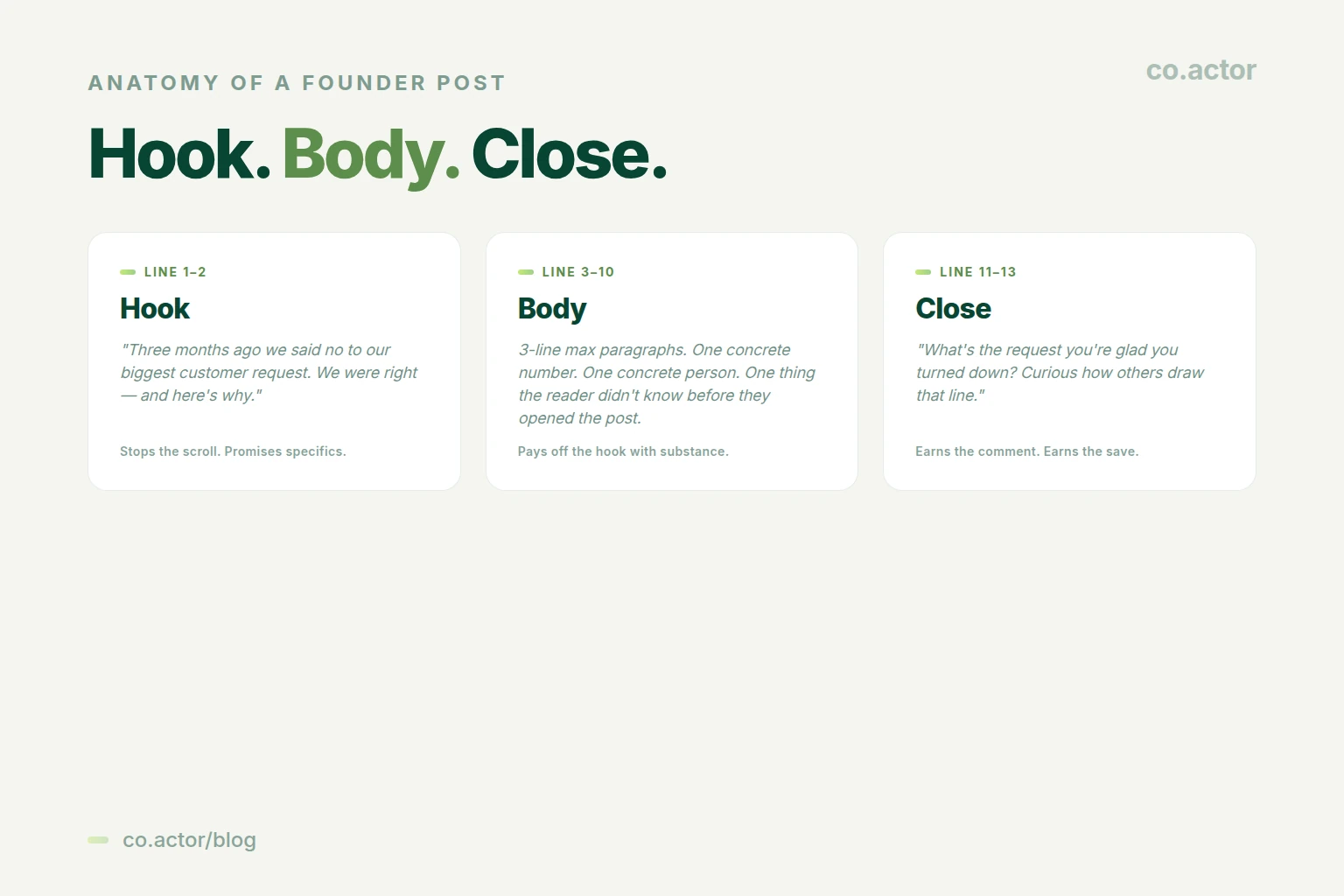
Hook (line 1–2). Two lines that stop the scroll. The strongest hooks promise specificity ("we said no to our biggest customer") rather than abstraction ("here's why saying no matters"). If your hook could be the title of a generic LinkedIn carousel, it's not specific enough.
Body (line 3–10). Three-line maximum paragraphs. One concrete number, one named customer or person, one piece of information only you could write. The body has to pay off the promise the hook made. Vague pay-off is worse than no pay-off.
Close (line 11–13). A close earns the comment, the save, or the reshare. The strongest closes do one of three things: ask a specific question your audience can answer, name what you're going to write about next, or invite a counter-argument. Generic closes ("hope this helps!") return generic engagement. See the viral post formula for the full breakdown.
A Weekly Rotation That Doesn't Burn You Out
Three posts a week is the cadence that holds. Five is unsustainable for most founders. One isn't enough volume for the algorithm to learn your topic DNA.
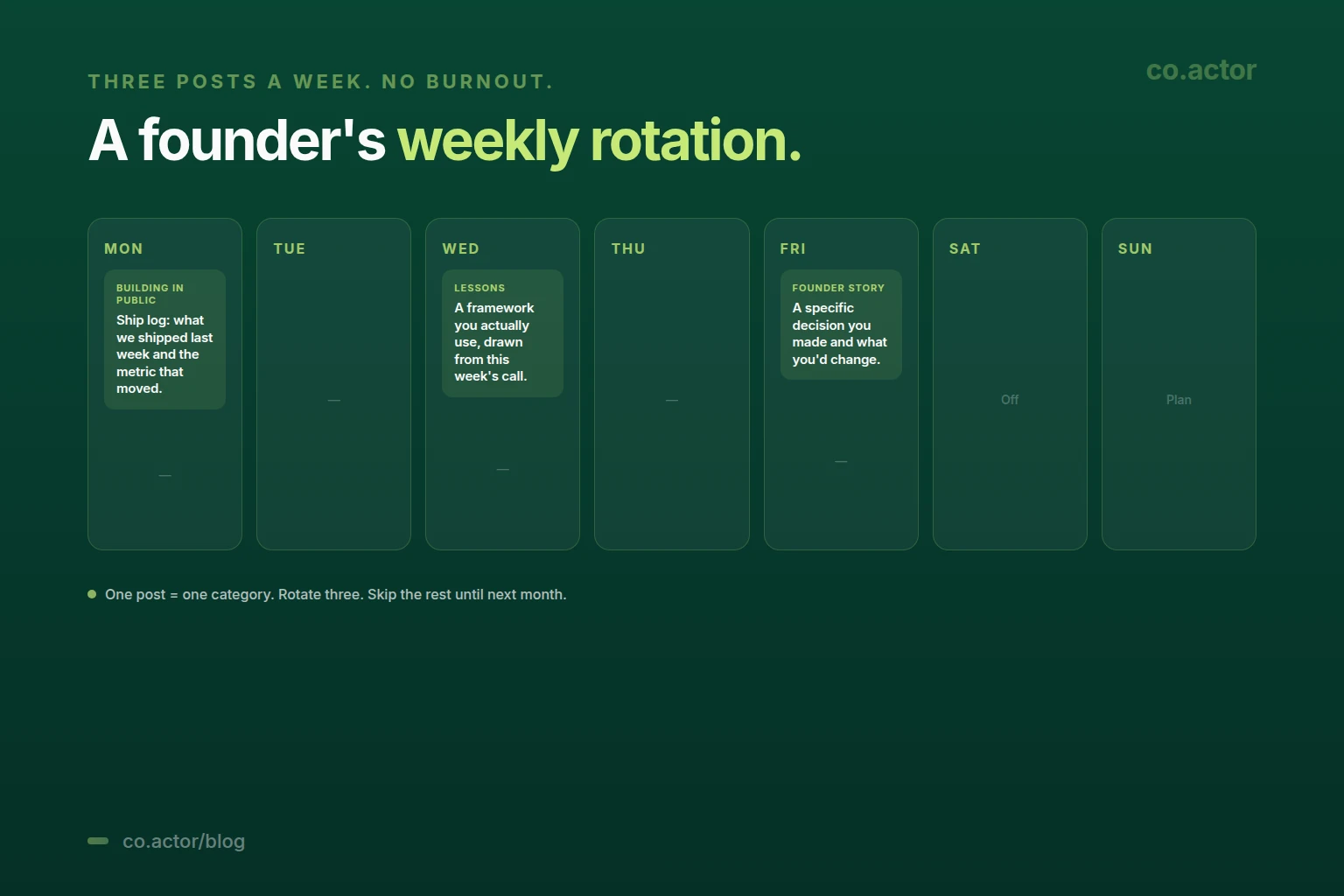
Monday — Building in Public. Ship logs, metrics, customer requests you said no to. Mondays catch the audience while they're planning their week and looking for fresh substance. Product posts here align with your audience's mood: tactical, mid-research.
Wednesday — Lessons & Frameworks. Frameworks, counterintuitive lessons, templates. Wednesdays are the highest-save day in the LinkedIn week — readers are actively in the middle of work and reach for content they'll use. Frameworks own this slot.
Friday — Founder Story. Origin, mistakes, routines, opinions. Fridays are reflection days — the audience is in a slower scroll mode, more receptive to personal content. Founder Story posts often get fewer impressions but deeper engagement.
Industry Commentary, Team & Culture, and Engagement Starters slot in as substitutes when the standard rotation doesn't fit a given week. A particularly strong industry trend justifies displacing Monday's ship log. A new hire justifies displacing Friday's founder story. The weekly default is the discipline; the substitutions are the variety.
Frequently Asked Questions
How many times a week should a founder post on LinkedIn?
Three times a week is the sweet spot. It's enough volume for the algorithm to learn your topic DNA, but not so much that quality drops or you burn out. Founders posting once a week struggle to build momentum; founders posting daily often see quality decay by week three. Three structured posts beat seven rushed ones.
Should I use AI to write LinkedIn posts as a founder?
Use AI to draft, never to publish. AI is excellent for outlining and expanding bullet points into paragraphs. AI is terrible at the specifics that make founder posts work — the customer name, the actual number, the real conversation, the moment you changed your mind. Use AI for scaffolding. Bring your own substance. See our LinkedIn AI toolkit for the full workflow.
Do I need to post all 30 ideas?
No. The 30 ideas are a menu, not a checklist. Pick three categories that match how you naturally think — most founders rotate Building in Public, Founder Story, and one of Industry Commentary or Lessons. Five formats per category give you enough variety to never repeat yourself within a month, and skipping the categories that don't fit you keeps the work sustainable.
What's the difference between B2B SaaS and DTC founder content?
B2B SaaS founders win on Industry Commentary and Lessons & Frameworks — buyers research deeply and reward thinking that helps them frame their own problem. DTC founders win on Building in Public and Founder Story — purchase decisions are emotional and the brand IS the founder's voice. Both should run Engagement Starters; both should run Team & Culture sparingly.
Should I post about competitors on LinkedIn?
Carefully. The Comparison post (idea #14) works when you frame it as category education rather than competitive attack. "Tool A is better for X, Tool B is better for Y, here's how to choose" reads as service. "Tool B is bad and we're good" reads as insecure. The algorithm doesn't punish competitive content — buyers do. If your post would embarrass you to send to a customer, don't post it.
How long should a founder LinkedIn post be in 2026?
150 to 350 words. Shorter and the algorithm reads it as low-effort; longer and most readers won't scroll to the end. Inside that range, structure matters more than length: hook in the first two lines, body in 3-line paragraphs, a clear close. The save signal is the highest-value engagement metric in 2026 — see our metrics deep dive for the full breakdown.
What's the single biggest mistake founders make on LinkedIn?
Posting generic "leadership thoughts" instead of specific founder content. The algorithm and the audience both reward specificity — a named customer, an actual number, a real decision, a date. Vague wisdom about "embracing failure" goes nowhere. A post about the customer request you turned down last Tuesday goes everywhere. Every post needs at least one piece of information only you could write.
Build the Founder Content Engine That Compounds
Serge Bulaev is the CEO and founder of Co.Actor, a LinkedIn growth platform for B2B founders and their teams. He writes about content systems, profile positioning, and how the LinkedIn algorithm actually rewards modern creators.
Related Reading
- LinkedIn for Founders & CEOs: The Data-Backed Playbook
- The LinkedIn Content Engine: Build a Repeatable System Without Burning Out
- LinkedIn Algorithm 2026: What 360Brew Actually Rewards
- LinkedIn Metrics That Actually Matter in 2026: WES, Save Rate, Comment Depth
- The LinkedIn Viral Post Formula: Hook, Body, Close That Travels
- LinkedIn Personal Profile vs Company Page 2026
Written by
