Most people on LinkedIn are stuck in a posting-first model. Write content, push it out, hope it travels, check the analytics, and when the numbers underperform, post more. The professionals growing fastest in 2026 aren't doing that. They're showing up — substantively — in other people's comment sections. And it's growing their profile, their relationships, and their pipeline faster than their own posts ever did.
This article is about that move only. Not how comments help your own posts. The other direction — what happens when you spend 15-20 minutes a day leaving substantive comments on other people's content. We'll cover how the 360Brew algorithm reads those comments, what makes a comment substantive, the daily routine that works, and the 90-day curve that determines whether the strategy compounds or just fizzles.
TL;DR — In Five Bullets
- 360Brew reads your comments the same way it reads your posts. LinkedIn's 150-billion-parameter LLM analyzes substance, topic alignment, and conversation depth as expertise signals.
- Your comment travels with the author's reach. A substantive comment on a creator's post is exposed to everyone who sees the post — you don't need their followers, you've already shown up where they are.
- Outreach following prior engagement converts up to 93% better than cold outreach (Martal 2026). Every substantive comment is a first touch.
- Topic consistency over 60-90 days is what makes commenting compound. Random comments across unrelated topics dilute the signal.
- The daily routine: 15-20 minutes, 10-15 substantive comments, two-layer target list. Profile visits first, pipeline last. Stick with it for 90 days.
How 360Brew Reads Your Comments
Until 2024, LinkedIn was a signal-counting system. Comments mattered more than likes, but the system was fundamentally adding things up.
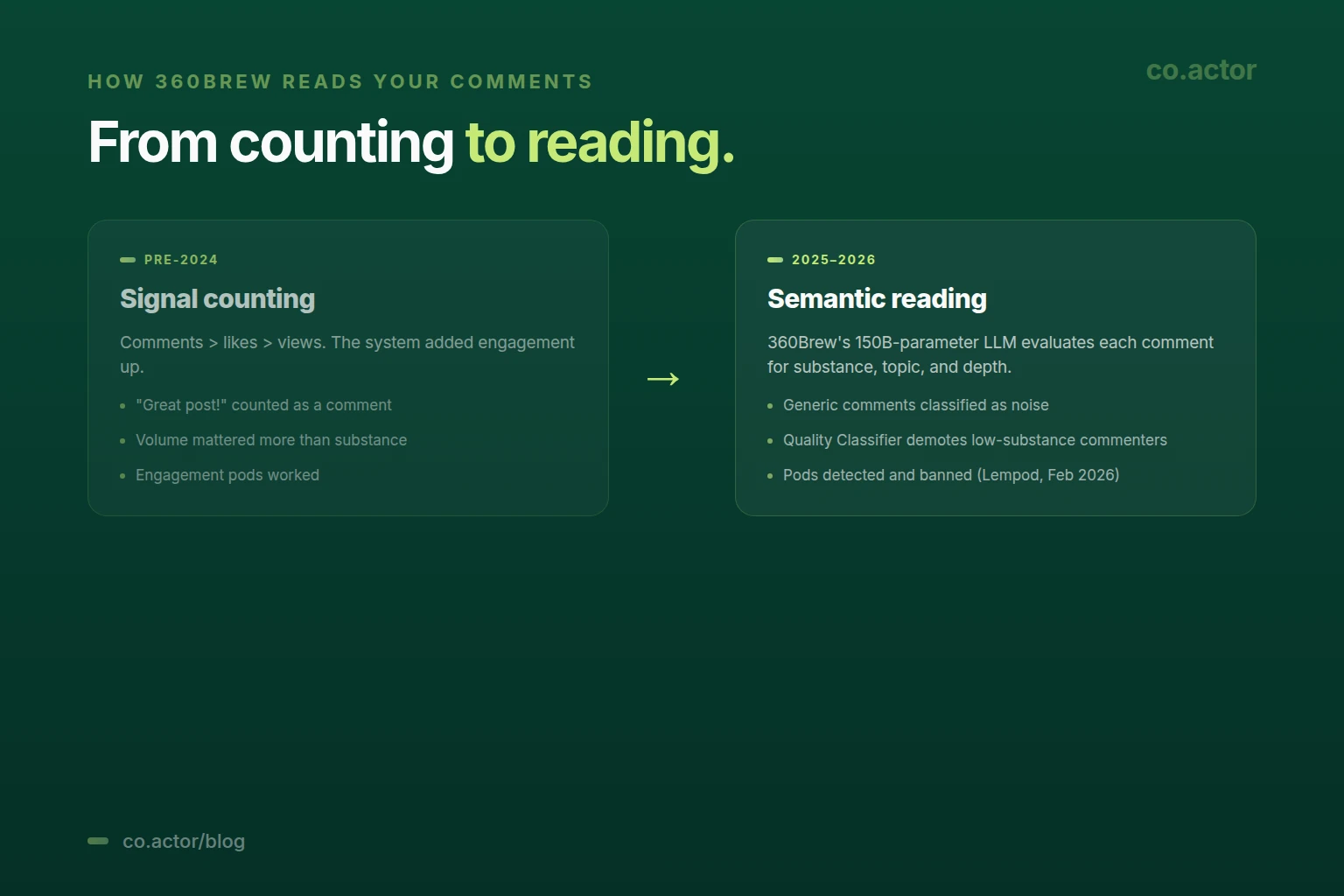
In 2025, LinkedIn rolled out 360Brew — a 150-billion-parameter language model based on LLaMA 3, documented in an arXiv paper from January 2025. Instead of counting signals, 360Brew reads content semantically and uses cosine similarity to evaluate relevance. It's a content-understanding system. The full algorithm deep dive is here.
This changes what comments do.
A "Great post!" comment is no longer a low-weight signal — it's a piece of text the model evaluates for substance, topic alignment, and contribution. When the substance is empty, the comment is downgraded to noise. The Quality Classifier — confirmed across 2026 sources, though not publicly named by LinkedIn — actively filters comments and demotes profiles that consistently produce low-substance engagement.
Substantive comments do the opposite. Every substantive comment you write becomes part of your topical signature. Comment 10 times across 30 days on a specific subject, with substance, and 360Brew starts treating you as a voice on that subject — visible in feeds aligned with that topic.
The shift in 2026: commenting isn't a way to nudge the algorithm anymore. It's a way to demonstrate expertise on a topic. The algorithm reads what you wrote — and uses it to decide who you are.
The Borrowed Audience and the First Touch
When you comment on a post, two things happen visibility-wise:
- Anyone who views the post sees your comment. Post reaches 50,000 people — your comment is exposed to 50,000 people. You didn't need 50,000 followers.
- Your comment appears in your own connections' feeds. "X commented on Y's post" with the post and your comment attached. Your network sees your engagement, often with more screen real estate than a like would get.
A substantive comment on a creator's post can produce more profile visibility for you than publishing your own post — because you've leveraged someone else's audience while your engagement signal still travels through your network.
But the bigger story is downstream: every comment is a first touch with another human.
Three types of relationships get built every time you comment substantively:
- With the post author. Creators notice the people who consistently bring substance to their comment sections. After three or four substantive comments from you, the author knows your name. Many of the most valuable LinkedIn relationships — collaborations, hires, partnerships — start exactly here.
- With other readers in the post's audience. Your prospects, customers, and future collaborators are reading creators' posts in your niche. Some are reading the comment sections too. They see your contribution, and you become a name they recognize. Some reach out directly.
- With peer commenters. Replying to other commenters' good points — adding to them, agreeing with nuance, respectfully pushing back — is how peer relationships form on LinkedIn now.
The 2026 outreach data backs this directionally:
- Outreach that follows prior engagement signals shows conversion lifts of up to 93% over cold outreach (Martal 2026).
- Personalized DMs after a prior comment get 15-30% more responses than DMs to people you've had no prior touch with.
- Omnichannel sequences combining LinkedIn engagement with follow-up email show 287% higher purchase rates than email-only.
The implication: don't think of commenting as "build my profile metrics." Think of it as "show up substantively where my next 50 important relationships are forming."
What Strategic Commenting Gives Your Profile
What strategic commenting actually shifts on your profile, in the order it tends to show up:
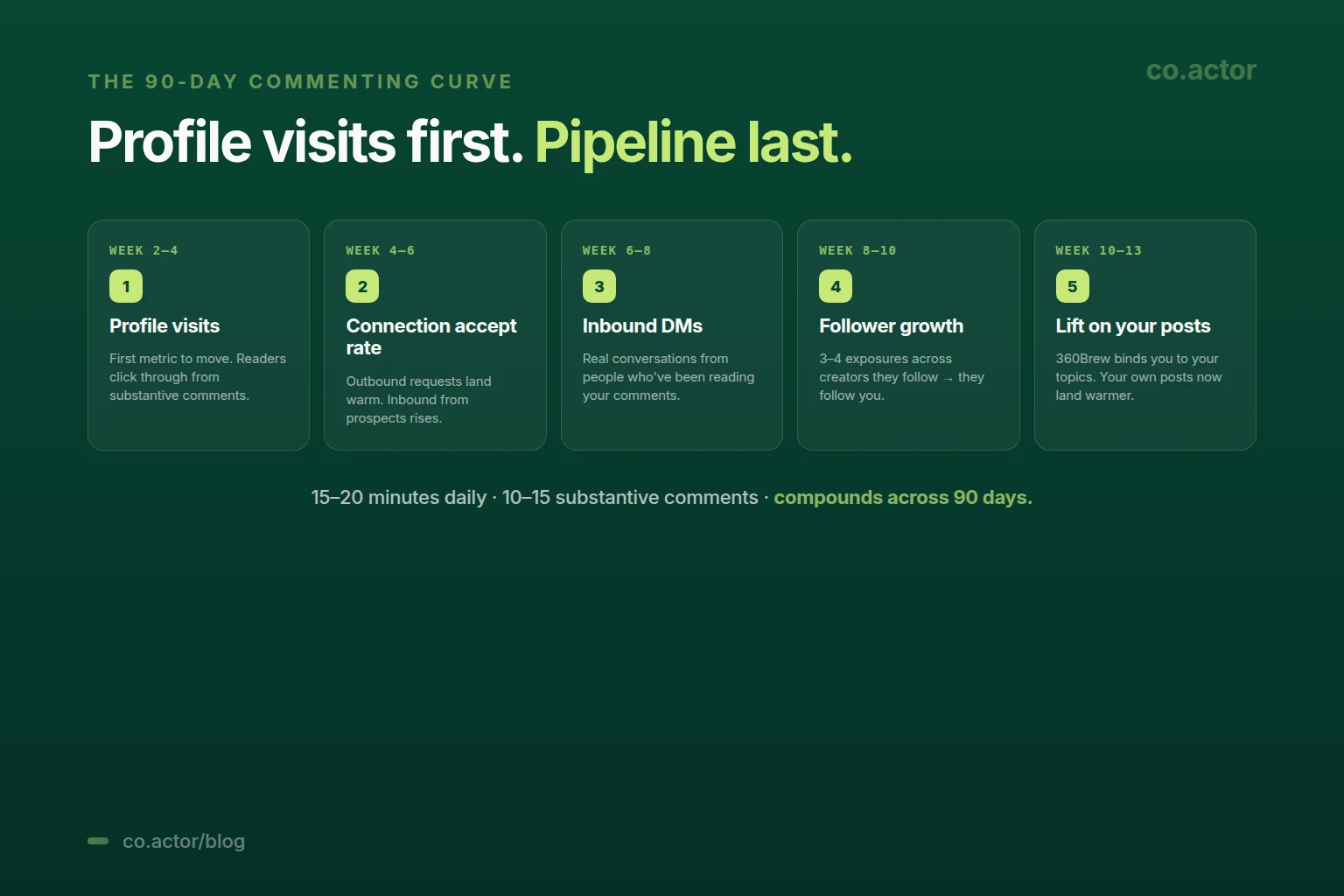
1. Profile visits climb first. Anyone reading your substantive comment is one click from your profile. Practitioners describe profile visits as the first metric that moves — usually within 2-4 weeks of a real commenting routine.
2. Connection acceptance rates rise. A connection request from someone who's been seeing your comments lands warm. The acceptance rate on outbound requests rises. Inbound requests from new prospects rise too.
3. Inbound DMs become part of the picture. Engaged readers go from "saw your comment" to "want to talk to you." This is where commenting starts producing real business outcomes — DMs that aren't pitches but conversations.
4. Followers grow without you posting. After three or four exposures across creators someone follows, they start following you proactively. You haven't written a post — they've decided you're worth following based on the substance you bring to other people's content.
5. Topical authority compounds. Over 60-90 days, 360Brew binds you to your topics. Your future posts get pushed to the audience the algorithm has built around your topical signal — you're not starting from zero on every post.
6. Your own content lands warmer when you do publish. The audience reading your post has often already engaged with you in comments. The engagement curve on your own posts steepens — not because your writing got better, but because the audience knows you.
The order matters: profile visits → connection acceptance → inbound DMs → follower growth → lift on your own content. The compounding curve plays out over 60-90 days, not 60-90 hours.
What Makes a Comment Substantive
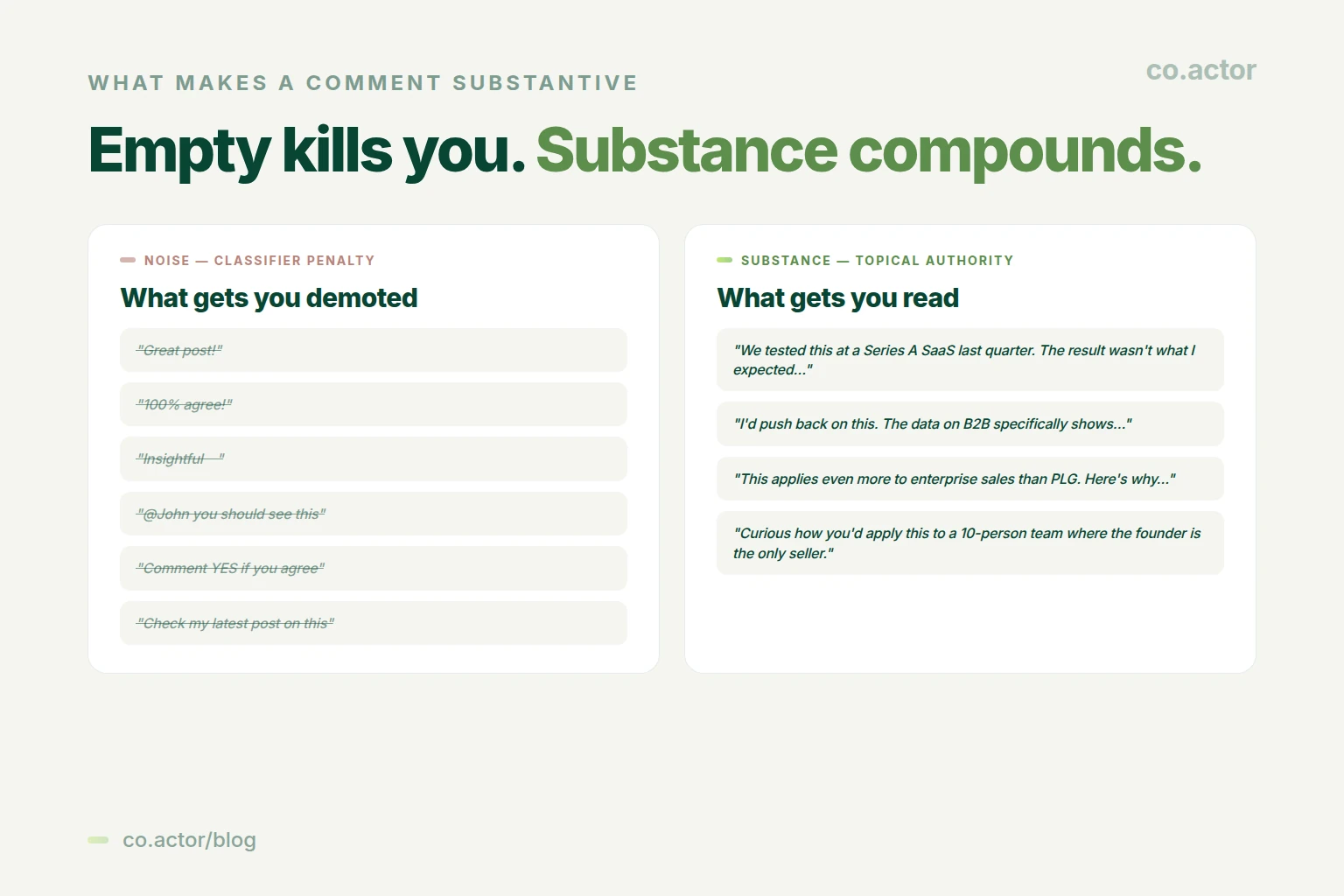
The Quality Classifier penalizes generic comments. The penalty isn't just on the comment — over time it tanks the commenter's overall feed visibility.
What Gets Classified as Noise
- "Great post!" / "100%!" / "Insightful!"
- Tags without context ("@John you should see this")
- Self-promotion ("Check my latest post on this")
- Engagement bait ("Comment YES if you agree")
- AI-generated generic templates (detected via lexical similarity)
What Works
- Personal experience. "We tested this at a Series A SaaS last quarter. The result wasn't what I expected…"
- Counter-perspective. "I'd push back on this. The data on B2B specifically shows…"
- Extended framework. "This applies even more strongly to enterprise sales than PLG. Here's why…"
- Substantive question. "Curious how you'd apply this to a 10-person team where the founder is the only seller."
- Specific example. "Saw this exact mechanic at a Series B fintech. The thing that finally moved the needle was…"
Length is contested in 2026 sources — practitioner estimates range from "15+ words" to "40-120 words sweet spot." The directional principle: longer comments demonstrate engagement depth and provide more semantic signal. Two words carry no information. Two sentences with a specific perspective carry a lot.
The practical rule: write the kind of comment a stranger reading the post would benefit from reading. If your comment doesn't add to the post for someone outside the conversation, it's noise.
Threading Multiplies Your Visibility
LinkHub's 2025-2026 analysis found that when a comment generates four to five replies, the post earns an additional 25-40% reach to second and third-degree connections. The algorithm reads threaded conversation as evidence of high-quality discussion and amplifies accordingly.
Three downstream effects on your profile when you spark a thread:
- The author notices you. Authors remember the people who started genuine conversations on their posts.
- The post gets pushed wider — with you visible at the top. The 25-40% reach boost means more people see the post, and your comment is sitting prominently in the conversation.
- The most engaged readers see you. Comment-section readers are the highest-quality subset of any audience. Your substantive thread is what they're stopping to read.
The mechanic only works if back-and-forth is real. The Coordinated Activity Rings detection in 360Brew catches predictable timing patterns and language similarity. Lempod, the best-known engagement-pod tool, was banned in February 2026. Pod-style coordinated commenting is dead. Genuine threading is more valuable than ever.
Why the First 10-15 Minutes Matter
Comments in the first 60-120 minutes of a post's life carry significantly more weight than comments left later. LinkHub cites a 4-10x multiplier on early comments. DataSlayer's April 2026 analysis: only about 5% of underperforming posts in their first hour ever recover to reach broader audiences.
For your commenting strategy, showing up early on creators' posts produces three compounding effects:
- Your comment is more visible because it's near the top of the comment stack instead of buried under 40 others.
- The algorithm weights your comment more heavily in deciding whether to push the post wider.
- You're more likely to get a reply from the author — they're actively monitoring early engagement.
The practical move: identify the 10-15 creators whose audiences you most want to be visible to. Turn on notifications for their posts. When they fire during your work day, prioritize getting a substantive comment in within the first 15 minutes when you can.
Topic Consistency: The 60-90 Day Window
Multiple 2026 sources converge on the same threshold: consistency on 2-3 topics over 60-90 days is what makes 360Brew start treating you as a credible voice in those topics. Not 3 days. Not 3 weeks. Roughly 90 days.
This applies to commenting as cleanly as it applies to posting. If you spend 90 days leaving substantive comments in a specific niche — sales operations, AI in marketing, B2B founder journey — your topical authority compounds. The algorithm starts treating you as a relevant voice on that topic when distributing other people's content.
The opposite also compounds: 90 days of random commenting across unrelated topics dilutes the signal. The algorithm can't bind you to a niche if your engagement is scattered. You become a generic profile, and your engagement is treated as such.
The implication: choose your topics, then comment within them. The same way you'd choose what to position your profile around, choose where to engage.
The Daily Routine That Works
Most credible 2026 sources converge on a 15-20 minute daily window. That window typically produces 10-15 substantive comments per day. Pushing past that volume manually degrades quality — and the Quality Classifier catches degraded quality faster than degraded volume.
A working routine:
- Build a target list — two layers. 10-15 creators in your niche (whose comment sections matter) + 10-15 specific prospects or future collaborators (whose content you'll engage with directly).
- Show up early when you can. First 10-15 minutes for the highest-priority creators. Notifications on for the most important 10-15.
- Write 10-15 substantive comments per day. Personal experience, counter-take, substantive question, extended framework. 2-5 sentences is a reasonable target.
- Reply when the author responds. Thread depth builds through real back-and-forth. Many of the highest-impact relationships start with a thread that turned into a DM.
- Engage with other commenters too. Replying to fellow commenters creates the multi-person back-and-forth that maximizes the post's distribution boost — and gets you visible to the most engaged subset of the post's audience.
The compounding curve is patience-dependent. Most people who try strategic commenting and stop at week three quit before topical authority stabilizes. Stick with it for 90 days — the inbox shifts.
What Kills Commenting Reach
A short list of what tanks commenting effectiveness in 2026:
- Generic comments at scale. Quality Classifier penalty on your profile, not just the comment.
- AI-generated comment templates. Pattern-matching detection identifies templates by lexical similarity.
- Tagging strangers without context. Reads as spam to the algorithm and to humans.
- Self-promotion in others' comment sections. Detected and demoted.
- Engagement bait language. "Agree?", "Yes/no?", "Tag someone who needs this."
- Pod-style coordinated commenting. Coordinated Activity Rings detection caught it; Lempod banned February 2026.
- Random commenting across unrelated topics. Dilutes the topic-author binding the algorithm builds.
Pattern: the algorithm now reads what you wrote and what your engagement pattern looks like. Tactics that try to game appearance-of-engagement get caught. Substance, alignment, and consistency don't.
A 30-Day Restart Plan
- Pick your 2-3 topics. Same topics you'd post about. Narrower = faster compounding.
- Build the two-layer target list. Creators (audiences you want visibility in) + prospects (specific people you want as customers, collaborators, hires).
- Block 15-20 minutes daily. Same time, same way you'd block writing.
- Write 10-15 substantive comments per day. Use the substance frameworks. Show up early on top creators when you can.
- Track relationships, not just metrics. Note weekly: which authors replied, which prospects engaged, which threads turned into DMs. The relationship pipeline is the real ROI.
- Move warm relationships forward. After 3-4 substantive comments on a prospect's content over 2-3 weeks, a connection request lands warm. After a meaningful thread with an author, a thoughtful continuation DM is welcome.
The ROI is on the 90-day curve, not the next-post curve. Profile views show up first, then connection acceptance, then inbound DMs, then follower growth.
Frequently Asked Questions
Why is commenting more important than posting in 2026?
Because 360Brew reads your comments the same way it reads your posts. Every substantive comment becomes part of your topical signature. A comment also borrows the post author's reach — your engagement is exposed to everyone the post reaches. For most users, 15-20 minutes of substantive commenting compounds more value than the same time spent writing one post.
How many comments should I leave per day?
10 to 15 substantive comments in a focused 15-20 minute window. Pushing past that volume manually degrades quality, and the Quality Classifier catches degraded quality faster than degraded volume.
What makes a comment substantive?
Personal experience, counter-perspective, extended framework, substantive question, or specific example. Length sweet spot: 2-5 sentences. The test: would a stranger reading the post benefit from reading your comment? If yes, post it. If no, don't.
Will the algorithm penalize generic comments?
Yes. The Quality Classifier flags generic comments and tags-without-context, and the penalty applies to your profile, not just the comment. Profiles with consistent low-substance engagement get demoted across the platform.
Do engagement pods still work?
No. Coordinated Activity Rings detection catches timing patterns and language similarity. Lempod was banned February 2026. Genuine threading (real back-and-forth between three or more people) is what the algorithm now amplifies.
How long until results show?
Profile visits in 2-4 weeks. Connection acceptance rate up by weeks 4-6. Inbound DMs by weeks 6-8. Follower growth without posting by weeks 8-10. Lift on your own posts compounds over 60-90 days. Most people quit at week three before the curve bends.
Should I comment on creators or prospects?
Both, with a two-layer target list. 10-15 creators (broad visibility into your niche's audiences) + 10-15 specific prospects (relationship-building that turns into DMs and deals).
Build the Engagement Routine That Compounds
Serge Bulaev is the CEO and founder of Co.Actor, a LinkedIn growth platform for B2B founders and their teams. He writes about content systems, profile positioning, and how the LinkedIn algorithm actually rewards modern creators.
Sources
- arXiv (Jan 2025) — Hamed Firooz et al., 360Brew architecture paper
- Martal Group — outreach conversion analysis (93% lift on engagement-led outreach)
- Sprout Social — LinkedIn algorithm 2026 guide
- Pettauer.net — 360Brew explainer
- LinkHub 2025-2026 — threading boost analysis (25-40% reach lift on threaded comments)
- DataSlayer April 2026 — algorithm changes recap
Related Reading
- LinkedIn Algorithm 2026: What 360Brew Actually Rewards
- LinkedIn Metrics That Actually Matter in 2026: WES, Save Rate, Comment Depth
- LinkedIn Profile Strategy 2026
- The LinkedIn Content Engine: Build a Repeatable System Without Burning Out
- 30 LinkedIn Post Ideas for Founders 2026
- LinkedIn Networking Playbook
Written by
