Two people can post the same amount on LinkedIn and only one of them gets paid. The difference is rarely talent, and it is almost never follower count. One of them knows what is being bought on this platform, and the other is posting into the void hoping something good happens. This article is the full map of how people make money on LinkedIn in 2026, what each path demands, and roughly what it returns.
Plenty is being bought. Companies pay writers to sound like their CEOs. Software firms pay niche experts to mention them once inside a normal post. LinkedIn itself has started paying people for consultations booked straight from their profile, which almost nobody has switched on. Some of the fourteen paths below you can start this month, some need an audience you do not have yet, and every one of them is being done by someone right now.
In this article
- Who pays you on LinkedIn, and who does not
- Group 1: selling your skill
- Group 2: selling access to your audience
- Group 3: selling your own product
- Group 4: getting paid by LinkedIn directly
- So what does this pay?
- Which path should you start with
- What to avoid
- Your action items this week
- Where we sit in this list
Who Pays You on LinkedIn, and Who Does Not
One distinction saves a lot of disappointment later, so it belongs before the list. On YouTube or TikTok, the platform pays you. Views turn into money more or less automatically once you qualify for the programme. LinkedIn has never worked that way and mostly still does not. There is no fund handing out money for a post that did well, no advertising revenue split on your writing, and no tip button.
| Platform | Does it pay creators directly? | Through what |
|---|---|---|
| YouTube | Yes, broadly | Advertising revenue share, memberships |
| TikTok | Yes | Creator rewards, gifts, subscriptions |
| X | Yes | Advertising revenue share, subscriptions, tips |
| Selectively, for a small group | BrandLink video revenue, Advice Sessions, LinkedIn Learning |
What changed in 2026 is that LinkedIn started building a few real payout products. They exist, they move money, and they are small and mostly invite-only. Group four below covers all three of them. For everything else, the model has stayed the same since the platform started.
LinkedIn hands you attention from a very specific, very wealthy audience. Turning that attention into money is your job, and there are about a dozen proven ways to do it.
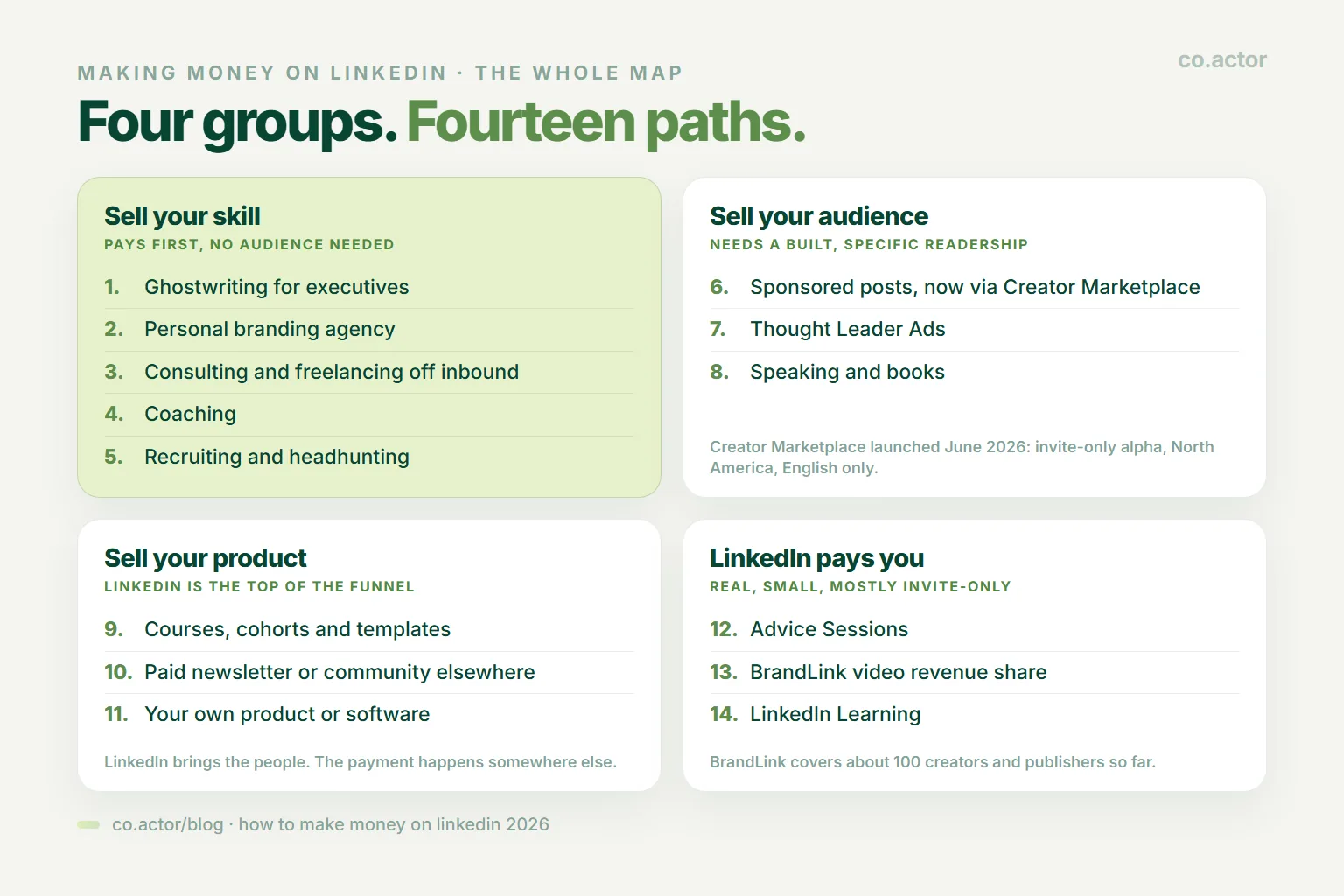
So the fourteen paths sort naturally by what you are selling. You sell your skill, you sell access to your audience, you sell a product of your own, or LinkedIn pays you directly. Everything people call "LinkedIn monetization" sits in one of those four boxes.
Group 1: Selling Your Skill
The biggest and most reliable money on LinkedIn comes from doing work for other people. It is unglamorous and it pays immediately, which is a better combination than it sounds. None of these five paths needs a follower threshold or a monetization product, and none of them needs permission from LinkedIn.
- Ghostwriting for executives. This is the single most common business built on LinkedIn. Founders, CEOs and investors know they should be posting, and most of them will never do it, so they pay someone to write in their voice, usually from recorded interviews. The work is normally sold as a monthly retainer rather than per post, because what the client is buying is consistency. Writers find clients by posting their own content as proof, by referrals, and by approaching executives who already post but clearly hate doing it.
- Running a personal branding agency. The same work with a team behind it. Instead of one writer, the client gets strategy, research on their buyers, a writer, someone handling engagement, and reporting. It is the version that scales past your own hands. This one is our own business, and there is an honest note about that near the end of this article.
- Consulting and freelancing off inbound. The most common path of all, and the one people rarely name as "making money on LinkedIn" even though it is exactly that. You post about what you know, people who need that thing find you, and they hire you. If you are already good at something a business pays for, this is available to you this month. A steady personal brand is what turns those posts into inbound instead of noise.
- Coaching. Career coaches, executive coaches, interview coaches and LinkedIn coaches all run on the same engine: visible expertise attracts people with a problem you solve. It works especially well here because the audience is professionals with money and career anxiety.
- Recruiting and headhunting. An underrated one. A recruiter with a real audience gets inbound from both sides, companies who want to hire and candidates who want to be found. The visibility does the sourcing that recruiters normally pay tools to do.
One honest note about rates in this group. You will find a lot of confident rate cards for ghostwriting online, and there is no verified data behind any of them. Rates swing enormously depending on your experience, how senior the client is, and whether you are only writing or also doing strategy, approvals and engagement. Anyone quoting you a single market rate is guessing, and the section on what this pays goes further into why that matters.
Key Takeaway: Selling a skill is the only group that pays before anyone knows who you are. If you need revenue this quarter rather than next year, start here.
Group 2: Selling Access to Your Audience
Once enough of the right people read you, the audience itself becomes the product. This is the part of LinkedIn that changed most in 2026, because the platform stopped ignoring it and built an official system for it.
- Sponsored posts. Brands pay you to write about them, or to mention them inside your normal content. This has been happening informally for years, and in June 2026 LinkedIn made it official with the Creator Marketplace, a system inside its advertising platform where brands search vetted creators by topic, expertise, audience and how their content performs. Two things are worth knowing. It is currently invite-only, in alpha, limited to North America and to English-language content, so most people cannot get in yet. And LinkedIn does not pay you here. It introduces you, and the fee is negotiated directly between you and the brand.
- Thought Leader Ads. A variation worth knowing about. Instead of paying you to write something new, a brand pays LinkedIn to promote a post you already wrote, with your face and your name on it. Companies do this because a real person's post outperforms a company ad. If you have credibility in a niche, this is a way for brands to pay for it without you writing a word. Our breakdown of paid versus organic covers how those ads sit next to everything else a company can buy.
- Speaking and books. Slower and less predictable, but real. Consistent visibility in a niche leads to conference invitations, paid workshops and publisher interest. One of our clients picked up eight speaking invitations in a year purely from being visible. This is not a business model on its own, and it is a common by-product once the other things are working.
What the fees look like is the question everyone asks. The most cited figure in 2026 is that a creator with 15,000 to 30,000 followers can charge $1,500 to $3,000 per sponsored post. Treat that as a signal rather than a rule. It comes from practitioners quoting their own deals rather than from audited data, and rates in this market are extremely negotiable.
The more useful thing to know is who buys: business software companies, marketing tools, recruiting and HR technology, agencies, and professional services firms. Which explains the strangest thing about money on LinkedIn.
Audience quality beats audience size, by a wide margin. Five thousand engineers who build things is worth more to a developer tools company than fifty thousand random followers. On Instagram you are priced on reach. Here you are priced on who is reading.
Group 3: Selling Your Own Product
In this group LinkedIn is the top of the funnel and the money is made somewhere else. Nobody pays you on the platform at all, which is why these paths get less attention than they deserve.
- Courses, cohorts and templates. You teach what you know, in public, for free, and a fraction of the people who learn from you will pay for the structured version. Cohort courses, workshops, template packs and paid training all run on this. The free teaching is what earns the right to sell the paid version, which is why the people who only post promotions never get anywhere.
- A paid newsletter or community somewhere else. LinkedIn newsletters are free to readers and you cannot paywall them, so people build the audience here and move the paying part off the platform, to a paid newsletter or a private community. LinkedIn has planned paid subscriptions and paywalled newsletters on its roadmap, but that has not launched, so for now the money lives elsewhere.
- Your own product or software. For founders this is the whole point. You post about the problem you solve, the people with that problem show up, and some of them become customers. No sponsorship, no retainer, just customers arriving because they trust the person building the thing. Founder-led content is currently the cheapest customer acquisition in business software, which is exactly why so many founders started posting.
The habit that makes all three work is the same: publishing often enough that people remember what you are known for. That is a production problem more than a creative one, and it is the reason a repeatable content engine matters more than any single viral post.
Group 4: Getting Paid by LinkedIn Directly
Small, new and mostly overlooked. These are the three products where LinkedIn moves money to you rather than introducing you to someone who will.
- Advice Sessions. Experts can offer paid one-on-one consultations booked directly from their profile. Someone reads your post, decides you know something they need, and books a paid session without ever leaving LinkedIn. For consultants and coaches that collapses the entire funnel into a single click, and most people still have no idea it exists.
- BrandLink. LinkedIn shares advertising revenue with creators whose video content carries pre-roll ads, which makes it the closest thing here to a YouTube-style payout. The catch is scale: it currently includes only a hundred or so creators and publishers. It is growing fast, though. BrandLink revenue rose roughly 200 percent in a single quarter, and payouts to creators and publishers more than tripled year over year, according to figures reported by Reuters. A small programme on a steep curve.
- LinkedIn Learning. The oldest payout of all. Instructors earn through course creation, licensing, royalties and affiliate arrangements. It is a real income stream with a real gatekeeper, since you have to be accepted as an instructor before any of it applies to you.
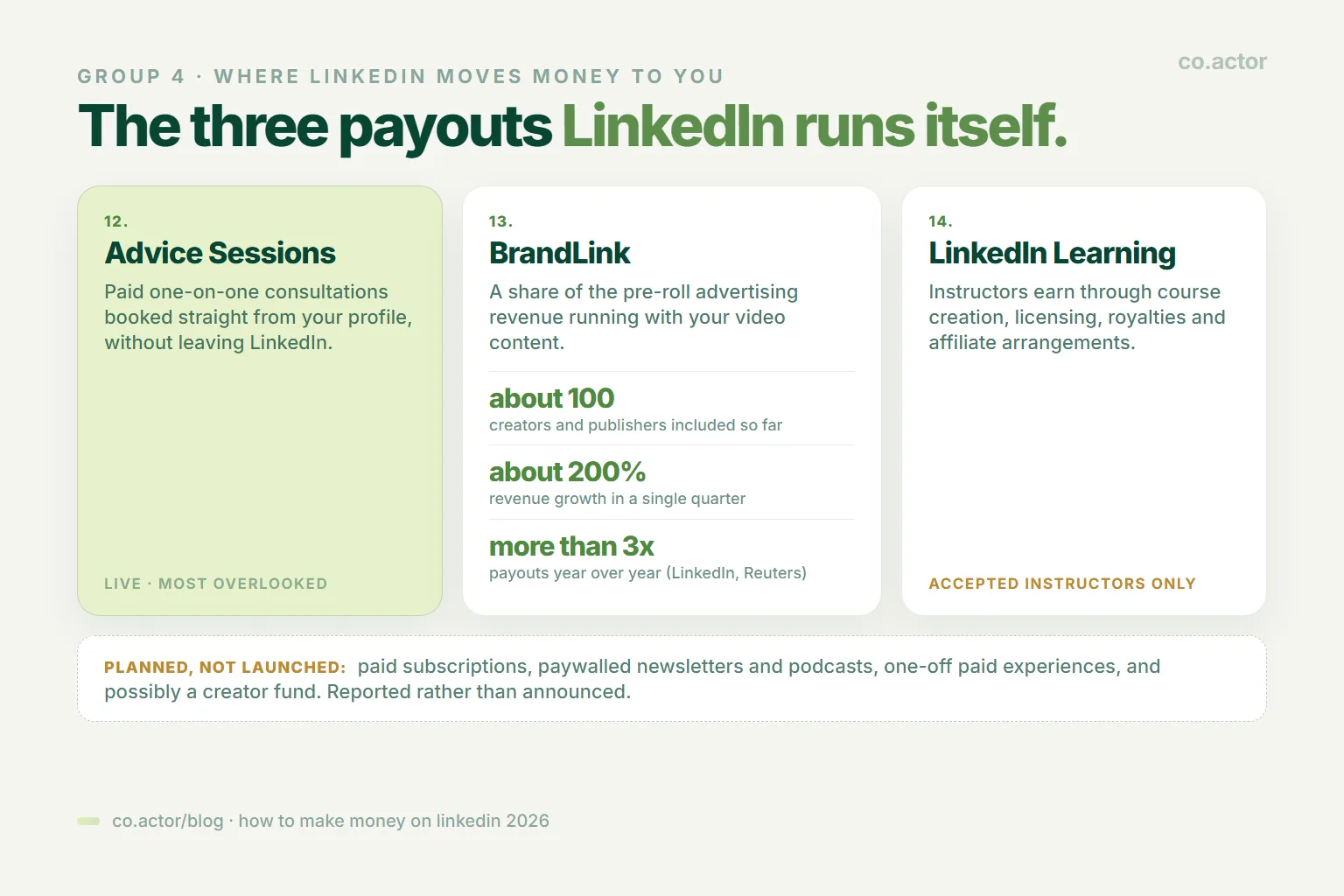
On the roadmap and not launched: paid subscriptions, paywalled newsletters and podcasts, one-off paid experiences, and possibly a creator fund. Those were reported rather than announced, so hold them loosely. The direction is clear enough. LinkedIn is slowly building the payout layer it never had.
Key Takeaway: Advice Sessions is the one to check today. It is live, it pays you directly, and it takes minutes to see whether your account has it.
So What Does This Pay?
This is the point where most articles on the subject start inventing numbers, and we are not going to. The honest answer has two halves, and the difference between them is the most useful thing in this article.
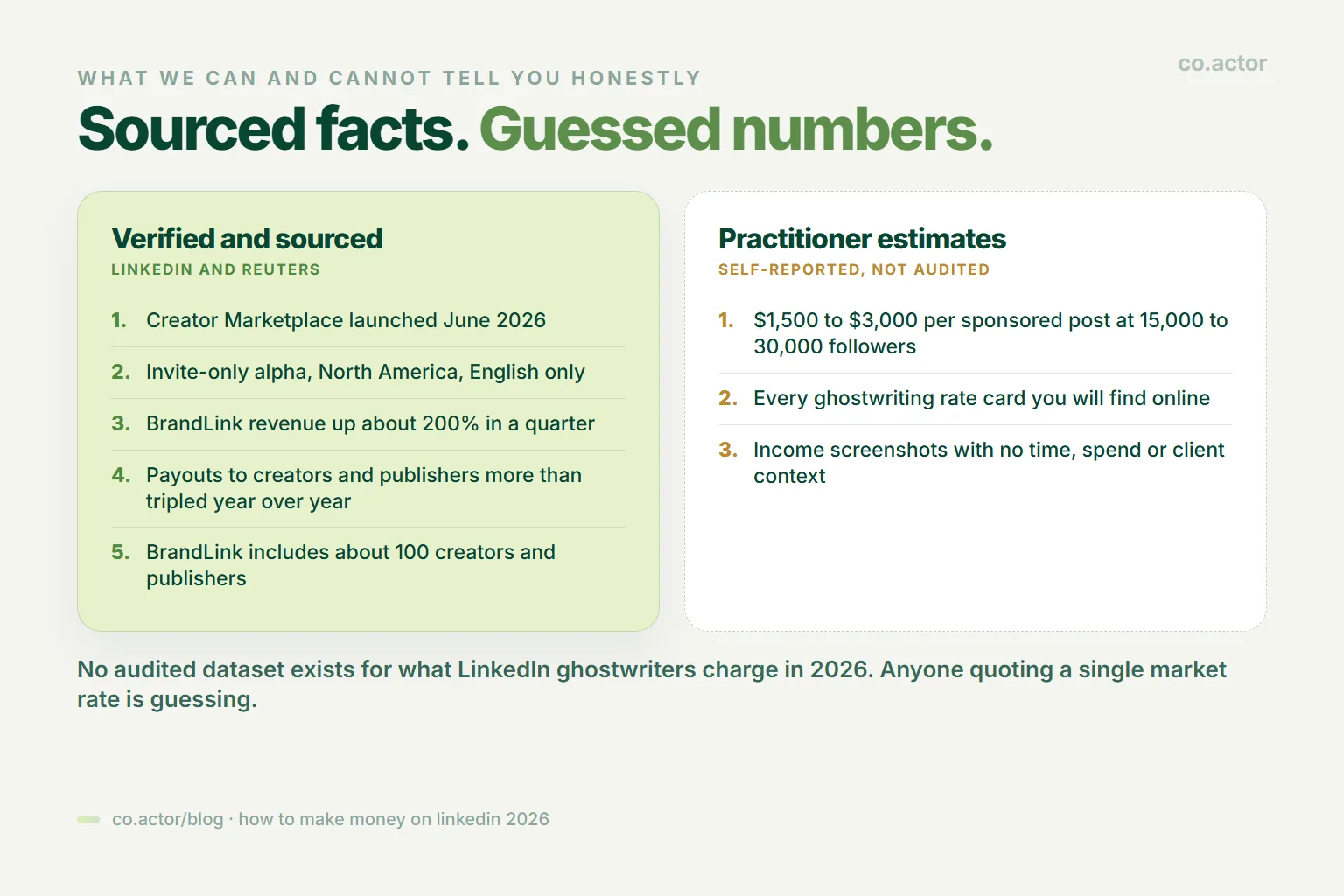
The verified figures are the ones tied to LinkedIn's own products: the Creator Marketplace launch in June 2026 and its alpha limits, BrandLink's growth of roughly 200 percent in a quarter, and payouts to creators and publishers more than tripling year over year. Those come from LinkedIn and from Reuters, and you can check them.
Everything else is practitioner reporting. Every ghostwriting rate and every sponsorship fee you will read anywhere, including the $1,500 to $3,000 figure earlier in this article, comes from people quoting their own results. There is no audited dataset for what LinkedIn ghostwriters charge in 2026. When someone publishes a confident table of rates, they built it from a handful of conversations, or from what they personally charge.
Three things can be said with confidence, and they matter more than any number:
- There is no follower threshold. Nothing unlocks at ten thousand. People with a few thousand engaged followers sell consulting comfortably, and people with eighty thousand passive ones sell nothing. If you want a measure of whether your presence is working, your social selling index tells you more about it than your follower count does.
- Services pay before attention does. Consulting, ghostwriting and coaching can produce revenue in weeks. Sponsorships and native payouts need a built audience, and that takes many months.
- Far fewer people earn here than the volume of posts about earning would suggest. Which brings us to the uncomfortable part.
A large share of the people teaching you how to make money on LinkedIn are making their money from teaching it. Their income is proof that selling a course works, and not proof that the method inside the course works.
That is not true of everyone and it is not always dishonest. But when someone's only demonstrable success is selling the promise of success, it is worth noticing before you hand over money.
Which Path Should You Start With?
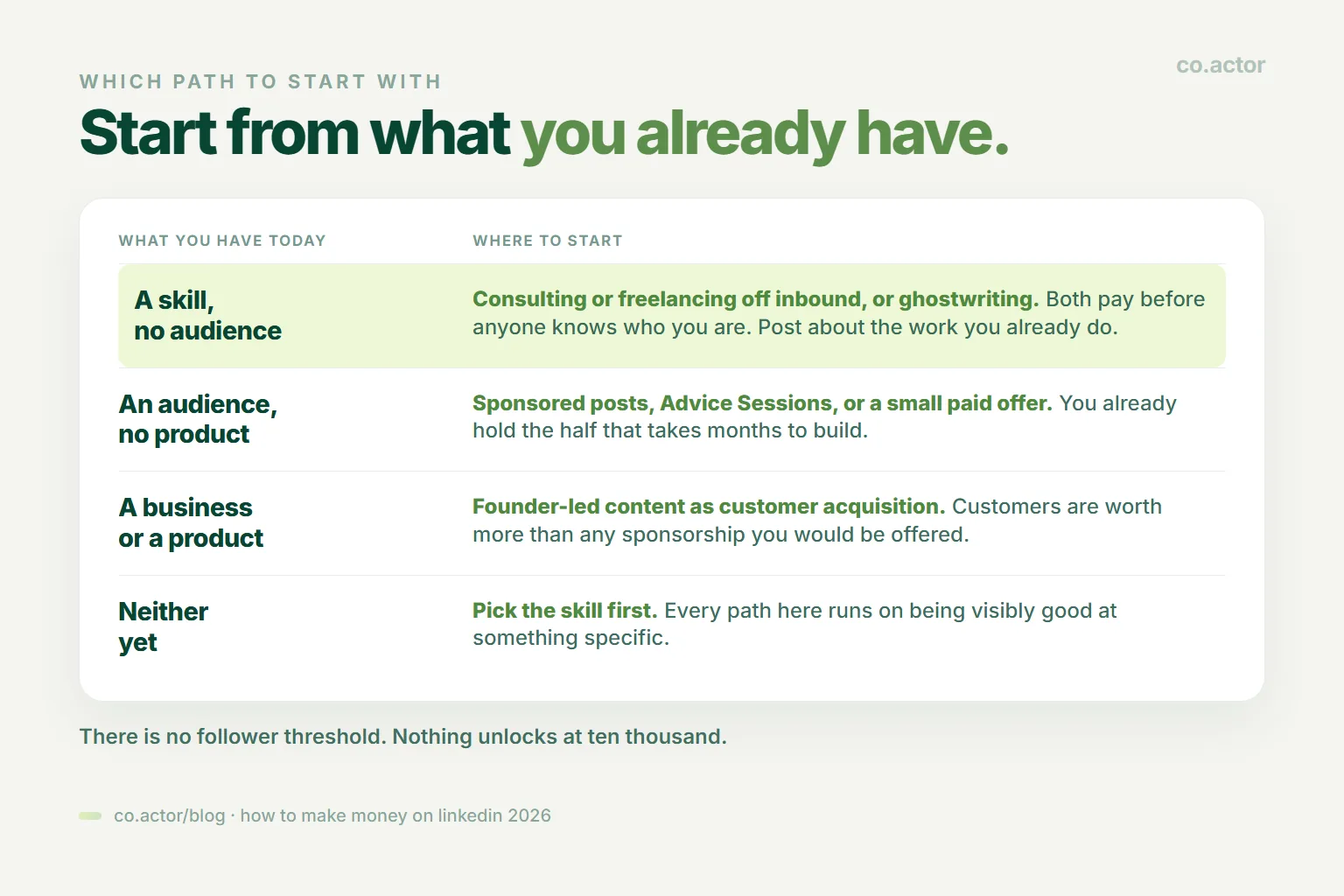
The right path depends on what you already have, not on which one sounds best. Read the four cases below and pick the one that describes you today rather than the one you would like to describe you.
If You Have a Professional Skill but No Audience
Start with consulting or freelance work off inbound, or with ghostwriting if you can write. Both pay before anyone knows who you are, which is the whole advantage of this position. Post about the work you already do and let the first client come from the twelve people who read it. The audience can grow later, on top of revenue that already exists.
If You Have an Audience but No Product
You are sitting on the harder half already, because attention is the part that takes months. Look at sponsored posts, at Advice Sessions, or at building a small paid offer for the people who already read you. The Creator Marketplace is worth watching even while you cannot get in, since the alpha will not stay North America only forever.
If You Have a Business or a Product
Stop thinking about monetizing LinkedIn and use it as customer acquisition instead. Founder-led content brings customers directly, and one good customer is worth more than any sponsorship you would ever be offered. Turning that attention into pipeline is a sales motion of its own, which our social selling guide covers step by step.
If You Have Neither Yet
Pick the skill first. Every path on this list runs on being visibly good at something specific, and there is no shortcut where the audience arrives before the substance does. Choose the thing you want to be known for, get properly good at it, and start posting about the work while you learn.
What to Avoid
Money attracts a predictable set of bad ideas, and all four of these still circulate widely in 2026.
- Engagement pods. Groups that agree to like each other's posts. They inflate the numbers that look like traction and produce none of the demand that pays.
- Bought followers. A number that converts nothing, on a platform that prices you on who is reading rather than how many.
- Automation to riches. Bots blasting connection requests and messages. This one breaks LinkedIn's rules and gets accounts restricted, and we covered LinkedIn automation in full recently.
- Unaudited income claims. Screenshots of revenue with no context about the time it took, the money spent, or the client base behind it.
The pattern behind all four is the same. They optimize the appearance of an audience instead of the trust that makes an audience worth money to anyone.
Your Action Items This Week
- Pick your group. Skill, audience or product. Be honest about which one you have today, because the wrong starting point costs you months.
- Check whether Advice Sessions is available to you. It is the fastest native payout to switch on if you consult or coach, and hardly anyone has looked.
- Write one post about the work you already do for money. Not a lesson, not a hot take, just what you do and who it helps. That single post is how most first clients arrive.
- Ignore the rate cards. Decide what your time is worth and quote that, instead of anchoring to a number a stranger invented.
The people earning well on LinkedIn are not running a secret playbook. They picked something they are good at, said so in public often enough that the right people noticed, and then sold the obvious thing to the people who noticed. The fourteen paths above are just different answers to one question: what are you selling, and to whom. Answer that clearly and most of this gets simple. Leave it vague and you will post for years while wondering why nothing converts.
The money on this platform has never come from posting. It comes from being known for something people already need.
Where We Sit in This List
Full disclosure, since it affects how you should read everything above. Path number two, the personal branding agency, is our own business. We run the agency version for executives who want the audience without becoming a content creator: we rebuild the profile, study their buyers, write three to four posts a week in their real voice, engage the accounts they care about, and hand warm leads to their sales team. It costs the executive around an hour a month.
That means we have a commercial interest in one of the fourteen paths, and you should weigh this article accordingly. It also means the rest of the list is written by people who watch all of it happen in client accounts every week. Both things are true, and you get to decide how much that is worth.
Frequently Asked Questions
Does LinkedIn pay creators for posts?
Broadly, no. There is no creator fund for ordinary posts, no advertising revenue share on your writing, and no tipping. Three narrow exceptions exist in 2026: BrandLink for video, Advice Sessions for paid consultations, and LinkedIn Learning for accepted instructors.
How much do LinkedIn ghostwriters charge in 2026?
No audited dataset exists. Every rate card online was built from a handful of conversations or from what the author personally charges. The work is normally sold as a monthly retainer, and rates vary widely with experience, client seniority and how much strategy is included.
What is the LinkedIn Creator Marketplace?
A system launched in June 2026 inside LinkedIn's advertising platform, where brands search vetted creators by topic, expertise, audience and content performance. It is invite-only, in alpha, North America and English only. LinkedIn makes the introduction; the fee is negotiated between you and the brand.
How many followers do you need to make money on LinkedIn?
There is no threshold. Nothing unlocks at ten thousand. A few thousand engaged followers in a specific niche outsell eighty thousand passive ones, because buyers here price on who is reading.
What are LinkedIn Advice Sessions?
Paid one-on-one consultations that experts can offer directly from their profile, booked without leaving LinkedIn. For consultants and coaches it turns a post into a paid session in one click, and it is one of the few products where LinkedIn pays you directly.
What is BrandLink and how much does it pay?
BrandLink shares advertising revenue with creators whose video carries pre-roll ads. It includes only about a hundred creators and publishers so far. Revenue rose roughly 200 percent in a quarter and payouts more than tripled year over year, per figures reported by Reuters. Per-creator amounts have not been published.
What is the fastest way to start earning on LinkedIn?
Selling a service. Consulting, freelancing, ghostwriting and coaching can produce revenue within weeks, with no audience threshold and no permission needed. Sponsorships and native payouts need a built audience, which takes many months.
Get Known for Something Before You Try to Sell It
Serge Bulaev is the CEO and founder of Co.Actor, a LinkedIn growth platform for B2B founders and their teams. He writes about content systems, profile positioning, and how the LinkedIn algorithm rewards modern creators.
Sources
- LinkedIn Creator Marketplace launch, June 2026: invite-only alpha, North America, English-language content only
- BrandLink revenue up roughly 200% quarter over quarter and payouts to creators and publishers more than tripled year over year, per figures reported by Reuters
- LinkedIn Advice Sessions, Thought Leader Ads and LinkedIn Learning instructor payouts (LinkedIn product documentation)
- Roadmap items reported rather than announced: paid subscriptions, paywalled newsletters and podcasts, one-off paid experiences, a possible creator fund
- Sponsored post and ghostwriting rates: practitioner and vendor estimates, self-reported and not audited
Related Reading
Written by
