Most people on LinkedIn have never seen their Social Selling Index. The LinkedIn SSI score is a 0-100 number LinkedIn calculates for every user, updated daily, free to check, and quietly used by recruiters, sales teams, and the algorithm itself to size up an account.
This guide is short and practical. Three things: what SSI actually measures, what your score means in context, and the link you can click right now to see yours. You can keep this open in another tab while you look at your own dashboard at linkedin.com/sales/ssi.
Key Takeaway — SSI in 60 Seconds
- SSI is a free 0-100 score LinkedIn calculates for every user. No Sales Navigator needed. Updated daily. Four pillars worth 25 points each.
- The four pillars: establish your professional brand, find the right people, engage with insights, and build relationships.
- The global average sits in the mid-30s to low-40s. "Above average" starts around 50, 65-74 is strong, and 75+ is what most 2026 guides call "good."
- Read it as a percentile, not an absolute. The dashboard ranks you against your industry and your network — context matters more than the raw number.
- It's a proxy for activity, not a revenue metric. Treat it as a useful diagnostic, not a leaderboard.
In this article
- What the SSI score actually is
- What SSI measures: the four pillars
- What a good SSI score looks like
- Does SSI actually matter?
- How to improve each pillar
- How to check your SSI in 60 seconds
- Frequently asked questions
What the SSI Score Actually Is
LinkedIn defines SSI as a benchmark for how effectively someone uses the platform for what it calls "social selling." In practice, the score applies to any active LinkedIn user, not just salespeople — the same mechanics that reward a good sales playbook also reward a founder, a job seeker, or a creator.
The important part: it's genuinely free. You don't need Sales Navigator or any subscription to view it. LinkedIn recalculates the number every day from your rolling activity, and it splits into four equal pillars, each worth up to 25 points for a maximum of 100.
What SSI Measures: The Four Pillars
Each pillar is weighted equally. The dashboard shows your component scores, so you can see exactly which one is dragging the total down.
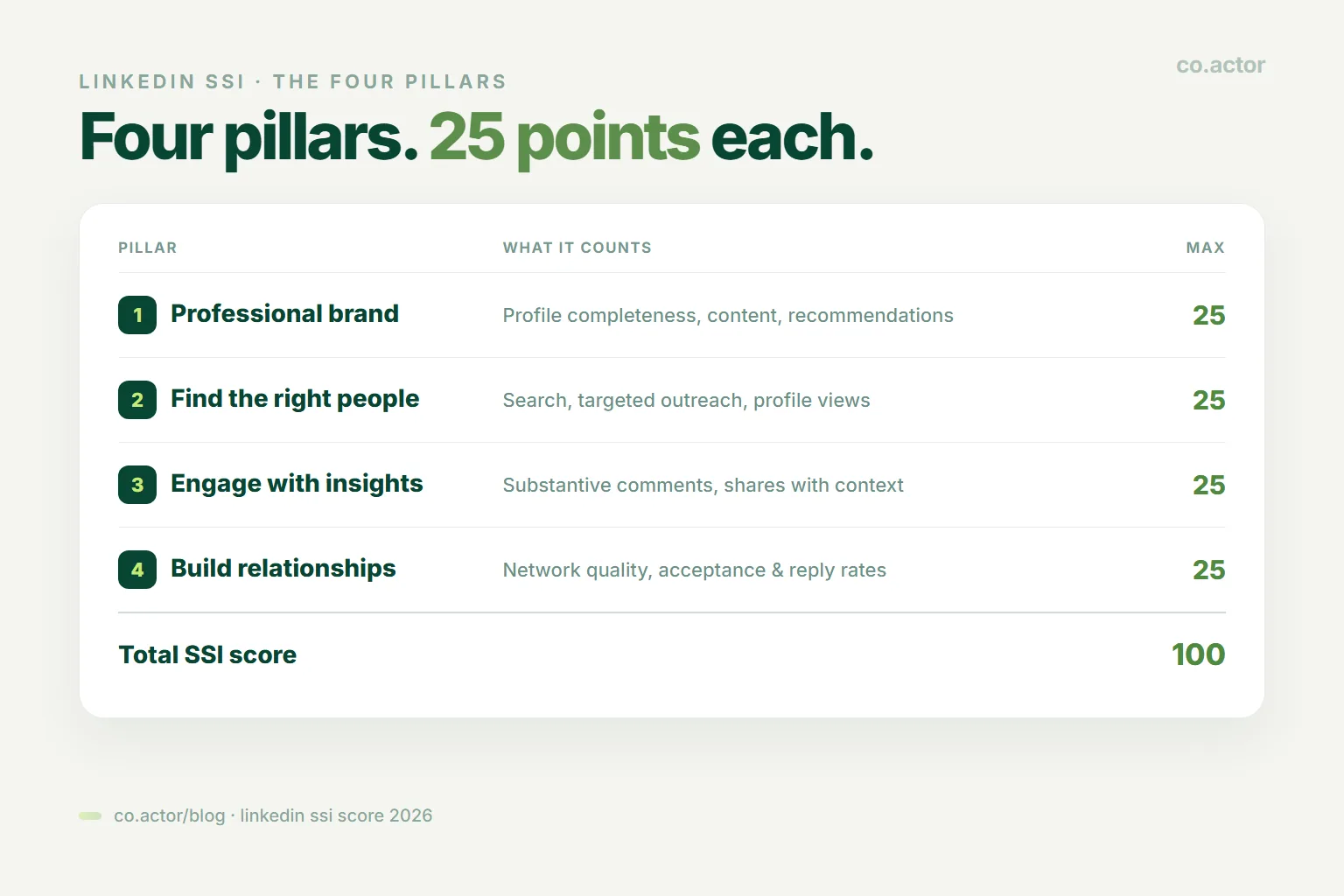
1. Establish your professional brand
How complete, credible, and active your profile is. Your headline, About section, experience, skills, recommendations, and the content you publish all feed this number. Profiles with full sections, real media, endorsements, and a consistent posting cadence score higher — the fundamentals covered in our personal brand guide.
2. Find the right people
How effectively you identify and connect with relevant people. Search usage, profile views, saved searches (for Sales Navigator users), and the ratio of targeted-versus-random connections all influence this pillar. People who use LinkedIn for research and outreach — the habits in our networking playbook — score higher than passive browsers.
3. Engage with insights
How often you like, comment on, and share substantive content. Generic reactions don't move this much. Comments that spark replies, shares with added context, and consistent engagement with industry-relevant content do. This is the pillar most directly tied to commenting — the mechanics are in our commenting strategy.
4. Build relationships
The quality of your network — particularly decision-makers and stakeholders — plus your acceptance rate on connection requests, your reply rate on messages, and ongoing two-way conversations. Sending requests that get accepted moves this. Sending many that get ignored hurts it.
LinkedIn doesn't publish the exact algorithm. What's known is that the four pillars are weighted equally and the score updates daily on rolling activity. Stop engaging for two weeks and you'll see the number drift down.
What a Good SSI Score Looks Like
LinkedIn doesn't officially publish "good" thresholds, but 2026 sales-enablement content converges on a consistent set of bands. Treat these as a directional consensus, not an official standard.
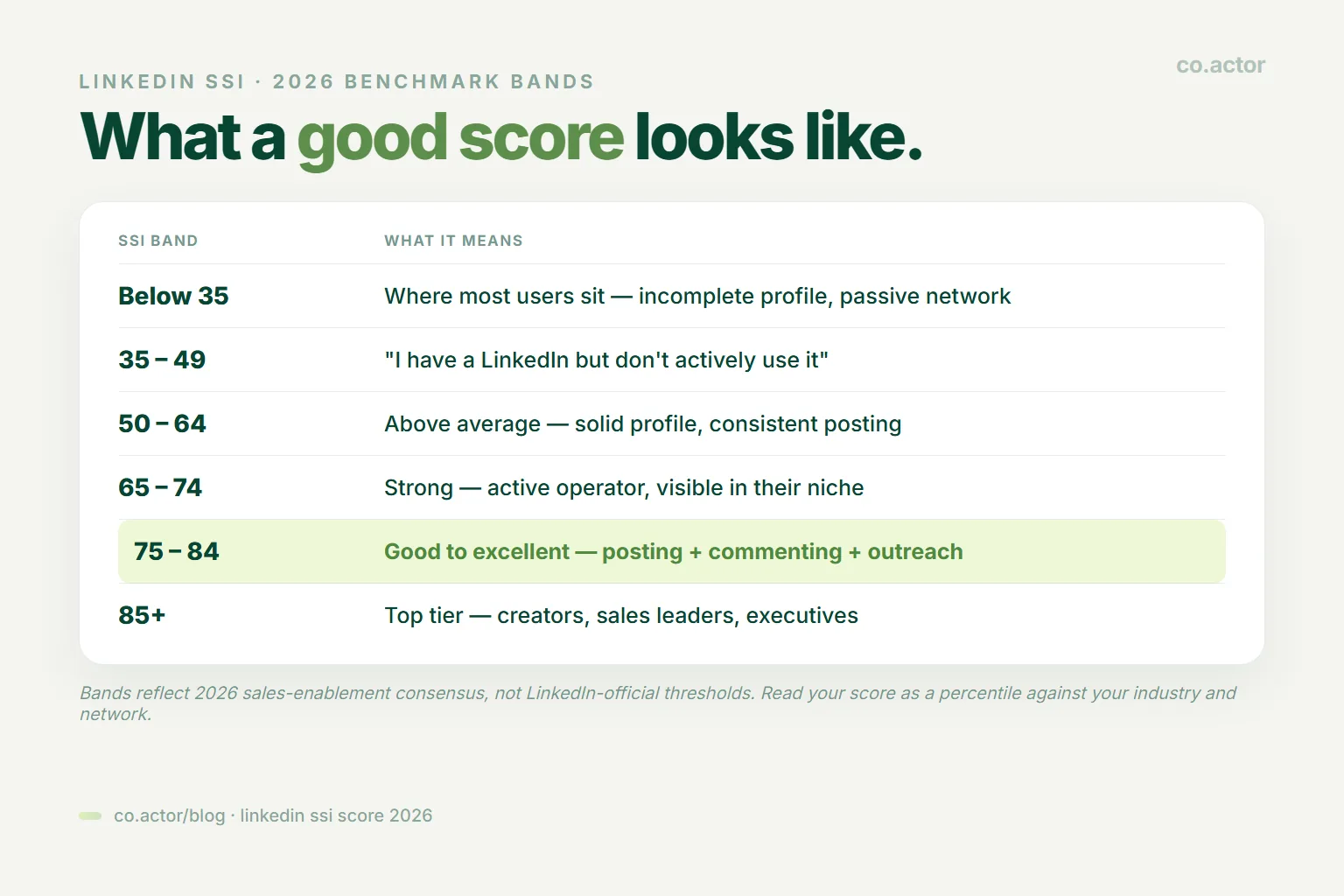
A practical rule beats any absolute number. The dashboard shows your rank against your industry and against your network, so a useful "good" target is being 10-20 points above your industry average, or sitting in the top 20% of your network. This is why SSI is best read as a percentile — a habit worth applying to all your LinkedIn metrics.
Two examples from real dashboards in 2026 show why context matters:
- A founder in Technology, Information and Internet with an SSI of 33 ranks in the top 47% of their industry. The raw score is below average overall, but the percentile is okay because tech professionals as a group are highly active.
- The same SSI of 33 in healthcare or legal would rank significantly higher in percentile — those industries are less active on LinkedIn overall, so the bar is lower.
That's why looking at the percentile under "Industry SSI rank" and "Network SSI rank" matters more than fixating on the raw 0-100 number.
Does SSI Actually Matter?
The honest answer in 2026: it matters, but not the way LinkedIn markets it.
LinkedIn's own marketing has long claimed higher SSI correlates with more sales pipeline — figures like "45% more opportunities" and "51% more likely to hit quota" still get cited in 2026 sales blogs. These come from LinkedIn's internal Sales Navigator analysis. The underlying dataset, methodology, and controls aren't publicly disclosed, so treat them as indicative, not definitive.
Independent 2026 commentary makes a different point: SSI is a good proxy for how actively and professionally you use LinkedIn, which correlates with sales outcomes because active LinkedIn use correlates with sales outcomes. The SSI doesn't cause the pipeline. Both are caused by the underlying behavior.
What this means practically: a high SSI doesn't make you successful on LinkedIn. Sustained activity that produces a high SSI is what makes you successful — and the SSI is just the dashboard reflecting it.
Where SSI is genuinely useful:
- As a diagnostic. If your "Find the right people" pillar is at 7 and the others are at 15+, your problem isn't visibility — it's targeting. The component breakdown tells you what to fix.
- As a benchmark over time. Watching the score move 5-10 points across a quarter as you adjust your routine is more meaningful than the absolute number.
- As a check on consistency. SSI rewards sustained activity. Post hard for two weeks and disappear for two weeks, and the score yo-yos. A steady weekly rhythm makes it climb and hold.
Where it's less useful: as a leaderboard to brag about, as a sole input to your strategy, or as a substitute for outcome metrics like meetings booked, deals closed, and followers gained.
How to Improve Each Pillar
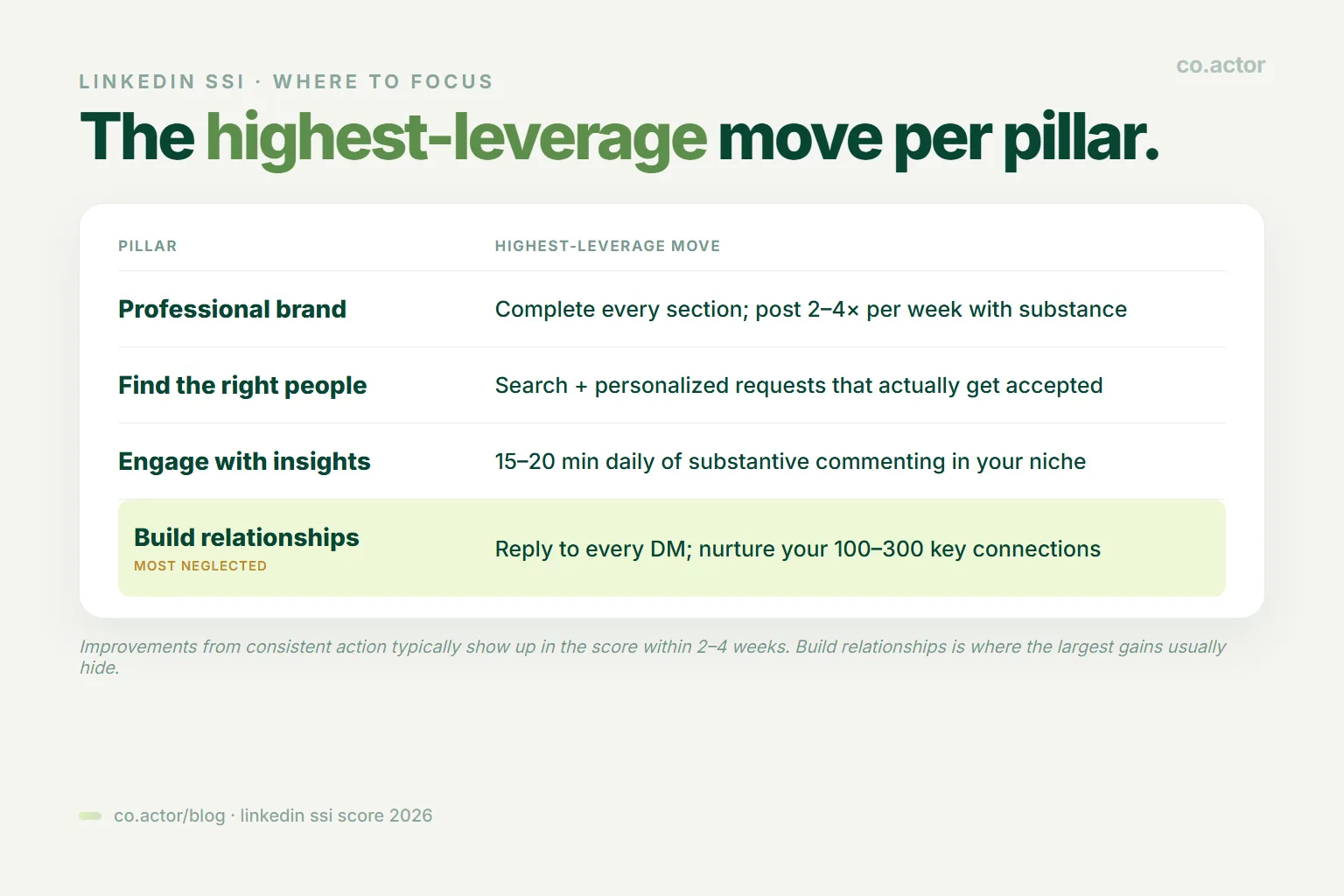
Once you know your component scores, you have a clear focus list. Improvements show up in the score within 2-4 weeks of consistent action.
Establish your professional brand
- Complete every section of your profile — the platform measurably weights completeness.
- Write a headline that names what you do and for whom, not "Visionary leader."
- Keep the About section to 3-5 short paragraphs with a clear one-liner.
- Use the Featured section for your best content, talks, or case studies.
- Post 2-4 times per week with substance — not engagement bait — and mix formats.
- Collect 3-5 recommendations from people you've worked with.
Find the right people
- Use LinkedIn search regularly — filter by title, industry, company size, region.
- View target profiles; this counts as a signal.
- For Sales Navigator users: save leads and accounts, and build lists.
- Send connection requests with short personal notes referencing specific reasons.
- Skip the spray-and-pray approach — high decline rates hurt this pillar.
Engage with insights
- Block 15-20 minutes daily for commenting on others' posts in your niche.
- Comment substantively — multi-sentence, with a specific personal angle.
- Share posts with your own framing, not blank reshares.
- Engage with your target prospects' posts to show up on their radar.
Build relationships
- Reply to every meaningful DM and comment in your conversations.
- Send connection requests that actually get accepted — this requires targeting.
- Follow up on accepted connections with a non-pitch first message.
- Maintain two-way conversations with the most relevant 100-300 connections — what 2026 LinkedIn data calls your "active engagement circle."
The component most people neglect is "Build relationships," because it doesn't feel like content work. It's where the largest gains usually hide.
How to Check Your SSI in 60 Seconds
The link is linkedin.com/sales/ssi. Here's what you'll see when you open it:
- Your current SSI out of 100, with a ring chart broken into four colored segments (one per pillar).
- Your Industry SSI rank — your percentile against people in your industry (e.g., "Top 47%").
- Your Network SSI rank — your percentile against people in your direct network (e.g., "Top 78%").
- The four components of your score — the breakdown showing which pillars are strong and which are weak.
- Your industry and network averages — for context on what's typical.
The page is free to view. You don't need Sales Navigator or any subscription. Open it in another tab, take a screenshot, and save it as a baseline. Check it again in 30 days after you've adjusted your routine — the number tells you whether your changes are working.
The SSI is one of the few honest dashboards LinkedIn gives you for free. It's not the most important metric on the platform, but it's one of the most accessible diagnostics. Open the link, look at your four numbers, and pick the lowest one. That's your next 30 days of work.
Frequently Asked Questions
What is LinkedIn's SSI score?
SSI, or Social Selling Index, is a free 0-100 score LinkedIn calculates for every user, updated daily, to benchmark how effectively they use the platform. It breaks into four pillars worth 25 points each and applies to any active user, not just salespeople.
How do I check my LinkedIn SSI?
Go to linkedin.com/sales/ssi while logged in. It's free and requires no Sales Navigator subscription. You'll see your score out of 100, a ring chart of the four pillars, your industry and network percentile ranks, and the averages for context.
What is a good LinkedIn SSI score in 2026?
LinkedIn doesn't publish official thresholds, but 2026 consensus bands put below 35 as most users, 50-64 as above average, 65-74 as strong, 75-84 as good to excellent, and 85+ as top tier. A better target is 10-20 points above your industry average.
Does a high SSI mean more sales?
Not directly. LinkedIn's "45% more opportunities" and "51% more likely to hit quota" figures are internal and not independently audited. SSI is a proxy for active, professional use — the activity behind the score drives results, not the score itself.
How often does the SSI score update?
Daily, based on rolling activity. It drifts down if you stop engaging for a couple of weeks and climbs and holds with a steady weekly rhythm. Improvements from consistent action usually appear within 2-4 weeks.
Turn the Diagnostic Into a Routine
Serge Bulaev is the CEO and founder of Co.Actor, a LinkedIn growth platform for B2B founders and their teams. He writes about content systems, profile positioning, and how the LinkedIn algorithm actually rewards modern creators.
Sources
- linkedin.com/sales/ssi — LinkedIn's official SSI page and Sales Solutions SSI definition
- HubSpot SSI guide — referenced across 2026 sources for free-access confirmation
- Breakcold 2026 SSI guide — benchmark bands
- 2026 LinkedIn sales-enablement content citing LinkedIn's "45% more opportunities" / "51% more likely to hit quota" claims (LinkedIn-internal, not independently audited)
Related Reading
Written by
