There are only three ways to get people to notice you on LinkedIn. You can pay LinkedIn to show your post as an ad. You can pay a popular person to mention you in their post. Or you can post yourself and earn attention for free.
That's it. Everything else is a version of these three. Most people pick the wrong one for their situation, and either waste money they didn't need to spend, or spend months posting into the void when a small budget would have worked faster.
This is the honest map: what each option really costs in 2026, what you actually get back, and a simple rule to know which one is right for you. No marketing-speak, every number explained in normal words.
Key Takeaway — If You Only Have 60 Seconds
- LinkedIn ads are expensive but they work — for businesses selling to other businesses. One click costs $5–10 (3–5× more than Facebook), but LinkedIn is the only place where that money reliably comes back.
- Paying a creator isn't about their follower count — it's about whether their audience is your kind of people. A good post costs $500–5,000 regardless of how big they are.
- The smartest trick of 2026: take a real person's post and pay to boost it as an ad. People click on a human 3–5× more than on a company.
- Posting yourself is free in money, but slow. It builds the most trust, but takes 6–12 months to really pay off.
- The deciding question is simple: how much do you earn from one customer? If it's small, posting yourself wins. If it's large, paying can be worth it.
In this article
- Option 1 — Pay LinkedIn (expensive, but it works)
- Option 2 — Pay a Person (you're buying trust, not views)
- The 2026 Trick: Thought Leader Ads
- Brand-New in 2026: Collaborative Posts
- Option 3 — Post It Yourself (free, but slow)
- So Which One Should You Pick?
- The One Rule That Settles It
- Your Action Items This Week
- Frequently Asked Questions
Option 1 — Pay LinkedIn (expensive, but it works)
When you run a LinkedIn ad, you pay every time someone clicks, or every time a thousand people see it. Here's what that costs in 2026, based on the latest benchmark data.
- One click: about $5 to $10. On Facebook the same click is closer to $1–2. So yes — LinkedIn is roughly 3 to 5 times more expensive.
- One lead (a real person who fills in their details and says "tell me more"): about $75 to $200.
- Smallest budget to even start: $10 a day technically, but you need more like $25–50 a day for it to mean anything. Below that, you get one or two clicks a day and learn nothing.
So why would anyone pay these prices? Because of one number that nothing else on the internet matches.
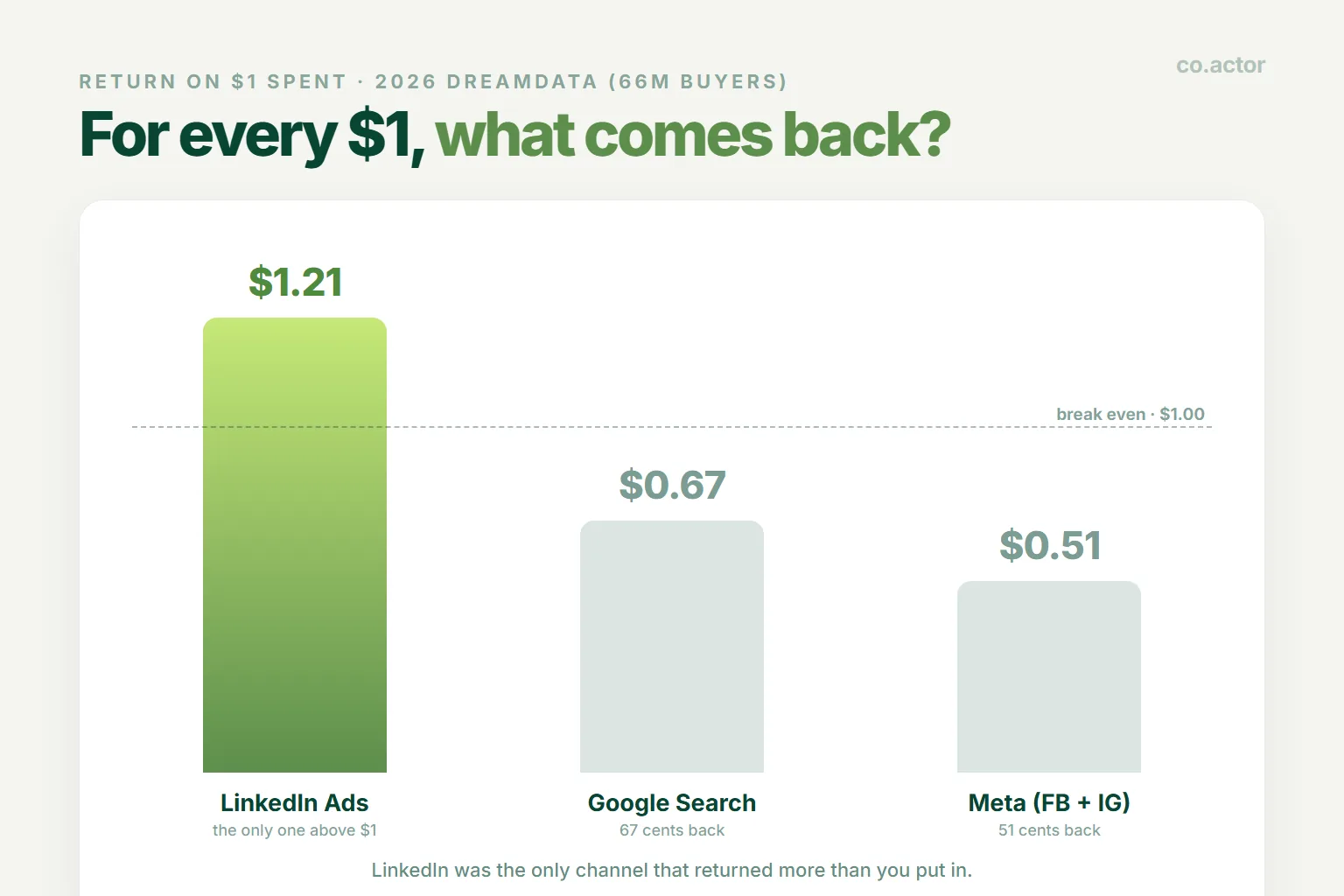
A large 2026 study by Dreamdata tracked 66 million business buyers across the web. It found that for every $1 spent on LinkedIn ads, businesses got about $1.21 back in real sales. The same dollar on Google search returned 67 cents. On Facebook and Instagram, 51 cents.
Read that again: LinkedIn was the only one of the three that gave back more than you put in. That's the whole reason businesses tolerate the high prices. The clicks cost more, but the people clicking are the right people — decision-makers at real companies, found by their job title. That same targeting is what makes LinkedIn a serious channel for social selling.
Who LinkedIn ads work for:
- Businesses that sell to other businesses
- Anything where one customer is worth a lot (thousands of dollars, not twenty)
- People who already know exactly who their customer is
Who wastes money on them:
- Anyone selling something cheap (the ad costs more than your profit)
- Brand-new products still figuring out who the customer is
- Tiny budgets — under ~$1,500 a month you can't gather enough information to improve
- Anyone expecting cheap Facebook-style clicks
The biggest mistake people make: chasing the cheapest leads. The cheap leads almost never buy. The expensive ones — people asking for a demo — are where the actual money comes from. Cheap attention is not the goal. The right attention is.
Option 2 — Pay a Person (you're buying trust, not views)
The second route: find someone with an engaged audience and pay them to post about you. Here's the part most people get wrong. They assume the price depends on follower count. It mostly doesn't.
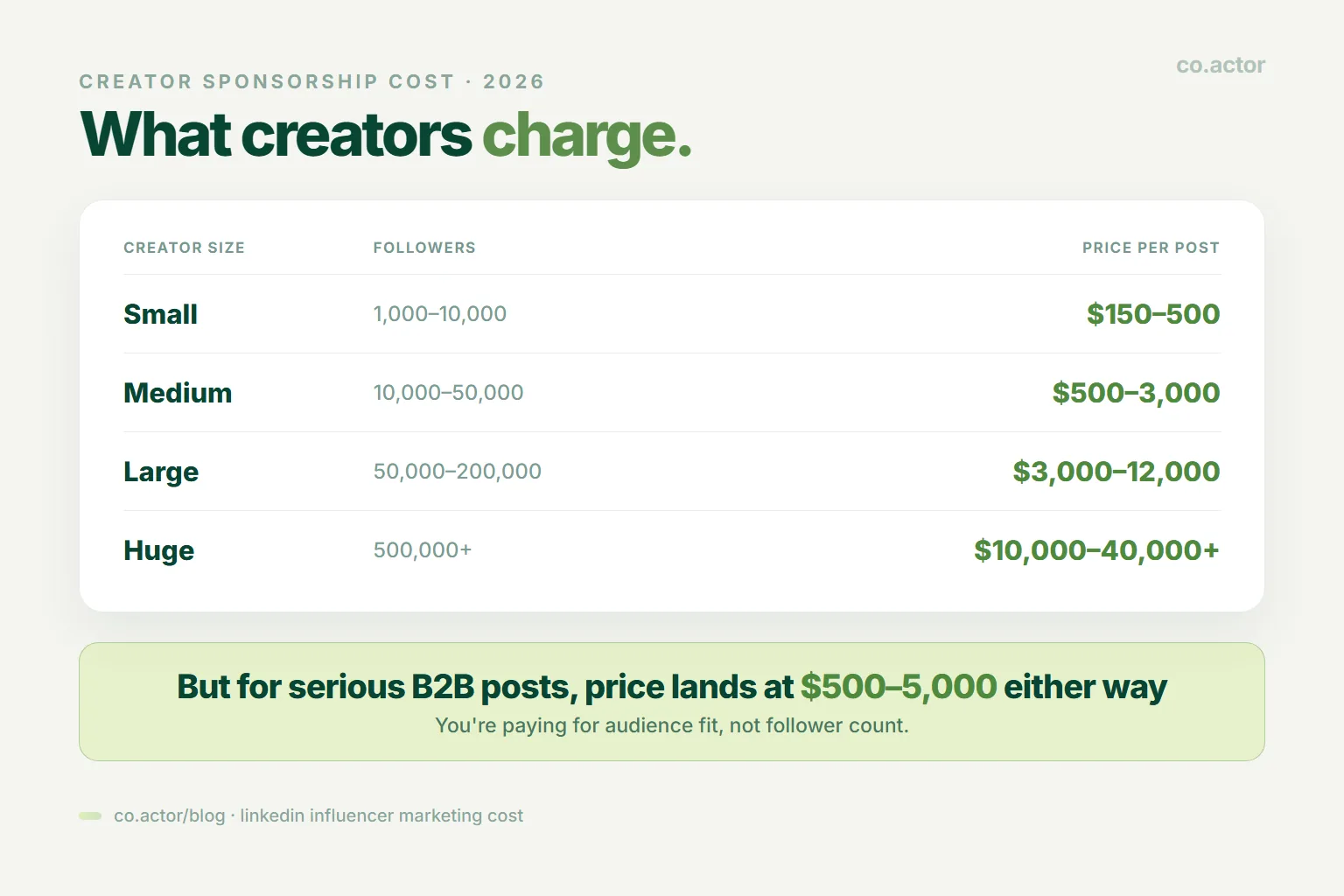
Rough 2026 prices for one sponsored post, from creator rate guides:
- Small creator (1,000–10,000 followers): $150–500
- Medium (10,000–50,000): $500–3,000
- Large (50,000–200,000): $3,000–12,000
- Huge (500,000+): $10,000–40,000+
But here's what the data actually shows: for serious business posts, the price lands around $500–5,000 no matter how big the creator is. Because what you're really paying for is audience fit — whether their followers are the exact people you want to reach.
A creator with 8,000 followers who are all, say, HR managers is worth far more to an HR software company than a creator with 200,000 random followers. Reach is cheap. The right reach is what costs money.
What you're buying isn't views. It's borrowed trust. When a person their audience already respects mentions you, that trust rubs off. People believe a human far more than they believe a company ad. The numbers back this up: posts from creators convert 2 to 4 times better than company ads, and the leads are warmer because they came in trusting you already.
The one big risk: fake or mismatched audiences. Some creators have impressive-looking numbers that come from like-for-like groups, not real fans. Always check who follows them, not how many. If their audience isn't your kind of people, you're buying nothing.
The 2026 Trick: Thought Leader Ads
Now the clever part — and the single biggest shift in LinkedIn marketing this year. You can take a post from a real person (an employee, your CEO, or a creator you paid) and pay LinkedIn to show that personal post as an ad. It keeps the person's name, face, and voice. It just reaches more people. LinkedIn calls these "Thought Leader Ads."
Why does this matter? Look at the difference.
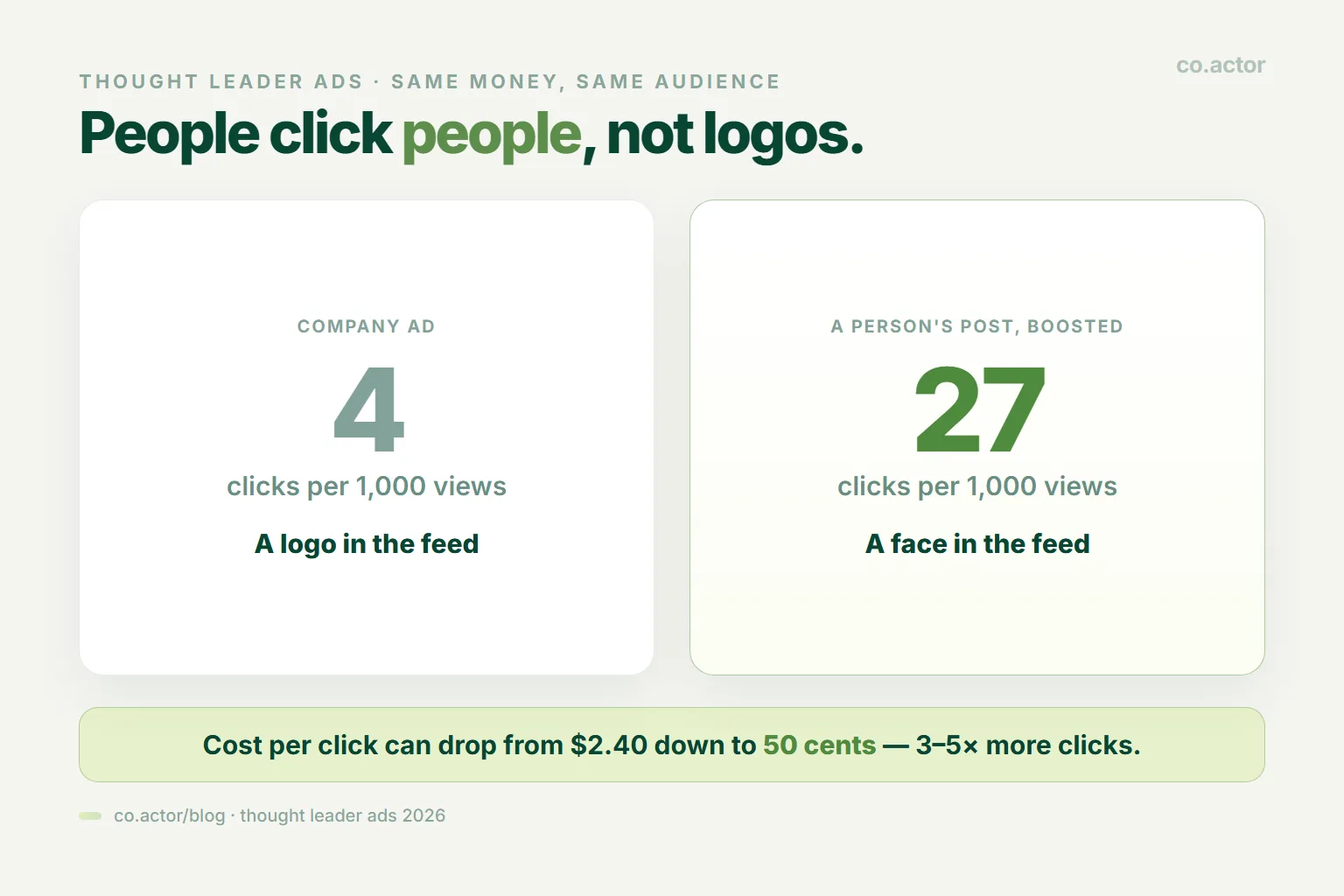
When the exact same content runs as a company ad versus a personal post, using 2026 ad benchmarks:
- Company ad: about 4 people in 1,000 click.
- Personal post boosted as an ad: about 27 people in 1,000 click.
That's not a small edge. It's 3 to 5 times more, sometimes more. And the cost per click drops — in some cases from $2.40 down to 50 cents.
The reason is human and simple: people engage with people, not logos. A face in the feed feels like a colleague. A company ad feels like an ad. This is also why a strong personal brand quietly outperforms a polished company page for most goals.
This is why the hot move in 2026 is a combination: pay a creator (or use your own team) for a genuine post, then pay to boost that exact post. You get the trust of a real voice and the reach of paid advertising at the same time. It beats running a plain company ad, and it beats a creator post that only reaches their own followers.
Brand-New in 2026: Collaborative Posts
There's one more change worth knowing about, because it quietly rewrites how paid partnerships work on LinkedIn.
LinkedIn is rolling out Collaborative Posts — a feature B2B creators have asked for for years. Two accounts co-author a single post, and it lands in both audiences' feeds at the same time. No reshare, no "via," no external link. One post, two names, double the reach.
Three ways people are already using it:
- Brand + creator. A paid partnership becomes native content instead of an obvious ad. The brand is a co-author, and the post reaches both audiences — without the link penalty and without the "this is an ad" feeling.
- Two colleagues. Instead of tagging each other back and forth, you publish one shared piece that hits both follower bases at once.
- Company + leader. Your company page and your CEO's profile put out one post together — no more posting the same thing twice and splitting the attention. (If you're weighing which account to lead with, see our take on personal vs company page.)
It's still in limited testing with a handful of creators, with a wider rollout promised in the coming months. If you pay creators or run brand partnerships, this is the format to watch — it turns a sponsored post into something that doesn't read like one.
Option 3 — Post It Yourself (free, but slow)
The last route costs no ad money at all. You post your own thoughts, consistently, and earn attention the slow way. What it actually costs is time. Three to five posts a week. Replying to comments. Showing up for months before it starts to build up.
What you get is the most trust of any option — and the warmest leads, because people come to you already convinced. For a consultant, coach, founder, or expert, this is often the single best source of customers there is. It just doesn't happen overnight.
Honest timeline:
- First 2–3 months: some likes, a few comments, not much business yet.
- 3–9 months: a real audience forms, DMs start coming in.
- 9–24 months: for many people it becomes their main source of new business — at almost no ongoing cost.
The catch is obvious: it's slow, and it only works if you can actually write something worth reading, regularly. Building a repeatable content engine is what separates the people who stick with it from the people who quietly stop. If you can't commit to that, paid options will serve you better.
So Which One Should You Pick?
Forget the theory. Here's the decision in plain terms, by your situation.
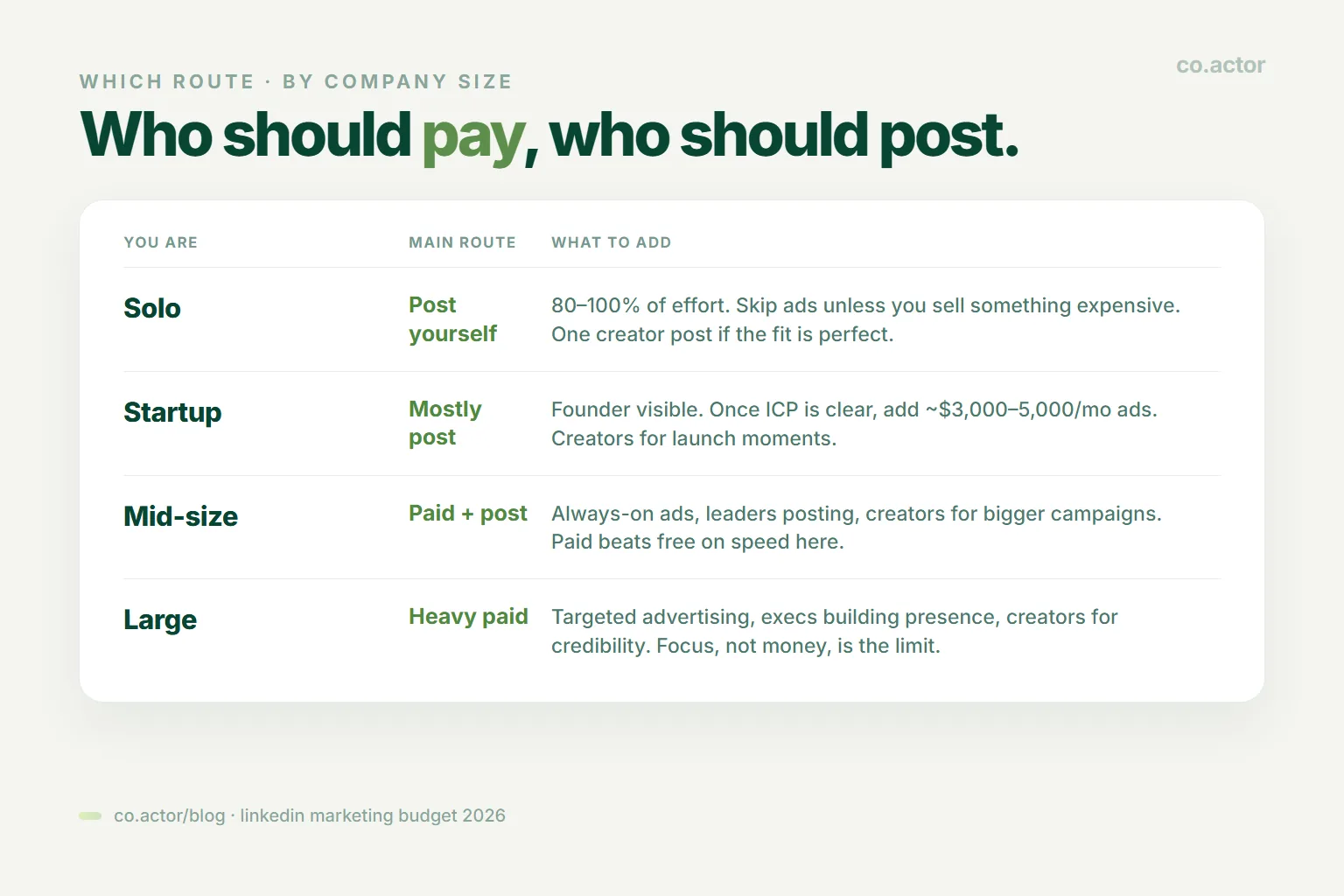
- You're one person — a consultant, coach, freelancer, expert: Post yourself. That's 80–100% of your effort. Skip ads unless you sell something expensive. Maybe try one creator post if you find a perfect-fit audience.
- You're a small startup: Post yourself as the foundation (the founder should be visible). Once you clearly know who your customer is, add a small ad budget — around $3,000–5,000 a month — to speed things up. Use creators for launch moments.
- You're a mid-sized company: Run ads continuously as a real channel, get your leaders posting, and use creators for bigger campaigns. This is where paid genuinely beats free on speed and volume.
- You're a large company: Heavy targeted advertising, executives building personal presence, creators for credibility. Money isn't the limit here — focus is.
The One Rule That Settles It
If you remember nothing else, remember this. Work out how much you earn from one customer.
If a customer is worth a little — say, under a couple thousand dollars over their lifetime — then ads will eat your entire profit. A $150 lead that turns into a $50 sale makes no sense. Post yourself instead.
If a customer is worth a lot — thousands or more — then a $150 lead is cheap, and paying makes sense. Pay, but pair it with real human content.
Paid attention buys you speed. Free attention buys you trust and lower costs over time. The wrong move is paying for speed you don't need, or grinding for trust when a small budget would've worked. Match the tool to your actual situation, not to what everyone else is doing. Whichever route you pick, the right tools make staying consistent far less painful.
One honest note on the numbers
Your Action Items This Week
- Do the one-customer math. How much is a single customer worth to you? Write down the number. It decides everything else.
- Pick your main route based on that number — post yourself if a customer's worth little, consider paying if it's worth a lot.
- If you're going to pay, start with a person, not a logo. Boost a real post from a real human before you ever run a plain company ad.
- If you're going free, commit to 3 posts a week for 90 days before you judge whether it's working. Anything less isn't a fair test.
Don't pay for reach you could earn — and don't grind for trust when a little money would move faster. Run the one-customer math first, and let that number tell you which road to take.
Frequently Asked Questions
Are LinkedIn ads worth it in 2026?
For B2B, yes. A click costs $5–10 (3–5× more than Facebook), but a 2026 Dreamdata study of 66 million buyers found LinkedIn returned $1.21 for every $1 spent, versus 67 cents on Google and 51 cents on Meta. Ads waste money if you sell something cheap, don't yet know your customer, or spend under ~$1,500 a month.
How much do LinkedIn ads cost in 2026?
About $5–10 per click and $75–200 per lead. The platform minimum is $10 a day, but you realistically need $25–50 a day, and under ~$1,500 a month you can't gather enough data to improve. These are ranges, not guarantees.
How much does a LinkedIn influencer post cost?
Rough 2026 rates: $150–500 (1K–10K followers), $500–3,000 (10K–50K), $3,000–12,000 (50K–200K), $10,000–40,000+ (500K+). For serious business posts the price lands around $500–5,000 regardless of size, because you're paying for audience fit, not follower count.
What are Thought Leader Ads on LinkedIn?
They let you boost a real person's organic post as an ad, keeping their name, face, and voice. People click humans more than logos: in 2026 benchmarks a company ad gets ~4 clicks per 1,000 views versus ~27 for a personal post, and cost per click can drop from $2.40 to about 50 cents.
Should I pay for LinkedIn reach or just post myself?
Work out how much one customer is worth. If it's small, ads eat your profit — post yourself. If it's large, a $150 lead is cheap, so pay, ideally paired with human content. Posting yourself is free but slow (6–12 months) and builds the most trust; paid buys speed.
Doing It Yourself, Without Burning Out
Serge Bulaev is the CEO and founder of Co.Actor, a LinkedIn growth platform for B2B founders and their teams. He writes about content systems, profile positioning, and how the LinkedIn algorithm actually rewards modern creators.
Sources
- Dreamdata 2026 — LinkedIn Ads Benchmarks Report (66M B2B sessions; 121% ROAS vs Google 67%, Meta 51%)
- FoundryCRO 2026 — LinkedIn Ads Benchmarks by Industry (CPC, CPL, company-vs-personal click rates)
- Influencer Marketing Hub — LinkedIn influencer marketing rate guides (creator pricing tiers)
- ZenABM 2026 — LinkedIn ad CTR by format (Thought Leader Ads highest)
- LinkedIn — Thought Leader Ads and Collaborative Posts product documentation and rollout notes
Note: many creator-marketing ROI figures are vendor-reported and indicative rather than independently audited. The Dreamdata ROAS and format-level click benchmarks are the most defensible hard numbers.
Related Reading
Written by
