For years, co-authoring on LinkedIn was a workaround. You tagged a partner in the copy. You wrote "posting on behalf of." You and a teammate published two near-identical posts and hoped both got picked up. It never looked like a real collaboration, because it never was one — just two solo posts sitting next to each other.
That is changing. LinkedIn has started rolling out Collaborative Posts: a native way for more than one account to publish a single post under a shared byline. On a network where your name beside a brand or a colleague carries real professional weight, a shared byline reads as an endorsement — not a duet. For teams building personal brands at scale, that is a new lever worth understanding before it reaches everyone.
TL;DR — In Five Bullets
- One post, multiple bylines, combined reach. Two or more profiles and Pages co-publish the same native post to all their networks at once.
- It runs on invite-and-accept. One person drafts, adds collaborators, and the post goes live only after each one confirms — much like Instagram's Collab feature.
- Three plays fit teams: brand + creator co-marketing, two peers cross-promoting, and a company Page + an executive's profile.
- It amplifies, it doesn't manufacture. Best for creators with an established following, agencies pitching brands, and companies with executives who already post.
- It's in beta. Limited testing with creators and brands, first shown at Cannes Lions 2026, wider rollout expected over the coming months. Use the gap to prepare.
In This Article
- What a Collaborative Post actually is
- How the invite-and-accept flow works
- Three ways teams use a shared byline
- Who should move first
- Collaborative Posts vs. Collaborative Articles
- How to prepare before the rollout
- Where a shared byline fits your content system
- Frequently asked questions
What a Collaborative Post Actually Is
A LinkedIn Collaborative Post lets two or more accounts — individual profiles and company Pages — publish the same post together, with every collaborator's name shown at the top. Instead of landing in one author's network, it reaches all of the collaborators' networks at the same time.
Instagram has had a version of this for years. LinkedIn is the platform where a shared byline means something different, though: your name next to a company or a respected peer is a professional signal, not just a tag. One post, multiple names, combined reach — that is the whole idea.
Key Takeaway
How the Invite-and-Accept Flow Works
The mechanic is simple and, importantly, consensual. One person builds the post in the normal composer, opens the "Add Collaborators" option, and invites the people or Pages they want on it. Once each collaborator accepts, the post publishes across all of their profiles simultaneously.
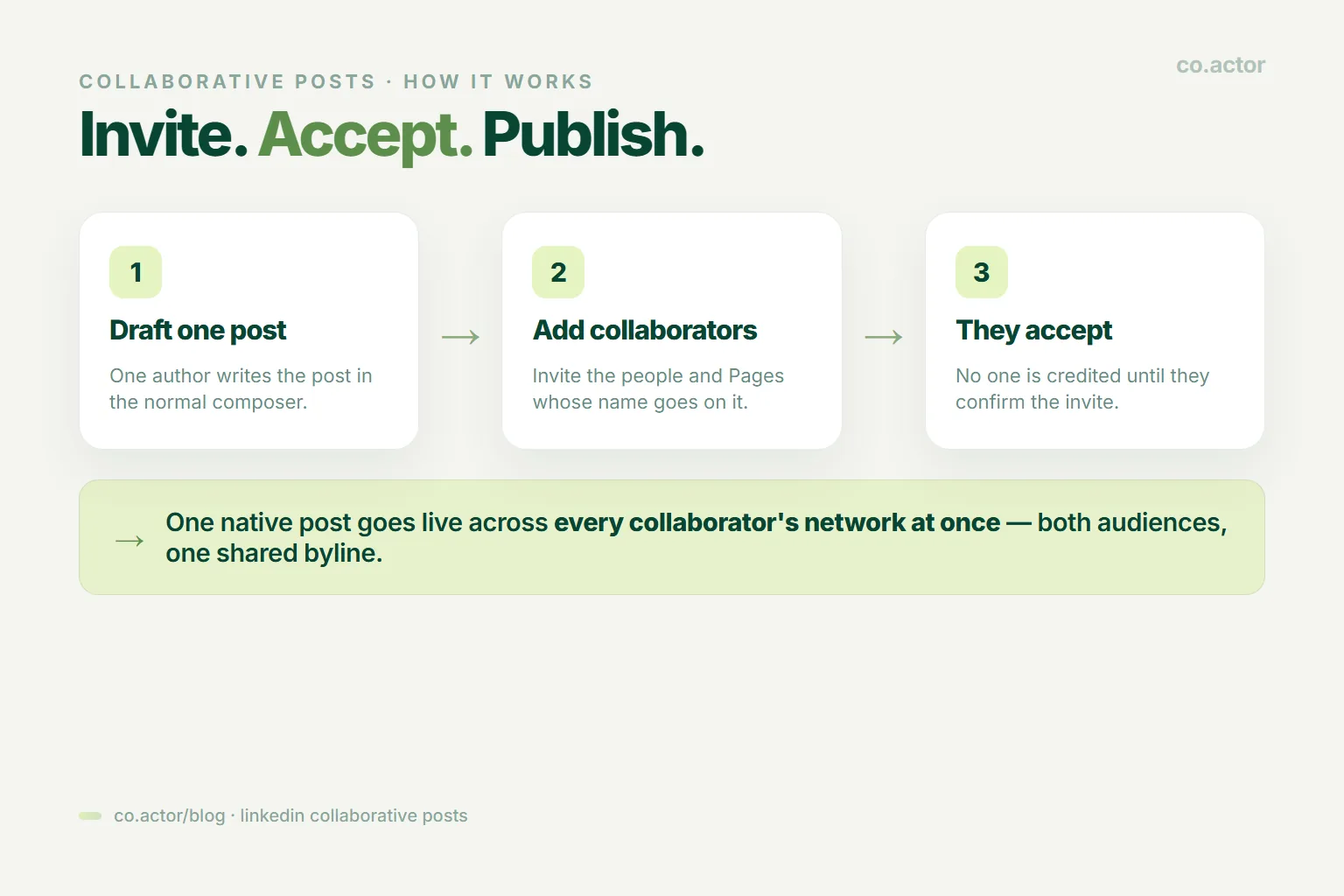
Two details matter here. First, nobody is credited until they accept — the same invite-and-accept model Instagram's Collab feature uses, so no one wakes up co-signing content they never saw. Second, for a company Page to appear as a collaborator, a Page admin has to enable collaboration and accept the invite. That admin step is worth flagging to whoever manages your content engine now, so it isn't a scramble later.
Three Ways Teams Use a Shared Byline
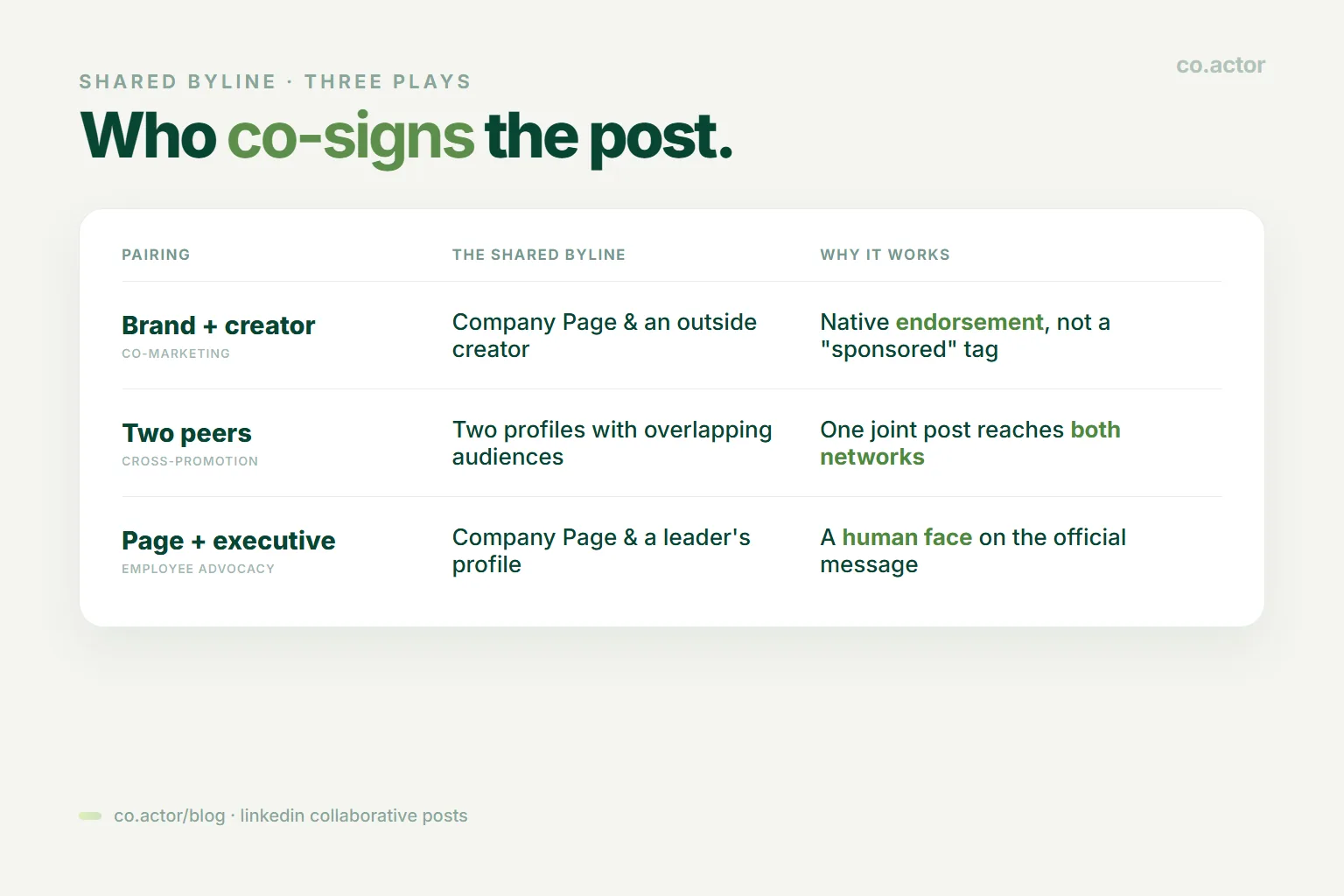
A shared byline isn't one tactic — it's a mechanism that fits at least three common team situations.
Brand + Creator Co-Marketing
A company Page and an outside creator co-author a single post, and it reaches both audiences as native content — not an external link, not a "sponsored by" line buried in the copy. Picture a consultant partnering with a product company on a launch: instead of the consultant posting and tagging the brand, the post carries both names at the top and shows up in front of the brand's whole follower base as a genuine collaboration. The brand borrows human credibility; the creator borrows reach. Both reputations are in it together.
Two Peers Cross-Promoting
Two people with overlapping but not identical audiences can replace the old "we tagged each other" routine with one joint post. Launching a report with another operator in your space? A single collaborative post puts it in front of both networks, from someone each audience already follows. The post is structurally shared from the start — there's no hoping a tag survives the feed.
Company Page + Executive
This is where a lot of B2B teams quietly struggle. The corporate account posts the official announcement; the CEO posts a personal take; now two versions of the same news compete in the feed and split the reach. With a collaborative post, the company Page and the executive's profile co-publish the same post. The announcement gets a human face at the top instead of a logo — and you stop diluting reach by publishing the news twice. For teams already running executive profiles, this connects personal credibility to the official message without cannibalizing either.
Who Should Move First
Not everyone needs to rush, but a few groups have the most to gain early.
- Creators with an established following. Once you have real audience, lending it to a partner — and borrowing theirs — meaningfully moves numbers. The bigger and more engaged your network, the more a shared byline is worth to whoever you invite.
- Agencies pitching brands. "We can co-author native posts with your executives" is a sharper offer than "we'll manage your page." A shared byline turns an advocacy program into something visible in the feed.
- Companies with active executive profiles. If your leaders already post, you've done the hard part. Collaborative posts finally let you tie that personal credibility to the official message.
The honest caveat: if your executives don't post and your following is thin, this feature won't fix that. It amplifies what's already working — it doesn't manufacture an audience out of nothing. Build the personal brand first; the shared byline compounds it.
Collaborative Posts vs. Collaborative Articles
Quick clarification, because the names collide. Collaborative Articles were the AI-prompted, skill-based explainers that invited the wider community to add their own perspectives — LinkedIn has since wound down new contributions to them. Collaborative Posts are ordinary feed posts co-authored by specific people and Pages you choose, with each collaborator credited at the top. Different feature, different purpose. If someone on your team conflates the two, that's the distinction.
How to Prepare Before the Rollout
The feature is in beta with a limited group of creators and brands, with early access first shown at Cannes Lions 2026 and broader access expected over the coming months. That gap is your prep window. A few things worth lining up:
- Build your co-author shortlist. Make an actual list of the creators, brands, and Pages whose name you'd want next to yours. Be specific — not "people in my industry," but names. When the feature reaches your account, you don't want to be scrambling for who to ask.
- Tidy your front door. A collaborative post sends a partner's audience to your profile. Check that your headline, banner, and recent posts say what you want them to. First impressions from someone else's network are ones you don't get back. Our networking playbook covers what a strong profile signals.
- Have something worth co-signing. The feature adds reach; it does not make weak content good. Save your strongest ideas — the launch, the data, the genuinely useful breakdown — for the partnerships that matter. A mediocre post with two names on it is still a mediocre post, just seen by more people.
- Pitch the collaboration, not the feature. When you approach a co-author, don't lead with "LinkedIn has this new thing." Lead with the shared idea: the joint report, the event recap, the launch you can both stand behind. The feature is the mechanism; the reason to say yes is the content. If you're short on angles, our post ideas for founders are a good starting point.
Where a Shared Byline Fits Your Content System
A collaborative post is a spike, and spikes only matter on top of a steady rhythm. The teams that will get the most out of this feature aren't the ones who fire off one flashy collab and go quiet. They're the ones with a consistent presence — regular posts, multiple profiles working in sync, a clear read on what's landing — so that when the collab moment arrives, they're inviting partners to something with momentum.
That steady layer is exactly what a team content system is for. Keep your founders and employees posting consistently, coordinate personal profiles and the company Page from one place, and the shared byline becomes a multiplier on a machine that's already running — not a one-off event you scramble to stage. Collaborative Posts are coming. Build the foundation now, so you're ready to make them count.
Frequently Asked Questions
What are LinkedIn Collaborative Posts?
A native feature that lets two or more accounts — profiles and company Pages — publish one shared post, with every collaborator's name at the top. It reaches all of their networks at once, and runs on an invite-and-accept flow similar to Instagram's Collab feature.
How do you create a Collaborative Post?
Draft the post as usual, open "Add Collaborators," and invite the people or Pages you want. Once each accepts, it publishes across all of their profiles at the same time. No one is shown as a collaborator until they accept.
Can a company Page co-author with a person?
Yes. Both members and Pages can be invited. For a Page to appear, a Page admin has to enable collaboration and accept the invite — which is what makes the Page-plus-executive play possible.
How is this different from Collaborative Articles?
Collaborative Articles were AI-prompted, community-contributed explainers that LinkedIn has wound down. Collaborative Posts are normal feed posts co-authored by specific people and Pages you choose. Different feature entirely.
When will it be available to everyone?
It's in beta with a limited group of creators and brands, first shown at Cannes Lions 2026, with a wider rollout expected over the coming months. Exact availability and interface may still change.
Build the Rhythm a Shared Byline Sits On
Serge Bulaev is the CEO and founder of Co.Actor, a LinkedIn growth platform for B2B founders and their teams. He writes about content systems, profile positioning, and how the LinkedIn algorithm actually rewards modern creators. Feature details here are based on LinkedIn's announcements and reporting as of mid-2026; Collaborative Posts are in limited testing, so exact availability and UI may change as the rollout widens.
Related Reading
Written by
