If you stopped writing LinkedIn articles around 2024, you weren't alone. The whole content world watched LinkedIn Pulse lose roughly 85% of its Google search traffic between March 2024 and March 2026. The "publish to LinkedIn for SEO" playbook collapsed. Most people quietly retired their drafts and moved on.
That was the right reaction to one set of facts. It's the wrong reaction to the full picture in 2026. Articles still rank in Google — just differently. AI search engines have made LinkedIn the #2 most-cited domain across major AI platforms. Newsletters built on the article format grew 150% year-over-year. And articles remain the only LinkedIn surface that lives on your profile indefinitely while a post fades in 48 hours. This is the rebuild guide.
If You Only Have 60 Seconds
- The "Pulse SEO collapse" is real but incomplete. /pulse/ traffic dropped 85% (25.8M to 3.9M monthly visits). The cause was Google's Site Reputation Abuse policy, not the death of the format. 481,000 Pulse pages are still indexed; LinkedIn's domain authority is still 98-99.
- AI search citations are the breakout use case. LinkedIn is the #2 most-cited domain across ChatGPT (14.3%), Google AI Mode (13.5%), and Perplexity (5.3%) — and #1 for professional queries. Long-form articles capture the largest share.
- Newsletters exploded — built on the article format. 150% YoY growth, 450M+ subscribers, 25-35% open rates. Triple-notification distribution bypasses the algorithm entirely.
- Articles are evergreen authority anchors. Posts vanish in 24-48 hours. Articles stay on your profile, get re-indexed in waves, and compound for months or years.
- The 2026 play uses articles on four fronts at once. Long-tail SEO, AI citations, newsletter infrastructure, evergreen authority. Most competitors abandoned the format. The window is open.
In This Article
- What actually happened to Pulse
- Articles still rank in Google — just differently
- The new reason: AI search citations
- Newsletters: the article format's second life
- The evergreen authority anchor
- When an article is the right form
- Article structure that works in 2026
- Distribution mechanics: getting reach
- Action items: restart the articles engine
- Frequently asked questions
What Actually Happened to Pulse
To understand why articles are worth writing in 2026, you have to understand what broke and what didn't.
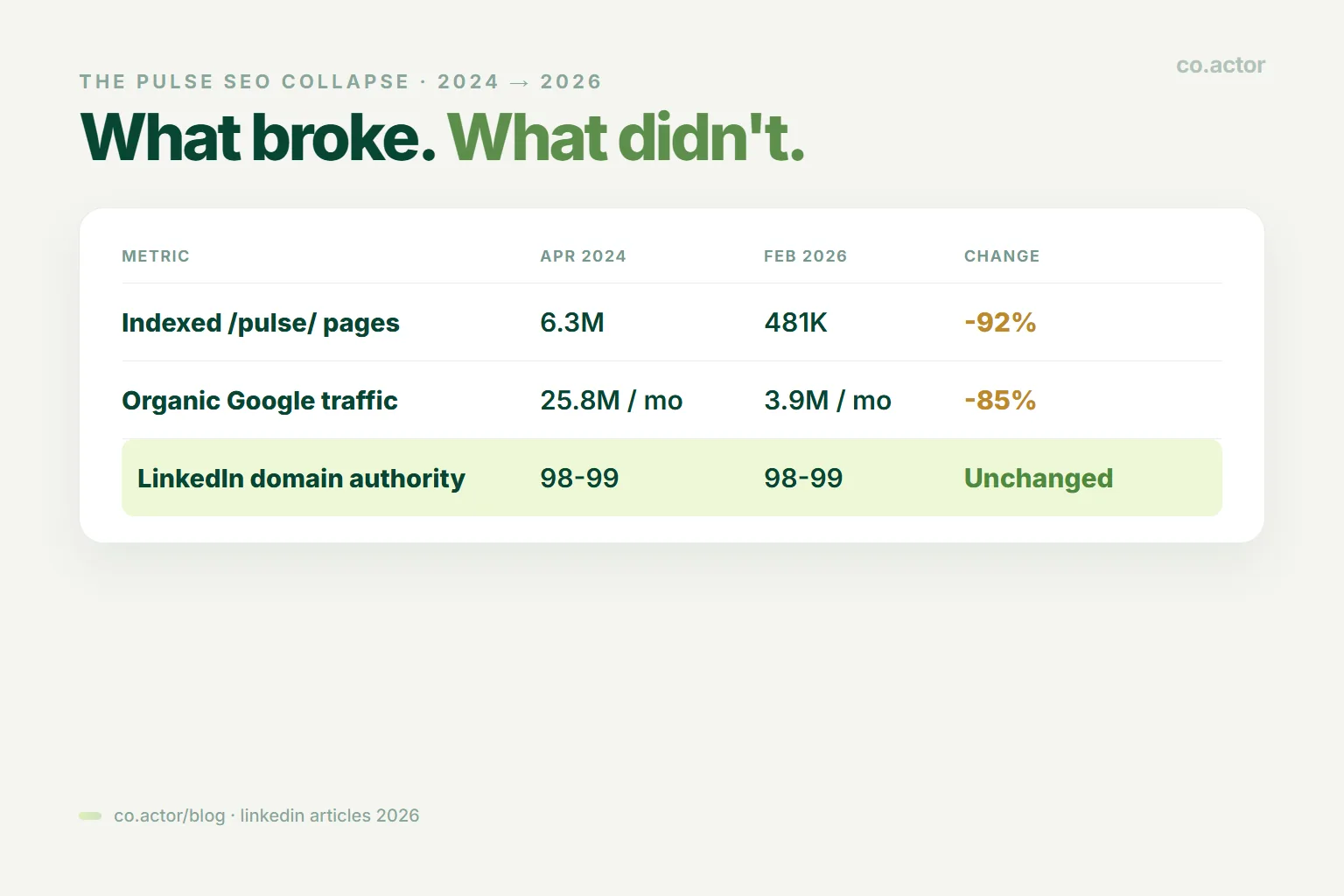
Between March 2024 and March 2026, LinkedIn /pulse/ — the URL prefix where articles live — went through a dramatic decline in Google search visibility. Indexed Pulse pages dropped from 6.3 million in April 2024 to about 481,000 in February 2026, a 92% reduction. Organic Google traffic to those pages fell from 25.8 million monthly visits to 3.9 million, an 85% loss.
The trigger was Google's Site Reputation Abuse (SRA) policy, announced in March 2024 and enforced starting May 2024. SRA targets a specific behavior: large platforms hosting third-party content that exploits the platform's domain authority but bears little editorial relationship to the host. Coupon sites publishing on news domains. AI-generated affiliate content on educational sites. And — for our purposes — random topics published on LinkedIn that had nothing to do with professional discourse.
LinkedIn never received a public manual action. The decline was algorithmic and gradual. The June-July 2025 core update accelerated the drop; the September-November 2025 enforcement waves finished the job for high-volume head terms.
Here's what most people missed: SRA didn't kill articles. It killed a specific use of articles — publishing generic content to ride domain authority for keyword traffic. The "10 productivity tips" playbook stopped working. What kept working is articles written on the author's actual expertise, on specific niche topics, with depth. LinkedIn's domain authority is still 98-99. The 481,000 Pulse pages still indexed aren't a graveyard — they're the articles that survived because they belonged.
Key Takeaway: The Pulse collapse punished generic content borrowing LinkedIn's authority — not the article format itself. Expertise-led articles on specific topics still belong in Google's index.
Articles Still Rank in Google — Just Differently
Articles still rank in Google search results in 2026. They just rank for a different set of queries than they did in 2022.
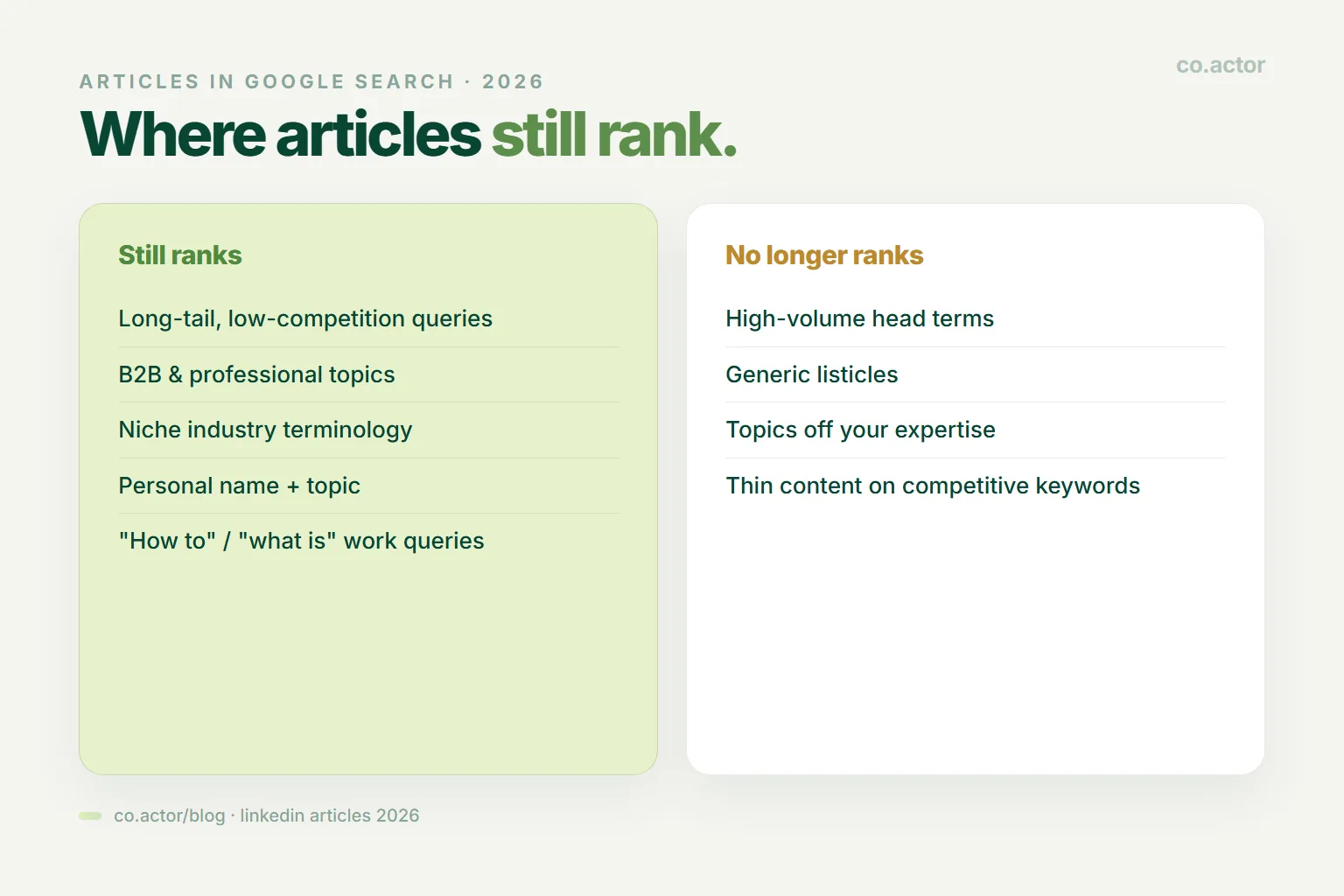
Where articles rank well in 2026:
- Long-tail queries. Specific, lower-volume terms with little competing content. "How to structure a B2B founder LinkedIn About section" will surface a well-written article; "best LinkedIn tips" won't.
- B2B and professional topics. Google recognizes LinkedIn as a trusted source for professional content.
- Niche industry terminology. Specialized vocabulary surfaces articles when there's no high-volume alternative.
- Personal name queries. Articles compound your search presence on your own name plus a topic.
- "How to" and "what is" queries in professional contexts. Structured workplace explanations still surface.
Where they don't rank: high-volume head terms ("productivity tips," "marketing strategy"), generic listicles, topics outside the author's expertise, and thin content on competitive keywords.
The strategic shift is from "ride domain authority for traffic at scale" to "build deep expertise content on specific topics where you can credibly rank." Think about your articles like a B2B content marketer thinks about long-tail SEO: choose specific topics, use your name and topic terminology in the title, and write depth that justifies the rank. Traffic accumulates over months, not days — but it compounds. Our content guide covers the topic-selection side in more detail.
The New Reason: AI Search Citations
While Pulse was losing Google traffic, AI search engines started citing LinkedIn at scale. Two independent research studies in early 2026 confirmed it, and the numbers reset what "winning at search" means.
LinkedIn is now the #2 most-cited domain across major AI tools, after Reddit:
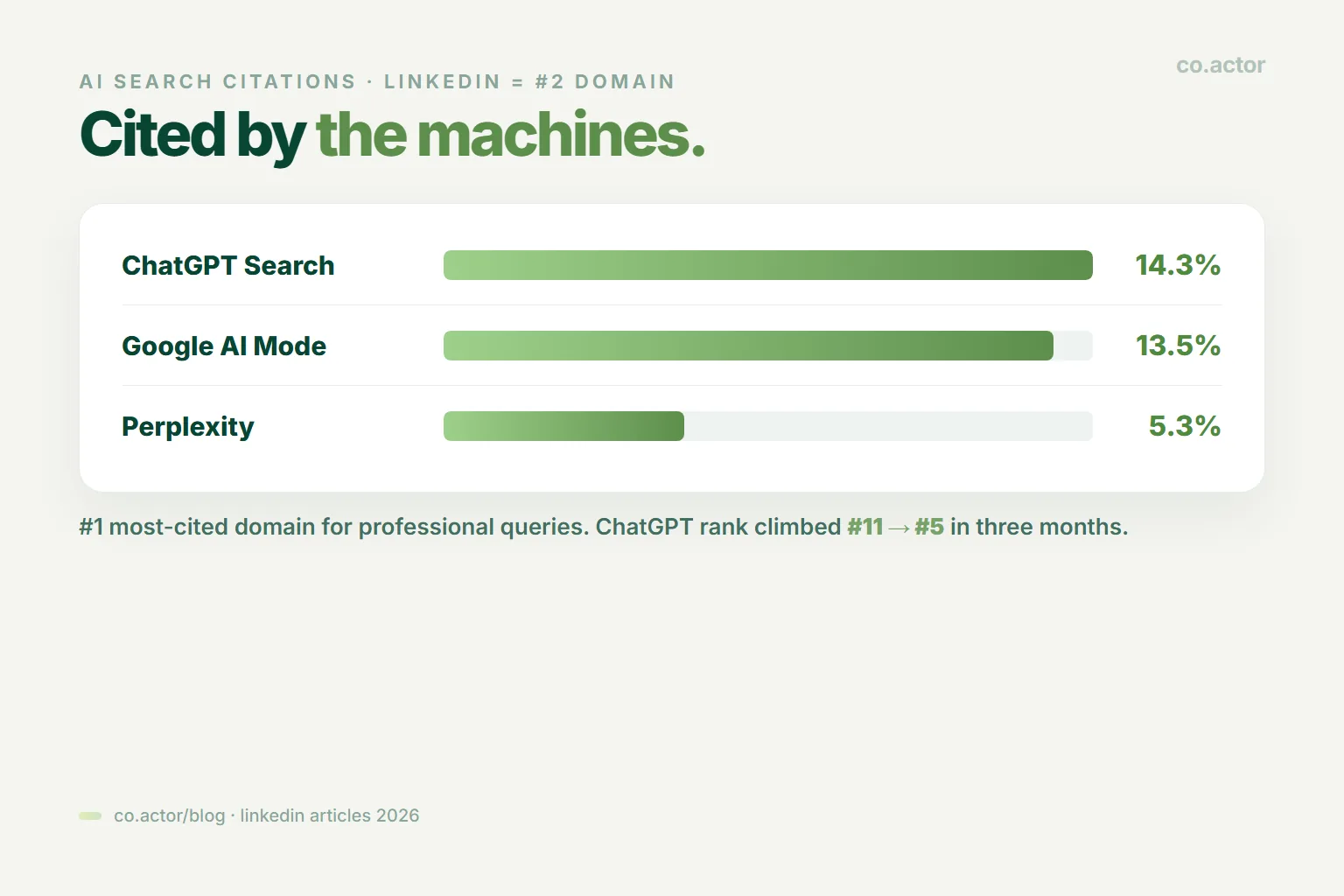
- ChatGPT Search: cites LinkedIn in 14.3% of responses
- Google AI Mode: 13.5%
- Perplexity: 5.3%
- Microsoft Copilot and Gemini also draw heavily on LinkedIn content
For professional queries — the ones your business cares about — LinkedIn is the #1 most-cited domain on every major AI platform. Higher than Reddit, Wikipedia, or any single publisher. The growth curve is sharper than the absolute numbers: LinkedIn's ChatGPT citation rank climbed from roughly #11 in November 2025 to #5 in February 2026 — a 2x climb in three months.
Why so heavily? Because the content matches what large language models look for when sourcing answers: clear authorship (a real profile attached), demonstrable expertise (work history visible), depth (long-form arguments), and topical specificity. LinkedIn structurally provides all four. The content type cited most is long-form articles of 500-2,000 words; mid-length posts of 50-299 words come second.
Key Takeaway: AI search is the new top-of-funnel. Every article on a specific topic in your domain gives the models another piece of attributable content to cite — and articles compound topical authority faster than posts.
Newsletters: The Article Format's Second Life
While articles-as-blog-posts lost ground, articles-as-newsletter-editions exploded. LinkedIn Newsletters grew 150% year-over-year. The platform now reaches 450M+ total newsletter subscribers, with 28 million members subscribed to at least one, and the top 1% of newsletters passing 100,000 subscribers each.
A newsletter edition is structurally a LinkedIn Article — same publishing surface, same long-form format, same SEO and AI-citation properties. The difference is distribution. When you publish an edition, every subscriber gets:
- A push notification on mobile
- An email in their inbox
- An in-app alert when they open LinkedIn
Three notification channels in parallel — none of which require the algorithm to decide whether your content gets distributed. This is the only LinkedIn content format with built-in, guaranteed distribution to your audience.
Newsletter open rates run 25-35%, above the ~21% email marketing average. LinkedIn has been investing in the format too: cover images and video for articles and newsletters, plus new analytics for "Email sends" and "Email open rate." The rhythm that works: weekly for short-to-medium newsletters (300-1,000 words), bi-weekly or monthly for long-form (1,500-2,500 words). Roughly 60% of top newsletters publish weekly. If you're going to write long-form on LinkedIn at all, run it as a newsletter — it's the difference between "shows up if the algorithm decides" and "lands in 25,000 inboxes Tuesday morning." A repeatable content engine makes that cadence sustainable.
The Evergreen Authority Anchor
A LinkedIn post fades from feed visibility within 24-48 hours. After a week it's nearly invisible; after a month it's archaeological. Articles work differently. Once published, an article stays on your profile indefinitely, accessible from your Activity section, linkable from your email signature, website, About section, or conference bio. It can be re-shared, repurposed into posts months later, and used in sales conversations as a credibility piece.
In 2026, articles also resurface inside the feed in waves. The wave-based distribution model — where strong content can resurface 2-3 weeks after publication when topical signals re-trigger — applies to articles. A well-performing article isn't just an evergreen reference; it's feed inventory that can come back to life.
The numbers reflect the shift. Articles plus long-form posts saw a 40% year-over-year increase in engagement. Document posts (PDF carousels) — another long-form format — hit a 6.60% engagement rate, the highest of any format on the platform. Three years from now, when a prospective client researches you, the framework you wrote in 2026 is still there — still ranking, still cited. This is the difference between content as exhaust and content as compound interest. Founders can see the same effect play out in our LinkedIn for founders breakdown.
When an Article Is the Right Form
Not every idea belongs in an article. Articles are the right format for six specific situations:
- Evergreen reference content. Frameworks, structured guides, methodology breakdowns, case studies — anything you'd want a customer or candidate to read months from now.
- Original thinking that needs space. A new framework or synthesis that requires building an argument from first principles. Posts are too short to do this without costly compression.
- AI citation bait. Deep, specific content in your area of expertise. "How to set up a sales compensation structure for a Series A SaaS startup" outranks "tips for sales compensation."
- Newsletter editions. Every edition is an article, and the newsletter layer multiplies reach by an order of magnitude.
- Authority signal on profile. A curated set of articles signals "this person thinks deeply about specific things."
- Repurposing source. One 2,000-word article cleanly produces 5-10 derivative posts — weeks of content runway from a single write. See our post ideas for angles.
When an article is the wrong format: timely or breaking news, hot takes, engagement-driven network building, daily "I'm here" rhythm posts, and anything below 1,000 words. If your content is reactive, conversational, or fundamentally short — it's a post. If it's structured, argument-driven, or fundamentally long — it's an article.
Article Structure That Works in 2026
A few technical parameters worth pinning down:
- Optimal length: 1,500-2,500 words, sweet spot 1,800-2,100. Shorter than 1,000 reads thin; longer than 3,000 hits diminishing returns on completion.
- Title: 150-character limit. Optimize for search intent — the keyword someone would actually type — and clarity over cleverness.
- Cover image. LinkedIn now supports cover images for articles and newsletters. Articles with them outperform those without on every metric the platform reports.
- Subheadings every 200-300 words. Readers scan first, read second — and subheadings help LLMs parse structure when citing.
- Short paragraphs. 2-3 sentences max.
- One central argument. Articles that cover too much get cited less, ranked less, and read less.
- Author identity prominent. AI models cite content from authors they can identify.
The publishing rhythm: 1-2 high-quality articles per week at maximum sustainable cadence; more realistically, 2-4 per month. Consistency matters more than volume — one article a week for 12 months beats 12 articles in week one.
Distribution Mechanics: Getting Reach
The honest truth: articles get less feed distribution than native posts. The 360Brew algorithm prioritizes content that lives on the feed surface — text posts, carousels, videos. The fix isn't to write fewer articles. It's to pair each article with a post-announcement that does live on the feed.
The pattern that works:
- Publish the article. Polish it, optimize the title and cover image, add the SEO description.
- Write a teaser post of 200-400 words that summarizes the key insight or sets up the central question. It should stand alone as a useful post — not "go read my article."
- Drop the article link in the first comment. Putting the link in the post body tanks reach; the algorithm penalizes external links.
- Engage in the comments for the first 90 minutes. Early engagement triggers wider distribution of the teaser.
- Repurpose the article into 5-10 standalone posts over the next several weeks, each re-linking the article in comments.
If the article is a newsletter edition, the distribution lift comes for free — subscribers get push, email, and in-app notifications regardless of the algorithm. For high-priority articles, paid amplification through Sponsored Content on the teaser post (not the article itself) extends reach further. The viral post formula covers how to write a teaser that earns those first 90 minutes.
Action Items: Restart the Articles Engine
A 30-minute starter you can run this week:
- Pick one specific topic in your area of expertise. Not "marketing," not "leadership" — something specific enough that a prospective customer in your niche would search it. The narrower the better.
- Write the article in 1,500-2,000 words. One central argument, subheadings every 200-300 words, short paragraphs, specific examples, and your name plus topic terminology in the title.
- Publish it as a standalone article first. If you have a newsletter, publish it as a newsletter edition instead — same surface, ten times the distribution. If you don't, this article is a candidate for starting one.
- Write a 300-word teaser post. Drop the article link in the first comment; engage with comments for 90 minutes after publication.
- Plan to repurpose it. Identify 5 standalone posts you can pull from the article over the next 4-6 weeks.
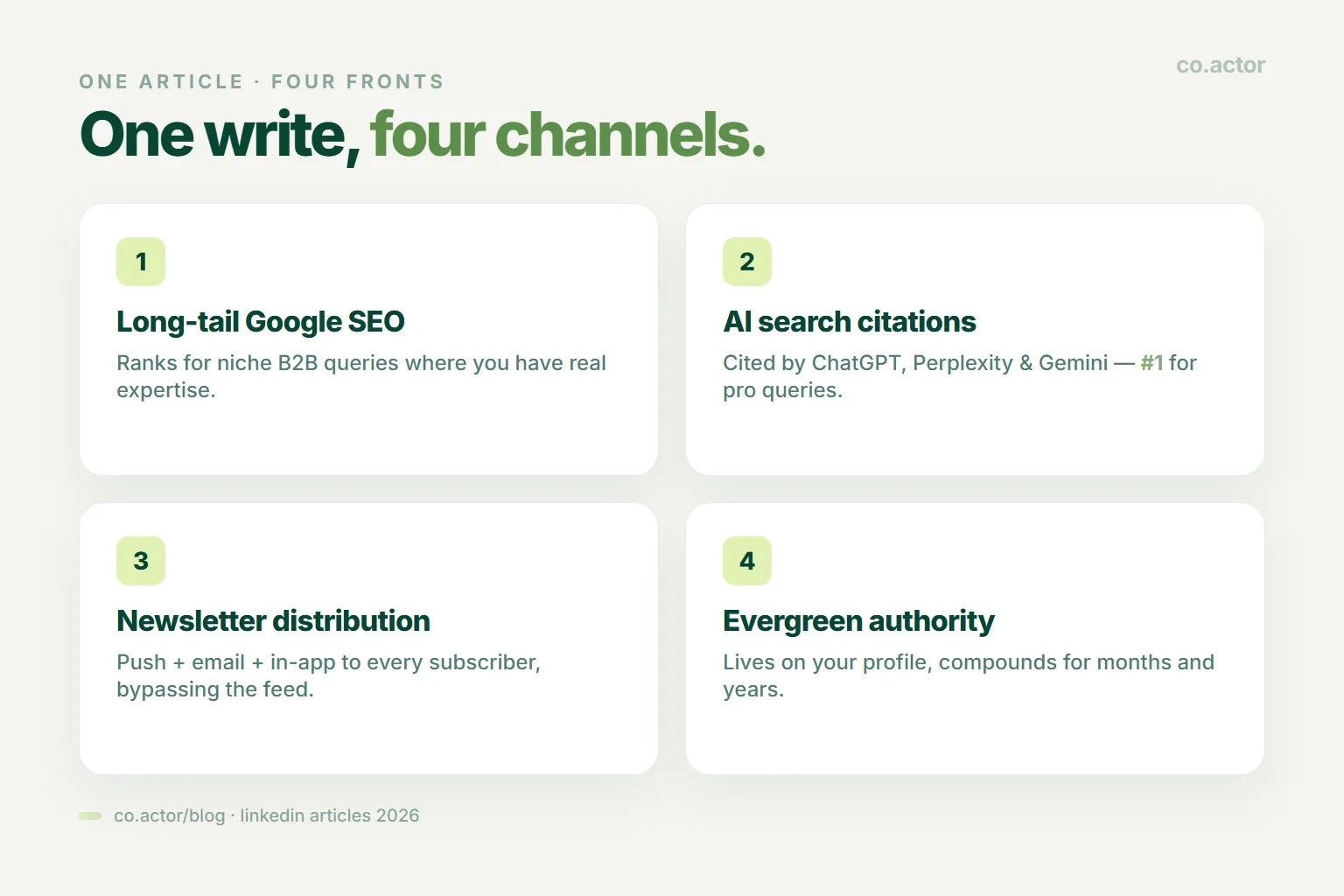
This single action sets up four content channels at once: targeted Google long-tail SEO, an AI citation source, newsletter infrastructure (or its starter), and an evergreen profile asset that compounds. If you stopped writing articles in 2024, the comeback is structurally easier than the original push — most of your competition still believes the format is dead. To automate the drafting and repurposing side, see our AI toolkit.
Key Takeaway: Most of the LinkedIn ecosystem still runs on a 2024 mental model — Pulse died, so articles are dead. They aren't. Write articles that work on all four fronts at once, and the window is yours.
Frequently Asked Questions
Are LinkedIn articles still worth writing in 2026?
Yes — but for different reasons than in 2022. The old "publish generic content to ride domain authority" play collapsed under Google's Site Reputation Abuse policy. What works now is articles that pay back on four fronts at once: long-tail SEO, AI citations, newsletter distribution, and evergreen profile authority.
Why did LinkedIn Pulse lose its Google traffic?
Google's Site Reputation Abuse policy, announced March 2024 and enforced from May 2024. It de-trusted generic third-party content borrowing a host domain's authority. Indexed /pulse/ pages fell from ~6.3M to ~481K, and organic traffic from 25.8M to 3.9M monthly visits — roughly 85%.
Do LinkedIn articles still rank in Google?
Yes, for a narrower set of queries: long-tail terms, B2B and professional topics, niche terminology, personal-name-plus-topic searches, and "how to / what is" workplace queries. They no longer rank for head terms or generic listicles. LinkedIn's domain authority is still 98-99.
How often do AI search engines cite LinkedIn?
LinkedIn is the #2 most-cited domain overall — ChatGPT 14.3%, Google AI Mode 13.5%, Perplexity 5.3% — and #1 for professional queries. Its ChatGPT citation rank climbed from ~#11 to #5 in three months. Long-form articles of 500-2,000 words capture the largest citation share.
Are LinkedIn newsletters the same as articles?
Structurally, yes — same publishing surface and long-form format. The difference is distribution: every subscriber gets a push notification, an email, and an in-app alert, bypassing the algorithm. Newsletters grew 150% YoY to 450M+ subscribers with 25-35% open rates.
What is the optimal length for a LinkedIn article in 2026?
1,500-2,500 words, sweet spot 1,800-2,100. Use subheadings every 200-300 words, keep paragraphs to 2-3 sentences, build one central argument, add a cover image, and keep author identity prominent.
When should I write an article instead of a post?
Write an article for structured, argument-driven, or long content: evergreen references, original frameworks, AI-citation depth, newsletter editions, profile authority, or repurposing sources. Write a post for reactive, conversational, or short content under 1,000 words.
Turn One Article Into Four Channels
Serge Bulaev is the CEO and founder of Co.Actor, a LinkedIn growth platform for B2B founders and their teams. He writes about content systems, profile positioning, and how the LinkedIn algorithm actually rewards modern creators.
Sources
- almcorp.com — LinkedIn #2 in AI Search Citations: 325K Prompts Analyzed (2026)
- foundationinc.co — LinkedIn Pulse Lost 89% of Google Traffic
- growtika.com — LinkedIn Pulse 85% Google Traffic Loss Research
- influenceflow.io — LinkedIn Newsletter Strategy Guide 2026
- semrush.com — 89K LinkedIn URLs Cited in AI Search Study
- brightedge.com — LinkedIn Learning and Pulse Articles Top AI Citation Sources
- contentin.io — When to Use LinkedIn Articles vs Posts
- techlasi.com — Best Practices for LinkedIn Articles 2026
Related Reading
Written by
