Most cold outreach on LinkedIn is broken. Templates that read like templates. Pitches in the first message. AI-generated openers that all sound the same. The recipients delete them, the senders blame the platform, and the next batch goes out.
What's working in 2026 looks different. The professionals who actually book meetings from LinkedIn DMs build warmth before the message, send fewer DMs that are personal enough to read, and understand the platform's invisible rate limits well enough to stay inside them. This article is the breakdown — what the 2026 limits actually allow, what response rates real benchmarks look like, what works in the message itself, and the warm-up funnel that converts 4-5x better than cold-only blasts.
TL;DR — In Five Bullets
- ~100 connection requests/week on free accounts. 200-250/week for high-SSI aged accounts. New accounts stay under 30/week. Rolling 7-day UTC window.
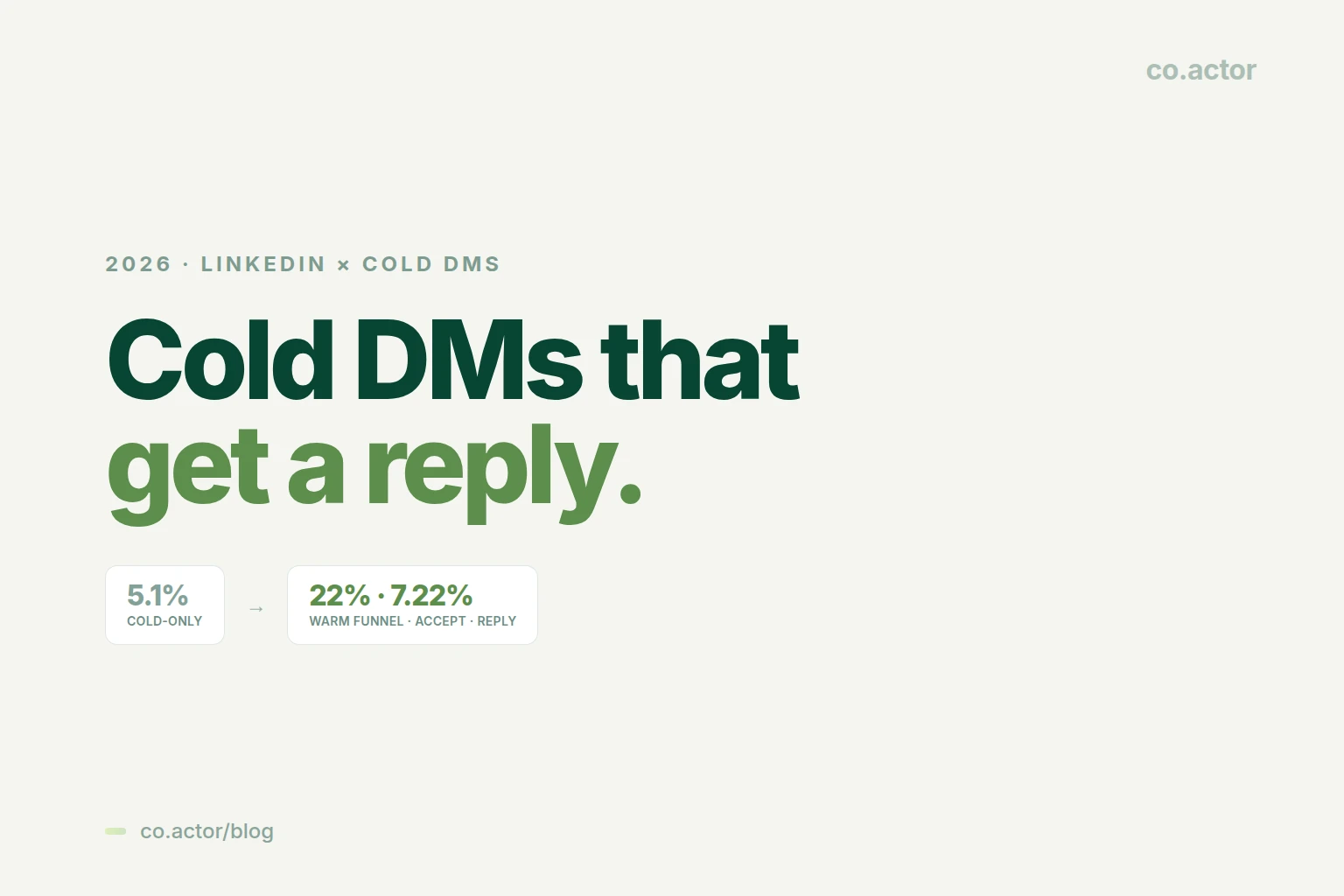
- Warm funnel beats cold-only. "Builder Campaigns" (profile visit + comment + connect + DM) get 22% connection acceptance and 7.22% reply rate vs 5.1% for cold-only (Expandi 2026).
- Personalized DMs roughly double response rate. 18% vs 9% (Sopro 2026). Real personalization, not "I see we're both in [industry]."
- First message under 120 words. 60-90 is the sweet spot. The first message starts a conversation, not delivers a pitch.
- Follow-up cadence: 3-5 messages over 10-14 days. 90-95% of replies come by message 5. Stop there.
What's Actually Allowed in 2026
LinkedIn doesn't publish definitive limits. The 2026 community testing converges on the following.
Connection Requests Per Week
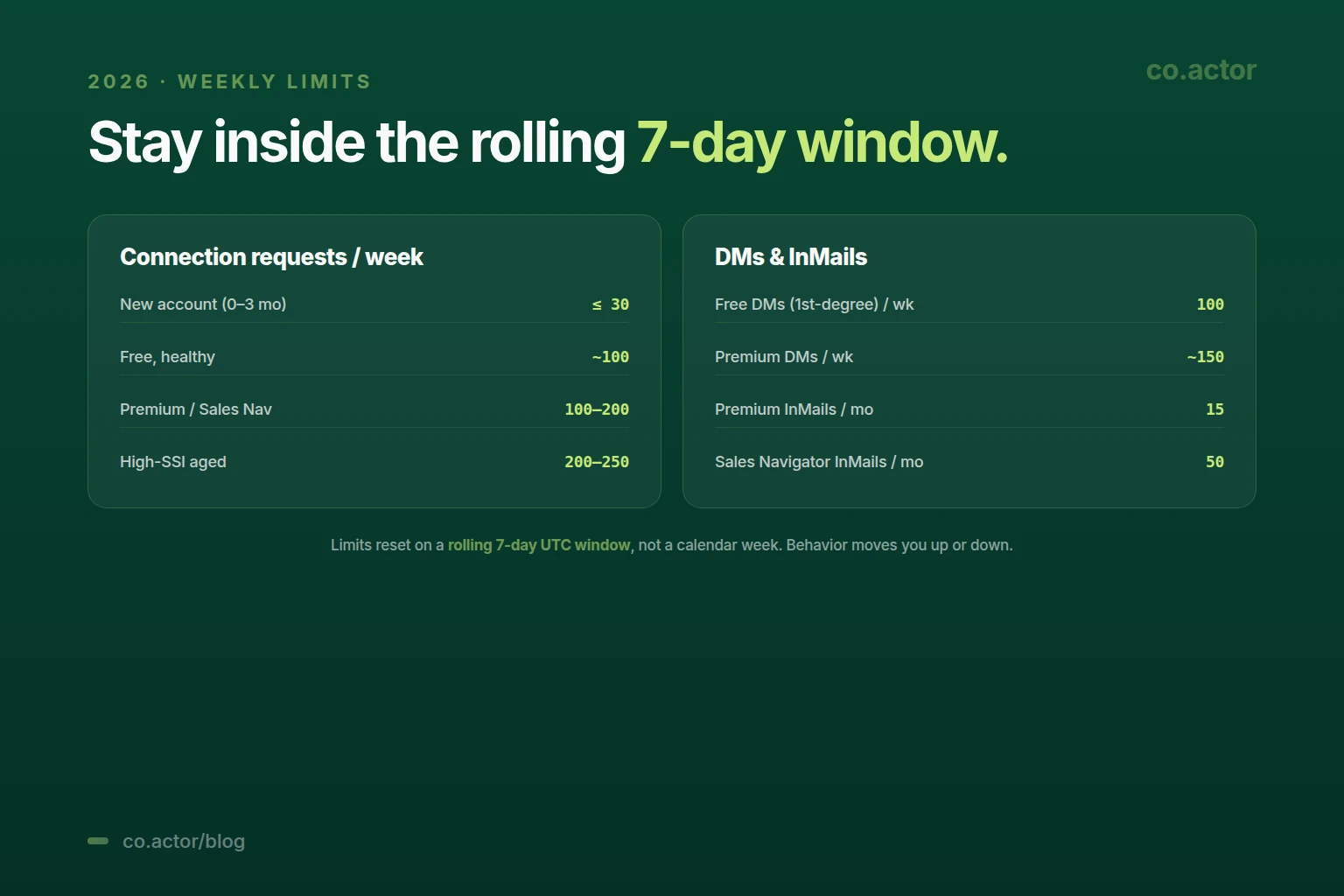
- Free accounts: ~100/week (safe target: 80/week, 15-20/day).
- Premium / Sales Navigator (standard): 100-200/week, 20-40/day.
- High-SSI aged accounts: up to 200-250/week.
- New accounts (0-3 months): stay under 30/week to build trust.
Direct Messages to Existing 1st-Degree Connections
- Free: 100 messages/week.
- Premium: ~150 messages/week.
- Sales Navigator: separate from InMail credits.
- No hard cap on individual conversations once you're connected.
InMails (Paid Messages to Non-Connections)
- Premium Business: 15 credits/month.
- Sales Navigator Core: 50 credits/month.
- Recruiter: 200 first week, then up to 1,000/day on aged seats.
- Refund: credit returned if recipient replies within 90 days.
- Open Profile InMails are free — they don't count against credits.
The reset: rolling 7 days, UTC, NOT calendar-based. Send 100 requests on Tuesday and 90 on Wednesday — your Tuesday batch resets next Tuesday at the same UTC time, not at midnight on Sunday.
The dynamic part: these limits aren't static. LinkedIn raises and lowers them based on your account behavior. High decline rate, high pending backlog, low InMail response rate, or aggressive sending patterns all push your limits down. High SSI score, sustained acceptance rate above 40%, mature account, and steady cadence all push them up. The goal isn't to hit the ceiling — it's to stay inside the limits with a high-quality send pattern that earns you the upper tier of the dynamic range.
Why Warm-First Beats Cold-Only
The single biggest 2026 finding on LinkedIn outreach: pure cold-to-stranger DMs underperform almost any other approach.
The Expandi 2026 "State of LinkedIn Outreach" report published a comparison:
- Cold-only outreach (no warm-up): ~5.1% reply rate baseline (matches cold email).
- "Builder Campaigns" (warm funnel sequence): 22% connection approval + 7.22% reply rate.
- Top performers (best targeting + signals): 16.86% reply rate.
- Webinar-based outreach (after a shared event): 14%+ reply rate.
The pattern is consistent. Outreach that follows prior engagement signals — a comment you left on their post, a like, a profile visit, a shared event — converts 2-4x better than the equivalent message sent cold.
This is the connection back to strategic commenting on others' posts. Commenting is the warm-up phase of cold outreach. By the time you send the connection request or the first message, the recipient has seen your name 3-4 times. You're not arriving cold — you're a familiar contributor finally introducing yourself directly.
The mechanic is simple: humans accept and respond to messages from people they recognize. The algorithm rewards accounts whose outreach gets accepted. The two reinforce each other — your warm acceptance rate keeps your weekly limit ceiling high, which means more outreach capacity for the next month, which means more relationships built.
The opposite is also self-reinforcing. Cold blast → low acceptance → reduced weekly limit → less reach → forced to send even colder messages → worse acceptance. Most accounts that get rate-limited or flagged in 2026 are stuck in this loop.
The Warm-Up Funnel
The sequence that works in 2026:
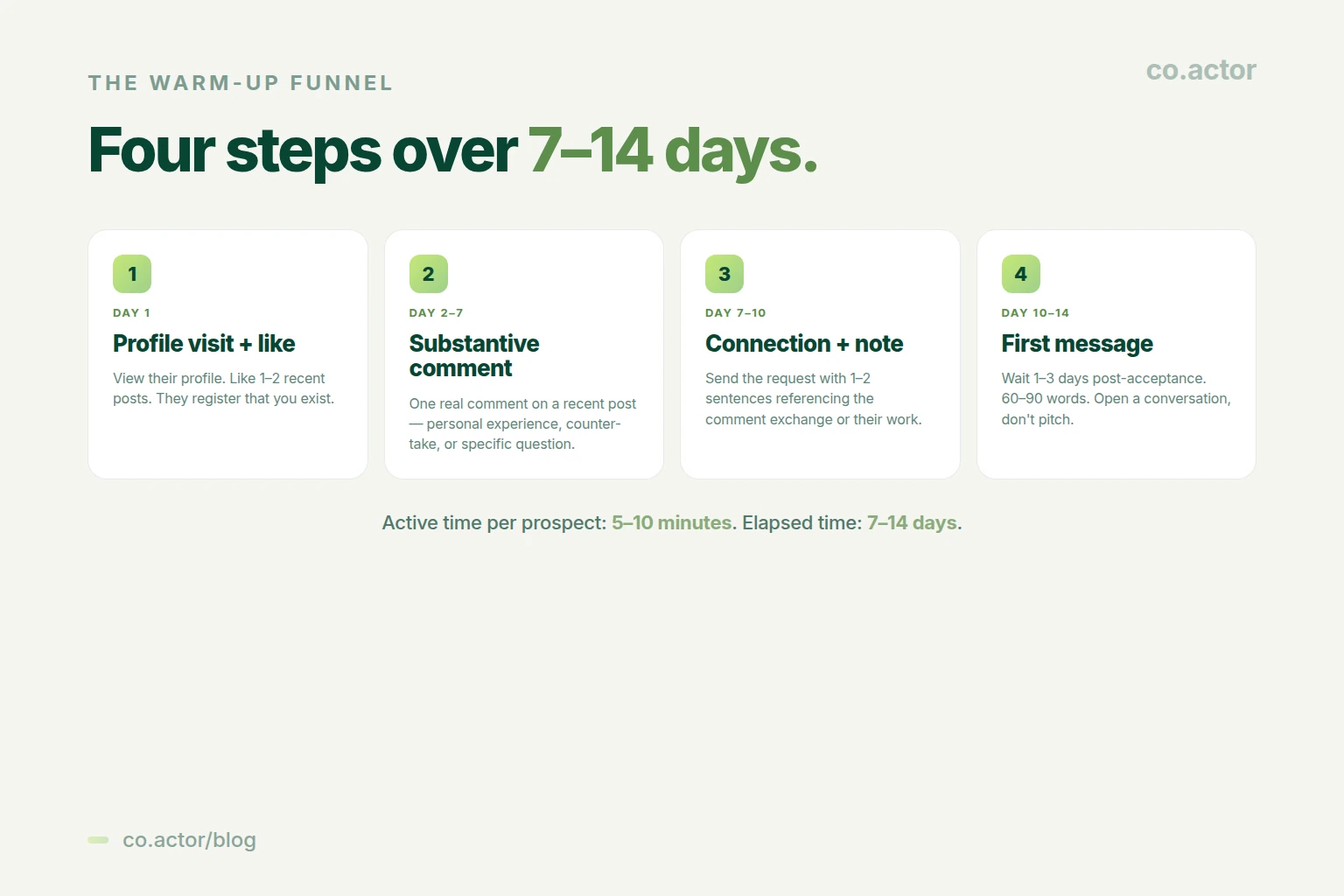
Step 1: Profile Visit + Like
View the prospect's profile. Like one or two recent posts. Both signals show in their notification feed and in LinkedIn's engagement graph. Cost: 30 seconds. They now register that you exist.
Step 2: Substantive Comment on Their Post
Within the next few days, leave one substantive comment on their content — personal experience, counter-perspective, specific question. Not "Great post!" The author notices the people who consistently bring substance. The full mechanic is in our commenting strategy guide.
Step 3: Connection Request — With a Short Personal Note
After 1-2 substantive touches, send the connection request. Include a 1-2 sentence note that references either the specific post or comment exchange, or a specific reason aligned with their work. Skip the generic "I'd love to connect to expand my network" — the sender count on those is so high in 2026 that LinkedIn essentially treats them as low-signal.
Step 4: First Message After Acceptance
Wait 1-3 days after they accept before sending the first message. Don't pitch. Open a conversation. Reference the original touchpoint. Ask one specific question that reflects you've actually read their work or content.
What this does mechanically:
- Acceptance rate climbs because you're recognized.
- First-message reply rate climbs because the conversation has context.
- Limit ceiling rises because LinkedIn's engagement graph reads your sequence as authentic outreach, not blasting.
- Future outreach gets easier because each successful relationship raises your account's quality signals.
The sequence takes 7-14 days per prospect in elapsed time, but the active time is 5-10 minutes per prospect. Most of it is just consistency: showing up where they already publish.
What Gets a Response
The 2026 data on what works in the message itself:
Personalization Roughly Doubles Response Rate
- Generic templates: ~9% reply rate.
- Advanced personalization (specific to company, role, context): ~18% reply rate (Sopro 2026).
- 81% of decision-makers engage with cold outreach when it's tailored to their context.
Length: Short Beats Long
- 60-90 words is the sweet spot for the first message.
- Under 120 words is the threshold; over that, reply rates drop significantly.
- 50-125 word range gets roughly 50% higher reply than longer messages.
Specific Opener Types That Work
- Reference a comment exchange. "Your point on X in the thread on [creator's] post stuck with me — curious how you'd apply it to…"
- Reference a shared event or content. "Saw you at [event] / saw you mentioned [report] — wanted to ask…"
- Reference role-specific pain you understand. "Working with [role] at [company size], the bottleneck I usually see is [specific thing]. Curious if that matches your view?"
- Mutual connection-based. "We're both connected to [person] — they spoke highly of how you handled [specific thing]…"
- Genuine curiosity about their work. "Your post on [topic] — specifically the part about [detail] — surprised me. Was that a one-off observation or are you seeing it consistently?"
Opener Types That Don't Work
- "I noticed you're in [industry] — I help companies like yours with…" (template detected)
- "Quick question — do you have 15 minutes for a call to discuss…" (pitch in first message)
- "I love your content!" (zero substance, reads as flattery)
- "I see we have X mutual connections — let's connect!" (no actual reason)
- Anything with a Calendly link in the first message (high-friction CTA, kills response)
The structural rule: the first message exists to start a conversation, not to close one. A response is success. A meeting booked from message #1 is rare and usually a sign you over-pitched the wrong person. Most converted relationships go through 3-7 message exchanges before a meeting is on the calendar.
Length, Timing, and Follow-Up Cadence
Length
- First message: 60-90 words.
- Follow-ups: progressively shorter (40-60 words).
- The longer the message, the lower the reply rate.
Timing
- Tuesday-Thursday: +15-20% reply rate vs Monday/Friday.
- 8-10 AM recipient's local time: highest open and reply rates.
- After 2 PM local: -25% reply rate.
- Avoid weekends entirely (unless you know they work weekends).
Cadence (B2B-Typical)
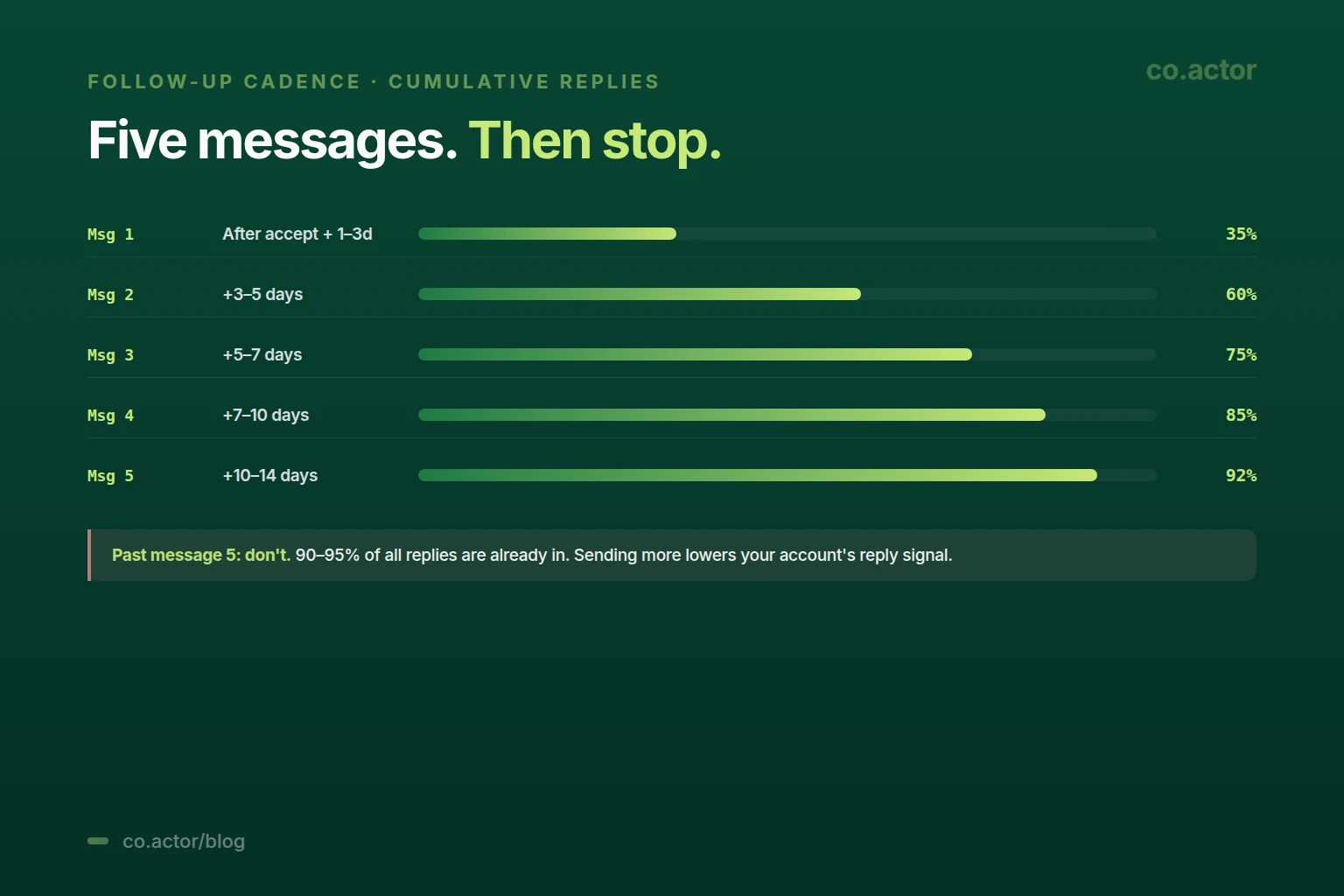
- Message 1: connection accepted + 1-3 days.
- Message 2: 3-5 days after #1 (no response).
- Message 3: 5-7 days after #2.
- Message 4: 7-10 days after #3.
- Message 5: 10-14 days after #4.
- Stop after 5. 90-95% of total replies come by message 5. Past that, you're just creating annoyance and lowering your account's response signal.
Reply Distribution Across the Sequence
- Message 1: 30-40% of total replies.
- Message 2: cumulative 55-65%.
- Message 3: cumulative 70-80%.
- Message 4: cumulative 80-90%.
- Message 5: cumulative 90-95%.
The bookend logic. Each follow-up should add a new angle, not just nudge. "Just bumping this" is a tell. A new specific question, a new piece of data, a new framing that respects their time — those work. The recipient should never feel like the same template is hitting them five times.
What Kills You in 2026
The patterns that get accounts flagged or DMs ignored:
- AI-generated personalization that feels generic. Recipients have seen the patterns. Templates that sound like a real human aren't real personalization.
- Pitching in the first message. Asking for a meeting, demo, or call before any conversation is the fastest way to get archived.
- Generic flattery openers. "Love your content!" / "Your post inspired me!" with nothing specific = zero signal.
- Calendly link in the first message. High-friction CTA. Kills reply rate.
- Sending all 100 weekly requests in one hour. Pattern-detected. Account flagged.
- High decline rate over time. Triggers reduced weekly limit. Compounds badly.
- Pending request backlog. LinkedIn requires manual cleanup before raising your ceiling. Withdraw old pending requests every 1-2 weeks.
- Connection request followed by immediate pitch. "Thanks for connecting! Quick 15 minutes to discuss…" — read as bait-and-switch.
- Bot-like language patterns across multiple DMs. Triggers Authenticity Score detection. Reduces account reach across the entire profile, not just messaging.
- Buying lists / scraping. Verified or purchased lists hit 5-6x worse reply rates than genuinely targeted.
The pattern: LinkedIn's 2026 systems read your outreach pattern, not just any single message. Accounts with bot-like signatures get progressively quieter. Accounts with substance-led, paced, contextual outreach get raised limits and improved deliverability.
When NOT to Send a Cold DM
A short list of situations where cold-DM-only is the wrong tool:
- Enterprise / large-deal sales. Cold DM-to-meeting on a six-figure deal almost never works. Warm intro, executive sponsorship, or in-person event lead are the channels that convert.
- Regulated industries (healthcare, finance, legal). Cold messaging triggers compliance flags and often violates the recipient's company policy. Use industry events and warm intros.
- Very senior contacts (C-level at large companies). They get hundreds of cold DMs. Almost none are read. Use warm intro, content engagement (comments on their posts over weeks), or industry conferences.
- Below 1-2% acceptance/reply rate baseline. If your numbers are this bad, the problem is targeting or message — not volume. More cold messages won't fix bad ICP.
- No prior touch and no public signal to reference. If you can't truthfully reference something specific they wrote, did, or attended, send a comment or like first. Build the signal before the message.
Action Items: Restart Your Outreach in 2026
- Audit your current limits and account quality. Check your SSI score, your acceptance rate, your pending backlog. If pending requests are over 100, withdraw the oldest. If acceptance rate is low, slow down and rebuild.
- Pick 30-50 prospects. Specific people. Not roles, not job titles. Real people whose work you can engage with on LinkedIn.
- Run the warm-up funnel. Profile visit + like + 1-2 substantive comments per prospect over 1-2 weeks before any connection request.
- Keep daily volume conservative. 15-20 connection requests/day for free accounts, 20-40/day for premium. Tuesday-Thursday weighted heavier than Monday/Friday.
- Connection note: 1-2 sentences referencing the specific touchpoint. Skip generic "expand network" language.
- First message: 60-90 words. Open a conversation, don't pitch. Reference the warm-up moment.
- Follow up max 5 times over 10-14 days. Each message adds a new angle. Stop at 5.
- Track three metrics weekly. Connection acceptance rate, first-message reply rate, conversation-to-meeting rate. Adjust the message before adjusting volume.
Frequently Asked Questions
What's the LinkedIn weekly connection limit in 2026?
~100/week on free and Premium accounts in standard mode. High-SSI aged accounts get 200-250. New accounts (0-3 months) under 30. Rolling 7-day UTC window. LinkedIn dynamically adjusts based on your account behavior.
How many DMs can I send per week?
To 1st-degree connections: 100/week (free), ~150/week (Premium). InMails to non-connections: 15/month (Premium Business), 50/month (Sales Navigator Core). Open Profile InMails are free. Credits return if recipient replies within 90 days.
What's a realistic cold DM response rate?
Cold-only baseline: ~5.1% (Expandi 2026). Warm funnel: 22% acceptance + 7.22% reply rate. Top performers: 16.86%. The lift comes from warm-up, not better copy.
What is the warm-up funnel?
4 steps over 7-14 days: profile visit + like → substantive comment → connection request with note → first message (60-90 words) after acceptance. Active time 5-10 minutes per prospect.
How long should a cold DM be?
60-90 words for first message. Under 120 max. Follow-ups progressively shorter (40-60 words). The first message starts a conversation, not delivers a pitch.
How many follow-ups before stopping?
Max 5 messages over 10-14 days. 90-95% of replies come by message 5. Past that, lowering your account's reply signal. Each follow-up adds a new angle.
Best time to send?
Tuesday-Thursday +15-20% reply rate. 8-10 AM recipient's local time. Avoid after 2 PM local. Skip weekends. Time the send to land in their morning, not yours.
Build the System, Not the Spam
Serge Bulaev is the CEO and founder of Co.Actor, a LinkedIn growth platform for B2B founders and their teams. He writes about content systems, profile positioning, and how the LinkedIn algorithm actually rewards modern creators.
Sources
- Expandi — State of LinkedIn Outreach H1 2026 (warm funnel data)
- Sopro — Cold Outreach Statistics 2026 (personalization data)
- LinkedIn Help — Invitation limits and best practices
- LinkedSDR, Wandify, Cleverly, Valley, Kondo — 2026 community testing on weekly limits
- Apollo, Cleanlist, Inboxkit — 2026 cold-outreach benchmarks (used directionally for length, cadence, timing)
Related Reading
Written by
