A post gets eight likes. You move on. Bad post. Except that same post might have pulled 80 saves. Or 30 sends — people forwarding it to colleagues in private DMs. Or a wave of new profile visitors who showed up because of it. You never saw any of that. LinkedIn didn't show you — until early 2026.
For the first time, LinkedIn now lets creators see what their silent audience is actually doing. And the gap between "looks like a flop" and "actually working" turns out to be enormous. This article is about that silent audience — roughly 90% of your followers — and the new analytics that finally make them visible. Plus what to write for them, what's a myth, and the format that wins for inbound in 2026.
TL;DR — The 6 Things to Know
- ~90% of your audience never engages publicly — and they're disproportionately your most valuable followers.
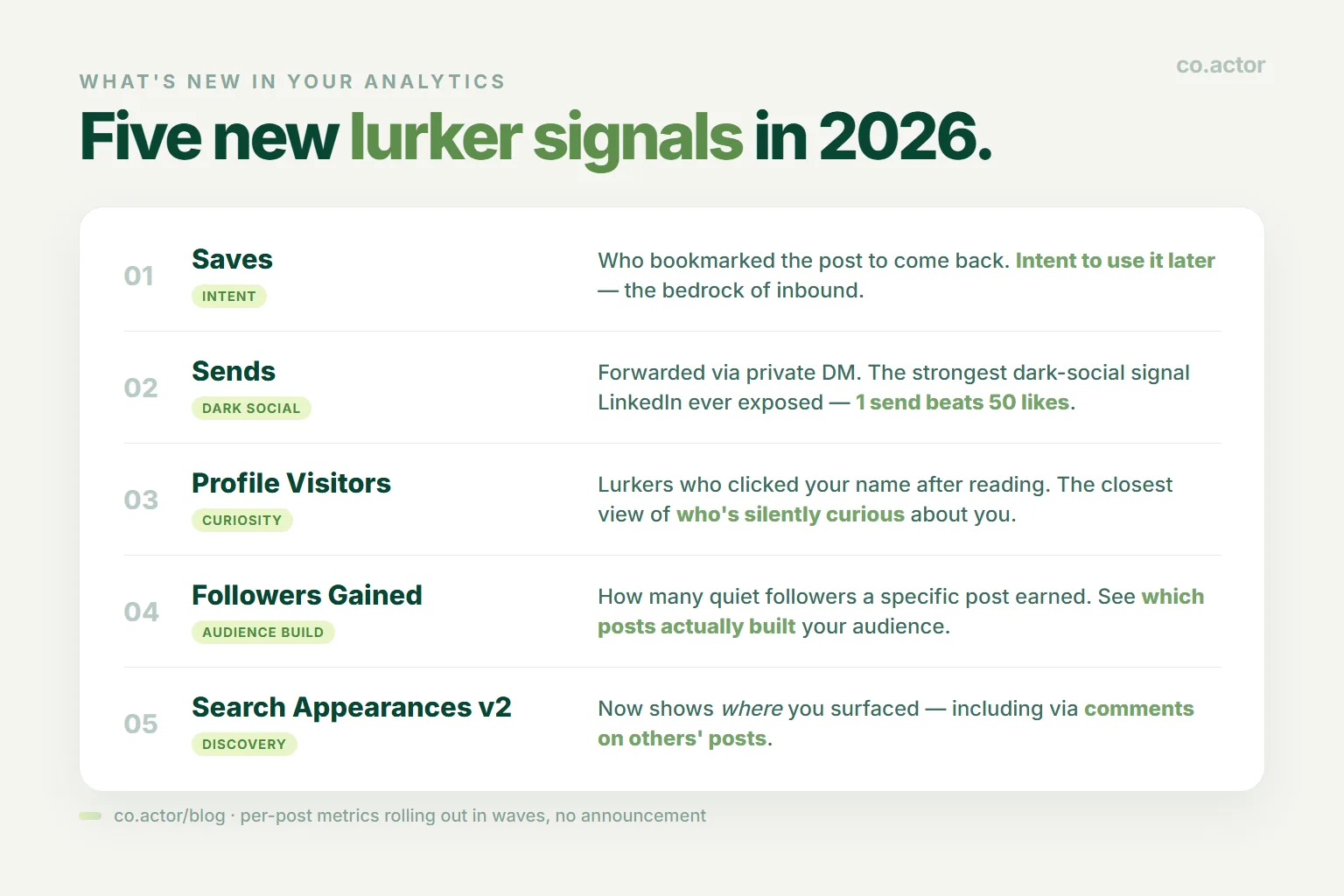
- LinkedIn rolled out lurker analytics in early 2026 — Saves, Sends, Profile Visitors per post, Followers Gained per post, Search Appearances v2.
- Saves outweigh likes. The 2026 ranking direction favors saves and sends over likes.
- Carousels and documents dominate — they outperform plain text by roughly 3-4x on saves and dwell.
- Comments and saves want different content. Hot takes get comments; frameworks and checklists get saved.
- A "send" is worth more than 50 likes. When someone forwards your post to a colleague in a DM, that's the strongest dark-social signal LinkedIn has ever exposed.
Who Lurkers Actually Are
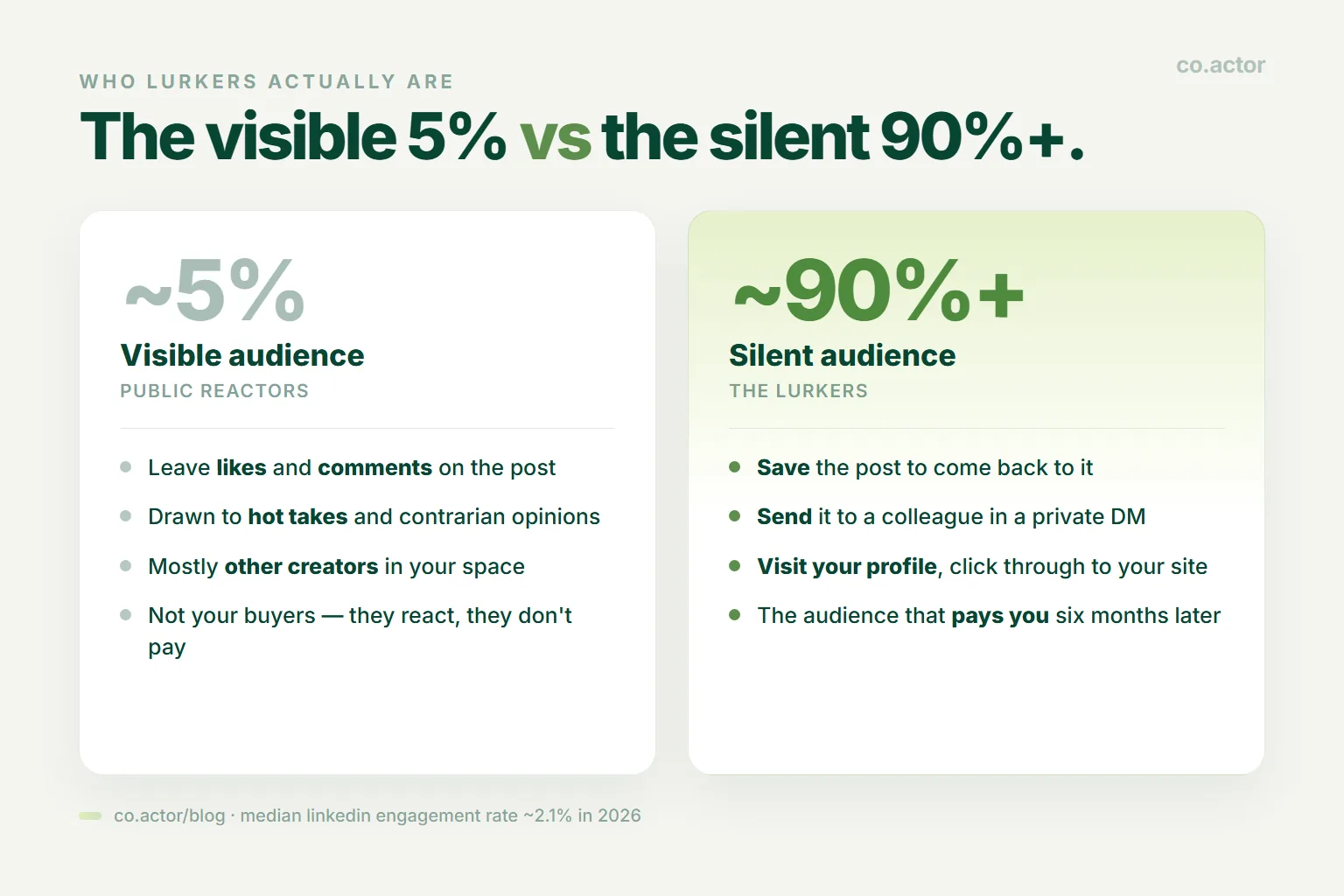
A lurker reads, saves, forwards your post to a colleague in a DM, visits your profile, clicks through to your website — and never leaves a public trace on the post itself. Six months later they show up in your inbox.
This group is around 90% of most LinkedIn audiences. The median LinkedIn engagement rate in 2026 sits at about 2.1%, so almost every impression you get stays silent.
The people who DO react in public — the active commenters — are mostly other creators in your space. Not your buyers.
What's New in Your Analytics
Open your LinkedIn analytics. If you haven't checked in a couple of months, you'll see new metrics rolling out — no announcement, no banner. Here's what they are and what each one tells you.
Saves
How many people bookmarked the post to come back to. A save means intent: someone plans to use this later. High save rate = your content is reference-worthy. The bedrock of inbound.
Sends
How many people forwarded it via private DM. This is the strongest dark-social signal LinkedIn has ever exposed. One send — a colleague saying "you need to see this" — is worth more than 50 likes from random scrollers.
Profile Visitors From This Post
How many lurkers clicked your name after reading. The closest LinkedIn has come to showing who's silently curious about you. A post with low likes but high profile visitors is probably outperforming a post with the opposite ratio — for inbound business outcomes.
Followers Gained From This Post
How many quiet followers a specific post earned you. Lurkers follow without commenting; now you can see which posts actually built the audience.
Search Appearances v2
Now shows where you surfaced, including via comments you left on other posts. Proves something creators have been saying for years: commenting drives silent discovery. Now you can measure it.
Sustained Reach (The Slow Burn)
If a post is still picking up impressions five days after publishing, you've made something evergreen. Viral posts spike and die in 24 hours. Save-worthy posts compound over weeks.
LinkedIn's own Help Center confirms creator analytics exists, but the docs lag the product — they don't yet enumerate saves and sends in writing. The features are there anyway.
Comments and Saves Want Different Content
This is where most creators go wrong. They copy whatever's getting comments — and accidentally write only for the 5%, losing the silent 95%.
The two audiences want different things.
What Gets Comments
- Hot takes and contrarian opinions.
- Direct "agree or disagree?" questions.
- Emotional, opinionated, polarizing posts.
- Personal stories.
- Short, punchy posts that invite a reaction.
What Gets Saved
- Frameworks with clear takeaways.
- Step-by-step processes.
- Numbered lists and checklists.
- Visual cheat sheets and reference cards.
- Multi-slide carousels someone can apply to their own work later.
Most engagement gurus optimize for the first list. That's why their content feels light and disposable — it works for vanity metrics, it doesn't compound.
If you want lurkers to remember you, write what they can save. If you want them to send your post to a colleague, write what makes the sender look smart for sharing it.
The Format That Wins With Lurkers
One 2026 analysis of 1.3 million LinkedIn posts found the ranking pretty clearly: document carousels and PDFs lead every other format on saves, dwell time, and profile visits — by a wide margin.
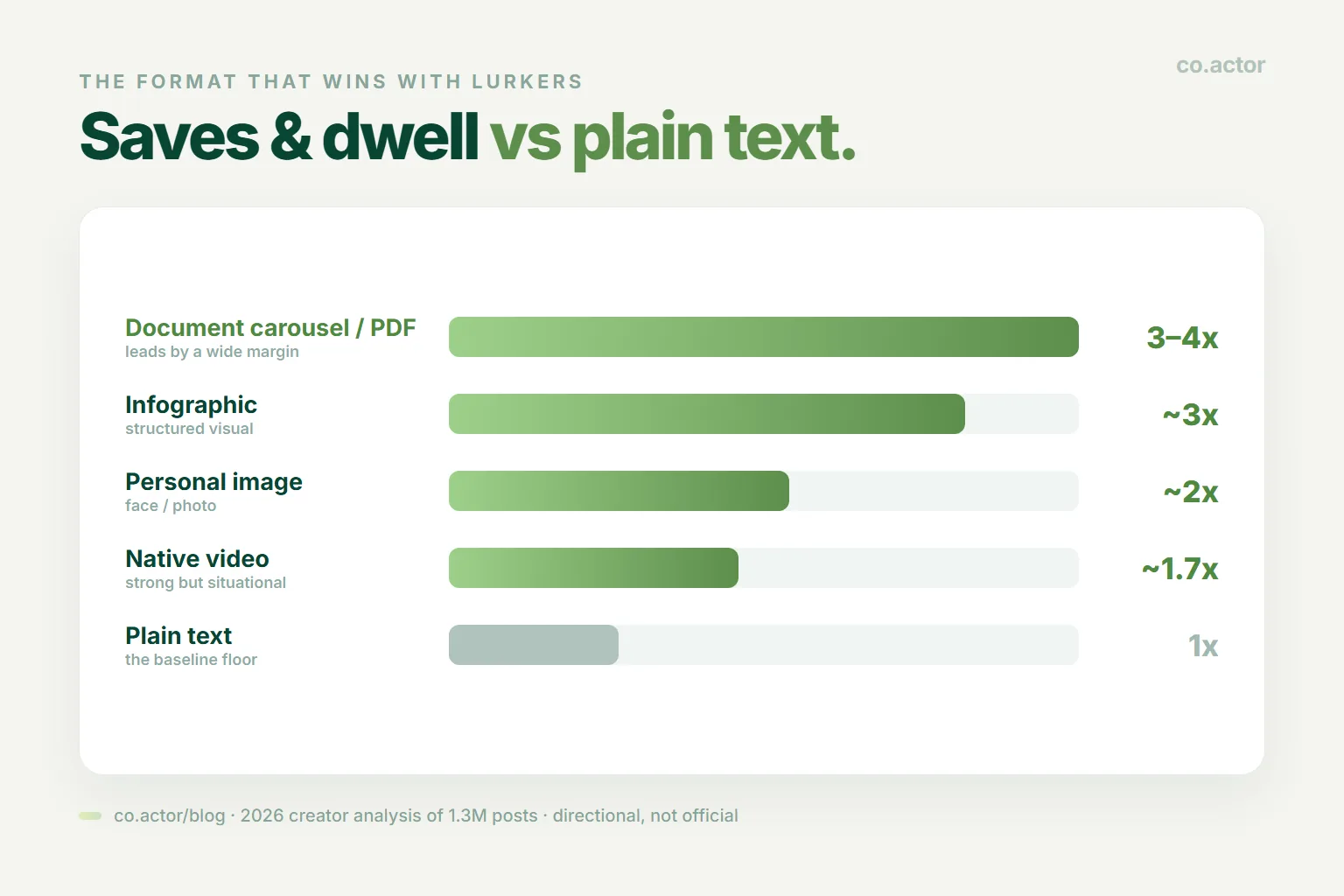
Against plain text as baseline: carousels perform about 3-4x better, infographics about 3x, personal images about 2x, native video about 1.7x. Text-only is the floor.
These aren't LinkedIn-official numbers — they come from creator testing. But every 2026 source points the same way: carousels and structured visual posts win when depth is the metric.
The 2023 "video is the future" advice didn't survive 2026. Video helps if you're already good at it. It's not the universal winner anymore. A 10-slide carousel breaking down a real framework will outperform a snappy video on most professional accounts — especially for inbound.
Writing FOR Lurkers, Not Commenters
You don't have to drop engagement-driven content. But if your business depends on inbound — clients, hires, deals — you need posts written for the silent reader too. Five principles.
1. Make It Scannable
Lurkers skim, they don't read. Short paragraphs. Bold the framework. Numbered lists. White space beats clever transitions.
2. End With Substance, Not Bait
Skip "what do you think?" — that's for commenters. End with one line a lurker can save, or a complete next step they can apply.
3. Put the Save Trigger in the First Three Lines
An opinion hook gets read or skipped. A framework promise ("here's the 3-step process I use for X") gets saved first, read later.
4. Drop the Engagement Triggers
"Comment YES if you agree." "Tag someone who needs this." These train the 5% to respond and signal to lurkers that you're low-substance.
5. Make the Cover Slide Carry the Carousel
The cover does 90% of the work for a save. It has to telegraph "this is useful later" in under two seconds.
Myths to Stop Believing
A few popular 2026 claims about lurkers and saves are worth flagging as overstated.
- Myth: "There's an exact algorithm point table — Like=1, Comment=12, Save=10." A point table circulating in May 2026 went viral. The original author called it "estimated" and "derived from observation." LinkedIn has never published numeric weights for engagement types. Treat every point table as reverse-engineered guesswork, useful directionally but not as ground truth.
- Myth: "Saves are 5-10x the weight of a like." Same problem. This was one creator's estimate, not a confirmed multiplier. The direction is right — saves rank higher than likes — but the exact ratio isn't verifiable.
- Myth: "Video is always the highest-performing format." Outdated. 2026 data consistently shows documents and carousels lead by ROI, with video as a strong but situational format.
- Myth: "Optimize your engagement rate above all else." Engagement rate is the wrong metric in 2026. Save rate, send rate, and profile-visitor rate map to business outcomes. Engagement rate maps to ego.
The Uncomfortable Truth
Engagement-driven content isn't useless. It grows audience and validates positioning. But it's been the only thing creators could measure — so it became the only thing they wrote for.
The audience that actually pays you, hires you, and recommends you has been invisible the whole time. Now it isn't.
What to Do This Week (30 Minutes)
- Pull up your last 10 posts in analytics. Note the new metrics if they're live on your account — Saves, Sends, Profile Visitors from this post, Followers Gained from this post. (Rolling out in waves; if you don't see them yet, check again in a few weeks.)
- Re-rank those 10 posts by save count, not like count. Your "best" post is probably different now.
- Compare save-to-like ratios across formats. Text vs carousel vs image. The format that wins for you on saves is the one to do more of.
- Open Search Appearances and look for "Comments" as a discovery source. If it's there, commenting on others' posts is measurably building your reach. Do more of it.
- Write one carousel this week. Pick a framework you actually use, build it into 6-8 slides with a save-worthy cover. End it with a takeaway, not "comment YES."
Frequently Asked Questions
What percentage of LinkedIn users are lurkers?
Roughly 90% or more. Median engagement rate sits around 2.1%. Public reactors are mostly other creators in your space, not buyers. Lurkers read, save, send, click, and visit profiles silently.
What new analytics shipped in 2026?
Five per-post metrics: Saves, Sends, Profile Visitors from this post, Followers Gained from this post, Search Appearances v2 (which now shows comment-based discovery).
Are saves more important than likes?
Yes directionally — the 2026 ranking system favors saves and sends. Exact point tables circulating online are estimates, not verified multipliers.
What format gets the most saves?
Document carousels and PDFs by a wide margin — about 3-4x plain text. Infographics ~3x, personal images ~2x, video ~1.7x. Text is the baseline floor.
Why do comments and saves need different content?
Comments come from reactors who respond to hot takes and questions. Saves come from people applying frameworks and checklists later. Writing only for comments loses the 95% who quietly buy.
Is video still the best format?
No. The 2023 advice didn't survive 2026. Video helps in the right context but isn't the universal winner. Carousels lead on saves and dwell.
How do I write for lurkers?
Five principles: scannable structure, end with substance not bait, save trigger in first 3 lines, drop engagement bait, carousel cover slide carries 90% of the save weight.
Write for the Audience That Pays You
Serge Bulaev is the CEO and founder of Co.Actor, a LinkedIn growth platform for B2B founders and their teams. He writes about content systems, profile positioning, and how the LinkedIn algorithm actually rewards modern creators.
Sources
- LinkedIn Help Center
- 2026 creator analytics testing on 1.3M LinkedIn posts (consolidated from multiple sources)
- Industry engagement benchmark reports — 2026 (median engagement rate ~2.1%)
Related Reading
Written by
