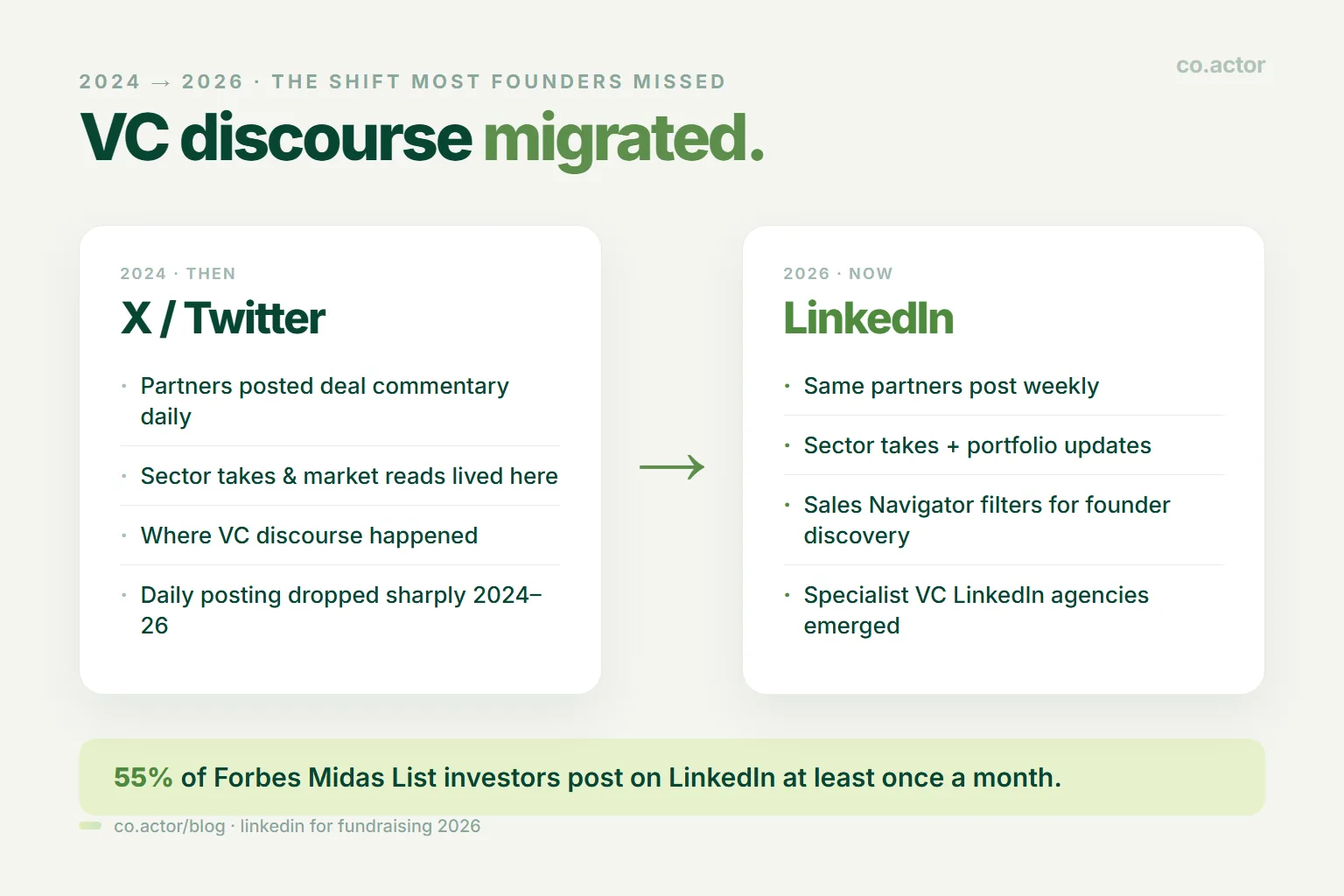
A small thing happened between 2024 and 2026 that changed how fundraising works. VC discourse migrated from X to LinkedIn. The same partners who used to post deal commentary on Twitter daily now post on LinkedIn weekly. Their daily reading shifted with them.
Most founders haven't updated their playbook. They still treat LinkedIn as a personal brand exercise and route fundraising through email and intros. The data in 2026 says something else: investors read LinkedIn now. Many check it before they take a meeting. Some invest in companies they first heard about there. This article is the breakdown — how VCs actually use LinkedIn in 2026, what they look at on a founder's profile, the warm-intro mechanic, and what works in a cold DM to an associate.
TL;DR — In Five Bullets
- 55% of Forbes Midas List investors post on LinkedIn at least once a month. The discourse migrated from X to LinkedIn over 2024-2026.
- LinkedIn DMs to associates and principals outperform email. InMails under 400 characters see ~22% higher response. Associate reply rates land at 18-25%. For partners, email first, LinkedIn 48 hours later as second touch.
- The warm intro via 2nd-degree connection still wins. LinkedIn just makes the routing visible. Cold DM is a backup, not the primary path.
- Build-in-public works as a pre-sell layer. 1-3 posts per week over 3-6 months with real evidence creates familiarity. By the time you DM, you're not new.
- What kills your raise is rarely the deck — it's the signal. Calendly in DM #1, PDF deck dump, tagging 12 investors, public complaints — these end conversations before they start.
The Shift Most Founders Missed
A 2024 Milltown Partners study referenced heavily across 2026 commentary found a specific pattern: roughly 55% of Forbes Midas List investors were posting on LinkedIn at least once a month, almost identical to their X/Twitter posting rate.
That parity, on its own, isn't surprising. What happened next was. Over 2024-2026, VC daily posting on X dropped sharply. LinkedIn stayed stable or grew. The discourse — sector takes, market commentary, portfolio updates, deal flow signals — that used to live on Twitter is now mostly on LinkedIn.
The implication isn't that VCs read every DM you send. It's that LinkedIn is now part of the daily information diet of the people running funds. They have feeds full of founder content, sector trend posts, and portfolio companies. They check it during the same windows they used to check Twitter. Their pattern recognition for "who's a serious operator" is now shaped by what they see in their LinkedIn feed.
A second, less-discussed shift: VC firms in 2026 are investing in LinkedIn as a channel at the fund level. Specialist agencies now serve venture firms specifically. Partner brands are being built deliberately. Sales Navigator filters tuned for founder discovery — stage, sector, recent role changes, ex-top-company signals — are part of normal sourcing workflows at many funds.
What this means for founders: if your LinkedIn presence in 2026 is sparse, outdated, or generic, you're invisible in a channel where investors are now actively looking. The cost of that invisibility used to be low. It isn't anymore.
What VCs Look at on Your Profile
When a VC opens your LinkedIn profile — after a warm intro, after a DM, before a meeting — they're scanning for a small number of specific signals. Most of them take 30 seconds total.
Headline
The first read. A clear statement of what you build and for whom, plus the most credible specific metric you can use, beats any clever phrasing. "Building B2B AI copilot for finance teams | 100+ midmarket customers" beats "Founder & visionary, helping companies do more." The first reads as an operator. The second reads as someone playing founder. The full profile strategy guide covers this for the 360Brew era.
About Section
A clean one-liner version of the headline, expanded. Problem, solution, who you serve, current stage. Investors are pattern-matching against thousands of founders. The ones who articulate the company in one paragraph get a different read than the ones who use the section for inspirational bio writing.
Experience
They're looking for two things: high-signal companies in your background (top startups, category leaders, FAANG, prior successful exits), and a coherent narrative connecting your past roles to the current company. An ex-Stripe PM building B2B payments infra reads as a thesis-fit founder. A founder whose history reads as "five unrelated jobs in five years" needs to explain the through-line — and if it isn't on the profile, they will assume there isn't one.
Traction Signals
Live product mentions. Customer logos or pilot counts. Links to launches, press, conference talks, accelerator badges (YC, Techstars, Entrepreneur First). These don't need to be flashy. They need to be present. A profile with zero traction signal feels like an idea, not a company.
Network Quality
Mutual connections you share with recognized investors, founders, or operators in your space. Who comments on your posts. A profile where the engagement is dominated by other serious operators reads differently from one where it's a mix of strangers and engagement bait. VCs notice this in seconds.
Content Behavior
Posting 2-4 times a week with substance is the "serious operator" signal in 2026. Thoughtful comments on industry threads visible to investors' networks are arguably even more important — they show the founder thinks publicly, can hold a position, and engages with the field. The commenting strategy guide covers this in depth.
The profile review is fast. It is also high-stakes — most "no" decisions happen here, before any conversation. The good news: this is the part of the funnel you control entirely.
The Warm Intro Mechanic (Still the Highest-Leverage Path)
Warm intros still beat cold outreach, almost universally. LinkedIn doesn't change that. It just makes the routing visible.
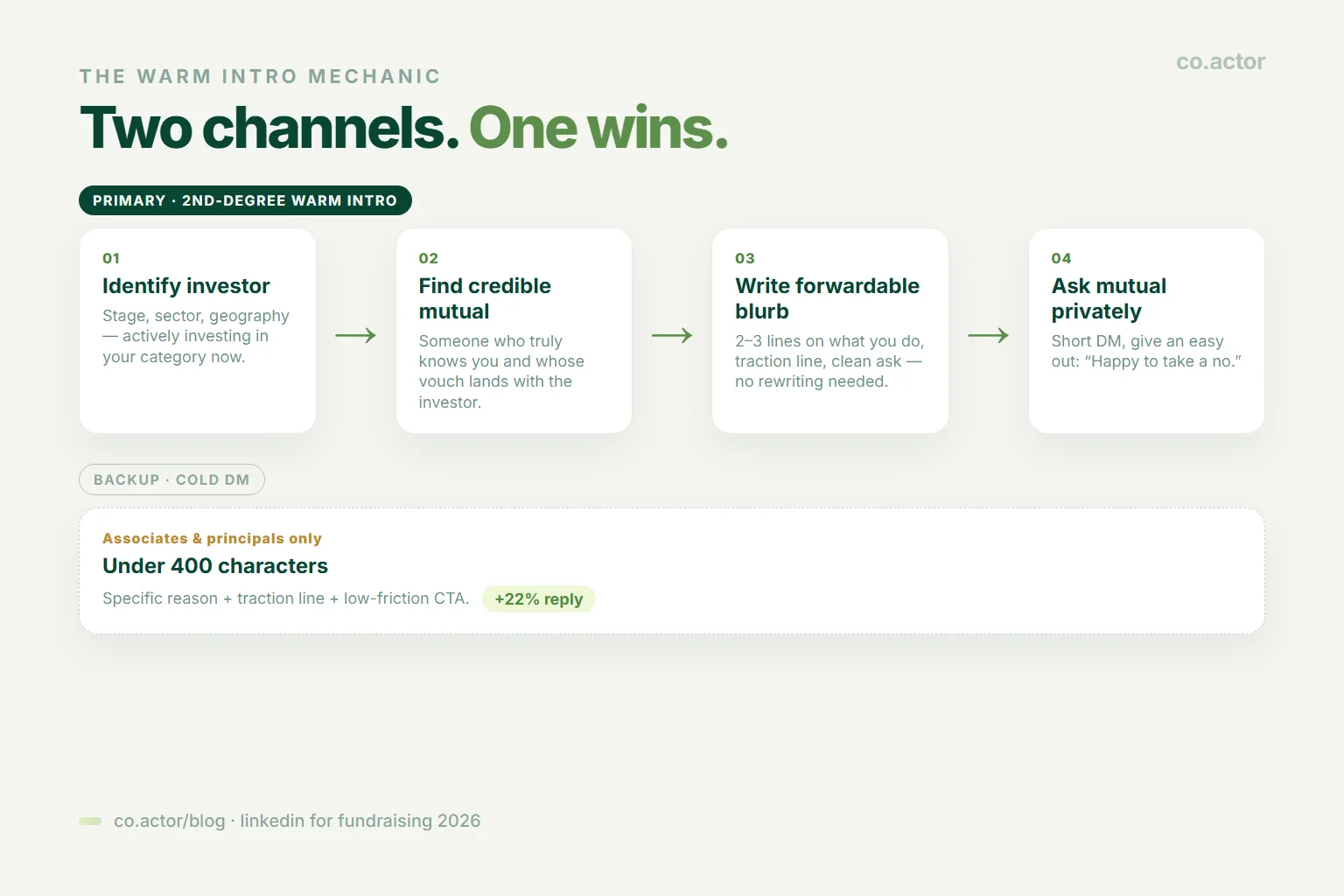
The mechanic in 2026:
- Identify the right investor. Stage, sector, geography. Confirm they're actively investing in your category right now — not three years ago, not when they had a different focus.
- Find mutual connections. LinkedIn shows you who's between you and the investor. Filter for the mutuals who actually know you (not LinkedIn-only connections you've never spoken to) and whose vouching would be credible to the investor — founders they've backed, other respected investors, senior operators in your space.
- Write a forwardable blurb. Two or three lines on what you do, one or two lines of traction or credibility signal, and a clean ask. Make it easy for the mutual to forward without rewriting. The blurb should be the entire pitch the investor needs to decide if it's worth 15 minutes.
- Ask the mutual privately. Short DM: "Saw you're connected to [Investor]. We're raising for [thesis] and would love an intro if you think it's a fit. Forwardable blurb attached." Give them an easy out: "Totally fine if you don't want to make the intro — happy to take a no."
A 2026 nuance worth noting: many mutuals prefer to comment on or engage with your content first before they make the intro. They want the investor to have already seen your name a few times. This argues for posting consistently on the topics you want investors associating with you — well before you're in active raise mode.
A second nuance: some mutuals will skip the email forward and offer a group LinkedIn chat instead. Accept that. It works the same way and often lands faster.
Cold DMs are a backup channel, not the primary path. If you have any warm route via 2nd-degree, take it — even if it's slower. The conversion rate gap is structural.
The Cold DM That Actually Works
When there's no warm route — or you've exhausted them — cold DM is the channel. The 2026 data is specific about what works.
Who You DM Matters
Associates and principals reply far more often than partners. Reply rates on well-targeted associate / principal DMs land in the 18-25% range. Partners and GPs are different — for them, email first, wait 48 hours, and then LinkedIn as a second touch. A cold LinkedIn DM to a partner as the first contact has near-zero expected return.
Length
Under 400 characters. The data is clear: InMails under that threshold see ~22% higher response than average outreach. Over 400 characters, response drops sharply. The first message exists to spark interest, not to pitch.
Structure That Works
- Line 1: Specific reason for them in particular. Sector, stage, portfolio adjacency, or a specific portfolio company that relates. Generic "raising and thought you'd be interested" is the dead version.
- Line 2: One sentence on what you build and for whom.
- Line 3: One credibility or traction line — a metric, a customer, a relevant background.
- Line 4: Low-friction CTA — "Worth a 15-min call?" or "OK to send a short overview?"
What Kills It
- Calendly link in the first message. Reads as transactional. Strongly correlated with no response in 2026 data.
- PDF deck attached. Investors prefer trackable links (DocSend, Notion, Pitch). PDFs end the data trail and feel old-fashioned.
- Novel-length messages. Anything over 400 characters drops response rates.
- Generic copy. Underperforms personalized by 60-70%.
- Weekend or late-Friday sends. Weak response windows.
Follow-Up Cadence
2-4 follow-ups across channels (LinkedIn + email) is where most replies come from. Each follow-up adds a new specific angle — a customer win, a new metric, a relevant news beat. Generic "bumping this" doesn't work. After 4-5 total touches with no response, stop. For the full cadence breakdown, see our LinkedIn cold DM strategy.
Build-in-Public as the Pre-Sell Layer
There is no clean 2026 study that says "X% of build-in-public founders got funded through LinkedIn." What there is: enough directional evidence to treat it as the warming infrastructure underneath everything else.
The pattern that works:
- Cadence: 1-3 posts per week over 3-6 months before and during a raise. Less than that and the signal is too thin. More than that and quality usually suffers.
- Evidence-led posts: Revenue milestones, retention numbers, customer proof, waitlist growth, product velocity. Numbers and screenshots beat narration.
- Narrative arcs: "Set this goal → tried this → here's what worked and failed → here's the next step." Story-shaped posts build pattern recognition that investors associate with serious operators.
- Investor-friendly framing: Market size, category velocity, ICP clarity. Posts that read as if a sophisticated reader is the intended audience perform differently from posts written for general LinkedIn engagement.
What doesn't move investors:
- Generic hustle content without numbers.
- Public "raising soon" hand-waving with no traction proof.
- Vanity metrics optimization.
The mechanic: by the time you DM an investor, they've already seen your name three or four times in their feed. The first message lands as a familiar founder, not a stranger. The deck reads as confirmation of pattern, not a fresh evaluation. This is the single highest-leverage thing you can do six months out from a raise. It doesn't require tools — it requires consistency on topics relevant to the investor base you'll eventually be talking to.
Stage-Specific Content That Lands
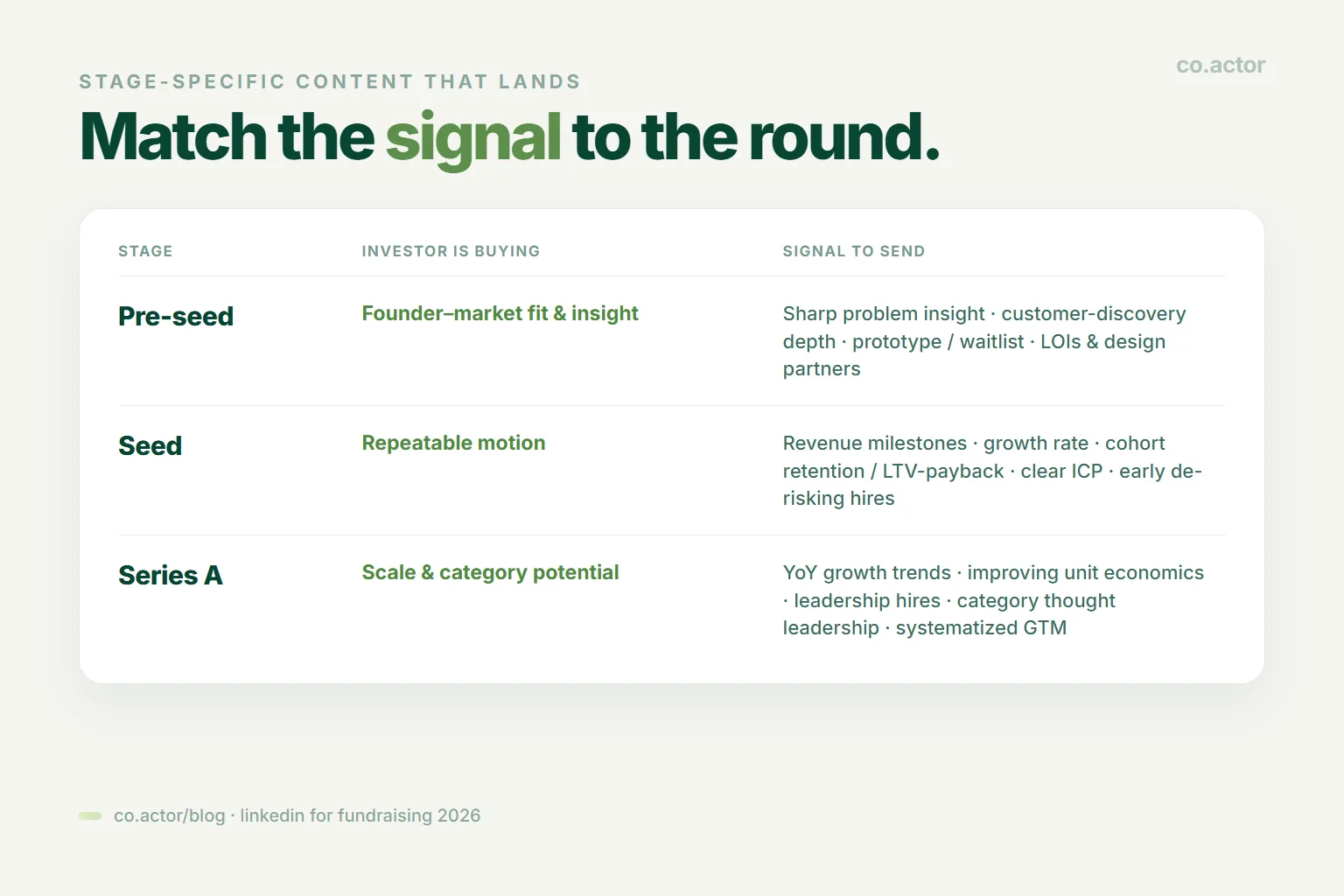
The content that fits each stage is different. Mis-matching stage and signal is one of the more common errors.
Pre-Seed
The investor is buying founder–market fit and insight. Content should show: the unique insight into the problem, the depth of customer discovery (interviews, patterns observed), early product evidence (prototype, demo, waitlist), and any traction-lite signals (LOIs, design partners, pilot agreements). DM positioning: "We're pre-seed. Here's the sharp insight. Here's the early pull. Here's why now."
Seed
The investor is buying repeatable motion. Content should show: revenue milestones (even in ranges if confidentiality requires), growth rate, cohort retention or LTV-payback signals, clear ICP definition with examples, early de-risking hires (first engineer, first sales hire), and short customer case studies. DM positioning: "We've proved people pay for this. Capital accelerates a motion that's working."
Series A
The investor is buying scale and category potential. Content should show: year-over-year growth trends, unit economics improving over time, leadership hires (VP Eng, VP Sales, Head of Product), category thought leadership and market definition, and signs of systematized GTM, onboarding, and product roadmap discipline. DM positioning: "We're ready to scale. Here's the evidence and the path to category leadership."
The same founder posting Series A content while raising pre-seed reads as overreach. The same founder posting pre-seed content while raising Series A reads as underwhelming. Calibrate the public signal to the round you're raising.
What Quietly Kills Your Raise
Behaviors on LinkedIn that turn off investors before any meeting happens:
- Public complaints about other investors. Even if accurate. Reads as a future risk.
- Aggressive follow-ups. "Bumping this" / "why haven't you replied" / "still waiting." The follow-up cadence matters; the tone matters more.
- Tagging 10+ investors in a single fundraising announcement. Looks spammy. Reads desperate.
- Engaging in political or inflammatory debates from the founder profile. Creates reputational risk for the fund. Some investors will quietly pass for this reason alone.
- "DM me I'm raising" as a comment under every VC post. Inverts the intended signal — instead of looking accessible, looks transactional and noisy.
- Inconsistent numbers between LinkedIn posts and pitch deck. If you cited 200 customers on LinkedIn last month and 150 in the deck this month, the question becomes which one is the lie.
- Long gaps in profile activity during the raise. If your last post is from eight months ago and your current message is "we're raising," the signal is that the founder doesn't actually run a public-facing operation.
The pattern: investors are pattern-matching for downside risk as much as upside. LinkedIn is one of the cheapest places to demonstrate either. Make sure yours is showing what you want them to see.
A 30-Day Pre-Raise LinkedIn Audit
- Rewrite your headline. Specific, metric-anchored, operator-style. Have one trusted founder or investor read it and tell you what they'd assume about your company. If they don't get it in 5 seconds, rewrite.
- Rewrite your About section. Five lines max. Problem, solution, who you serve, current stage, what's next.
- Audit your experience section. Make the through-line obvious. If past roles look unconnected to the current company, add one sentence per role explaining the connection.
- Add traction signals. Customer count or specific customer names if allowed. Press, talks, accelerator badges. Live product link.
- Map your 2nd-degree to your target investor list. For each target investor, identify the credible mutual who could make the intro. This is the warm-intro pipeline.
- Post 2-3x per week for the next 90 days. Evidence-led content matched to the stage you're raising at. No "I'm raising" content yet — build the signal first.
- Reserve the cold-DM channel for backup. Associates and principals only, under 400 characters, with specific reason in line 1, traction line, and low-friction CTA. No Calendly link, no PDF.
- Track the warm-intro pipeline weekly. Number of investor targets, number of mutuals identified, number of intros requested, number of meetings scheduled. This is the actual fundraising funnel — not the DM count.
Frequently Asked Questions
Do VCs actually read LinkedIn in 2026?
Yes. 55% of Forbes Midas List investors post monthly. The discourse migrated from X to LinkedIn over 2024-2026. Many investors check LinkedIn before they take a meeting.
What do VCs look for on a founder's profile?
Six signals scanned in 30 seconds: specific operator-style headline, clear About section, coherent experience narrative, traction signals (customers, press, badges), network quality (mutual connections, who comments), content behavior (2-4 posts/week + substantive comments).
Is warm intro still better than cold DM?
Yes, almost universally. The 2nd-degree warm intro via a credible mutual wins. Cold DMs are backup. The conversion gap is structural.
How long should a cold investor DM be?
Under 400 characters. InMails under that threshold see ~22% higher response. Four lines: specific reason, what you build, traction line, low-friction CTA.
Should I DM partners or associates?
Associates and principals: 18-25% reply rate on well-targeted DMs. Partners: email first, LinkedIn as second touch 48h later. Cold DM to partners first has near-zero expected return.
Does build-in-public help with fundraising?
Directionally yes, as a pre-sell layer. 1-3 posts/week over 3-6 months with evidence-led content creates familiarity. By the time you DM, the investor has seen your name 3-4 times.
What kills a fundraise on LinkedIn?
Public investor complaints, aggressive follow-ups, tagging 10+ investors, political debates from founder profile, "DM me I'm raising" comment spam, inconsistent numbers across posts/deck, long activity gaps.
Build the LinkedIn Signal Six Months Before the Raise
Serge Bulaev is the CEO and founder of Co.Actor, a LinkedIn growth platform for B2B founders and their teams. He writes about content systems, profile positioning, and how the LinkedIn algorithm actually rewards modern creators.
Sources
- Milltown Partners — Forbes Midas List LinkedIn activity (2024 study referenced across 2026 sources)
- Expandi 2026 — State of LinkedIn Outreach H1 2026
- Sopro 2026 — Cold Outreach Statistics
- VC-focused 2026 LinkedIn agency guides and trend roundups
- 2026 founder–investor outreach benchmarks (cross-referenced)
Related Reading
Written by
