Open your LinkedIn messages right now and count how many you genuinely wanted to receive. For most people the honest answer is close to zero. There is the connection request from a stranger, accepted out of habit, followed thirty seconds later by a wall of text about a service you never asked about. There is the "loved your recent post" that clearly came from someone who never read it.
None of this used to be normal, and a few years ago some of it worked. In 2026 cold outreach on LinkedIn mostly does not, and the reason is not that people got ruder. The whole thing quietly stopped adding up, for the sender and the receiver at the same time. This piece covers why that happened, what the reply-rate numbers look like now, and what the people still getting replies do instead. If you want the message-writing mechanics rather than the strategy question, our cold DM strategy guide handles that separately.
In this article
- What LinkedIn outreach means, cold versus warm
- Why cold outreach broke
- The pitch-slap, and why buyers stopped trusting the inbox
- The reply-rate math nobody shows you
- LinkedIn is capping how much you can send
- Who still needs cold outreach
- What good LinkedIn outreach looks like now
- The warm system: outreach is step five
What LinkedIn Outreach Means, Cold Versus Warm
Outreach means reaching out to people you do not know yet, on purpose, to start a business conversation. It is the digital version of a salesperson calling strangers, except the phone is LinkedIn and the call is a message. Someone wants to sell you software, hire you, or book a meeting, and instead of waiting for you to find them, they come to you.
On LinkedIn it almost always follows the same four steps. They build a list, often a few hundred names pulled automatically. They send a connection request, usually with no note because sending nothing is faster. Once you accept, they send a message, and in the version everyone complains about that message arrives instantly and gets straight to selling. Then they follow up, again and again, because sending more is cheap.
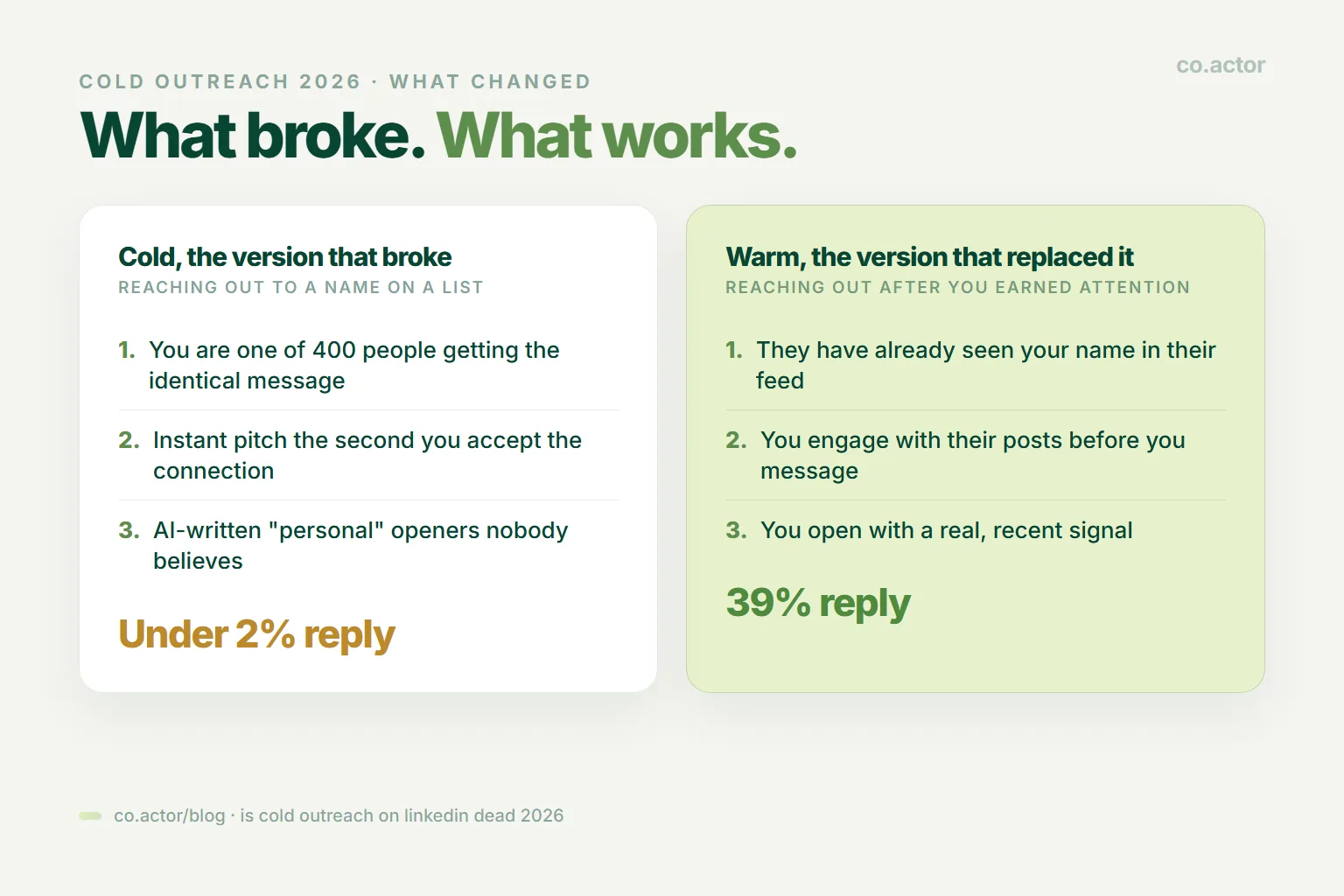
The single most important word in this whole story is the difference between cold and warm. Cold outreach means they are contacting you out of nowhere. You have never heard of them, never seen their name. You are a name on a list, and so are the other four hundred people getting the identical message. Warm outreach means the opposite. By the time they message you, you already know who they are, because you have read their posts, seen them comment somewhere, or been introduced by a mutual contact. That small bit of familiarity changes how the message lands.
Key takeaway
Why Cold Outreach Broke
To understand why cold outreach broke, it helps to remember why it ever worked. For a while, a well-written cold message was a pleasant surprise. Most people were not getting many, so a thoughtful note from a stranger stood out and often got a reply. It worked because it was rare. The moment something works on LinkedIn, everyone copies it, and rarity is the first thing to die.
Then AI finished the job. Writing a personalized opening line used to take a few minutes of reading someone's profile. Now a tool can scan a thousand profiles and generate a thousand "I noticed you are doing great work in fintech" openers before your coffee is cold. The cost of sending dropped to almost nothing, and the volume exploded.
That is the trap. When personalization is cheap and automatic, it stops being personalization. A line like "loved your recent post" reads the same whether it took genuine attention or none, and after the hundredth one, buyers can no longer tell which is which, so they assume the worst about all of them. The effort you put in becomes invisible, drowned out by everyone who put in nothing. The average professional now treats a full LinkedIn inbox the way they treat a ringing unknown number. They do not evaluate it. They do not pick up.
The Pitch-Slap, and Why Buyers Stopped Trusting the Inbox
One move did more damage than any other, and it has a name now: the pitch-slap. You have received it a hundred times. Someone sends a connection request with no note. You accept, because accepting is the polite default. Within a minute, sometimes within seconds, a long sales message lands, complete with a calendar link and a "when works for a quick 15 minutes?"
The reason it feels so bad is that it abuses a small act of goodwill. Accepting a connection is a tiny yes, a low-stakes "sure, we can be in each other's networks." The pitch-slap treats that tiny yes as permission for something much bigger, and everyone can feel the switch. It is the digital version of someone shaking your hand and immediately asking for your wallet.
What makes it worse in 2026 is the automation behind it. That instant reply the moment you accept is almost always a bot firing on a trigger, which means the person reaching out was not even present for the start of the conversation. People sense that. The lesson buyers took from years of this is simple and permanent: a stranger being friendly on LinkedIn usually wants something, and it usually is not worth finding out what. That instinct now greets every cold message you send, no matter how good yours happens to be.
The Reply-Rate Math Nobody Shows You
A word on where these figures come from. LinkedIn does not publish outreach performance data, so almost every number below comes from agencies and outreach vendors who ran their own campaigns. They come from people with something to sell, so treat them as directional rather than exact. They point the same way consistently enough to believe.
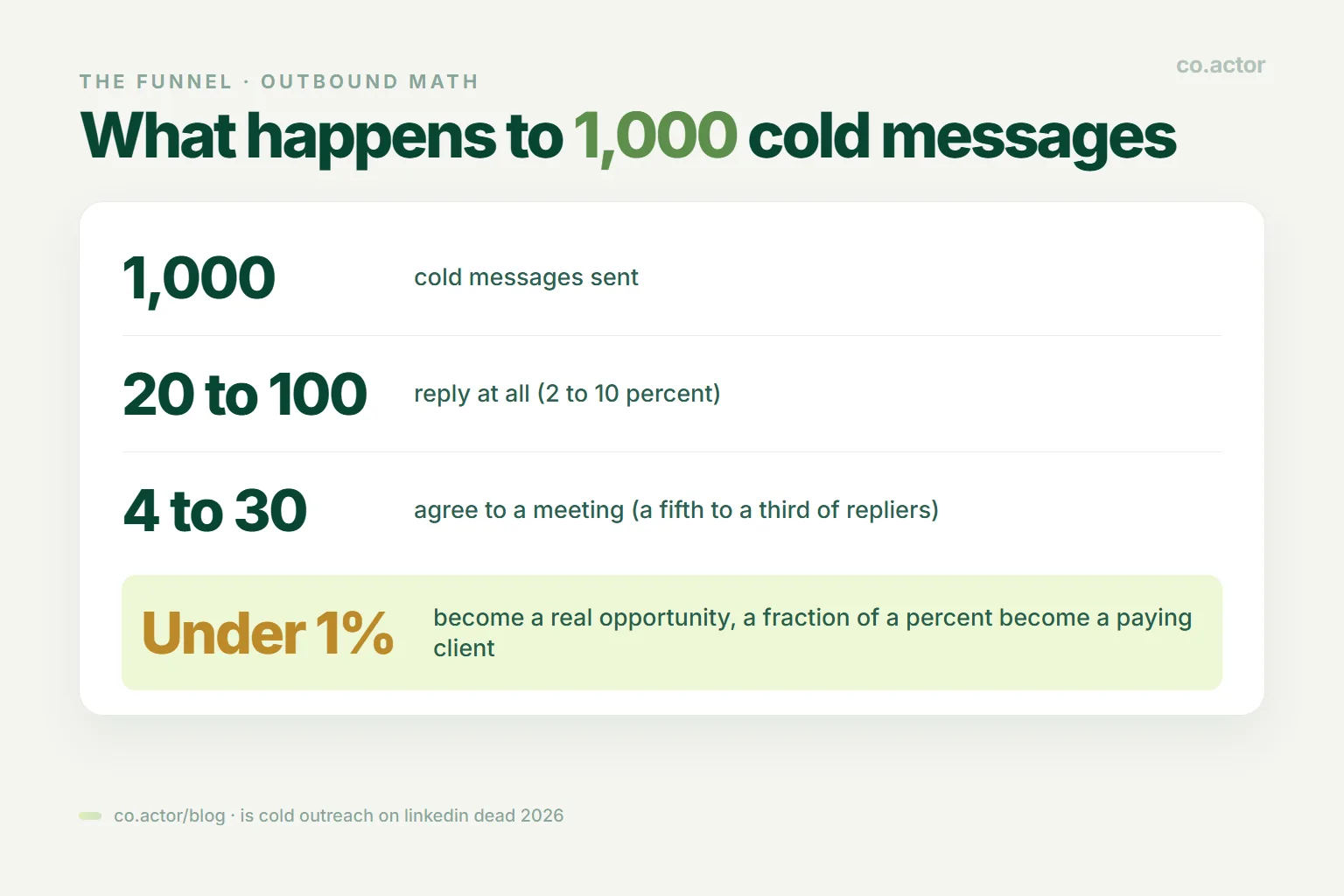
Across the 2026 outbound studies, a cold message gets a reply from somewhere between 2 and 10 percent of the people who receive it. Sit with that for a second: at the low end, ninety-eight out of a hundred people say nothing at all. Of the few who reply, only about a fifth to a third ever agree to a meeting, and of those meetings, maybe fifteen to twenty percent turn into a customer. Run it all the way through and under one percent of the people you cold-message become a real opportunity, and a fraction of a percent become a paying client.
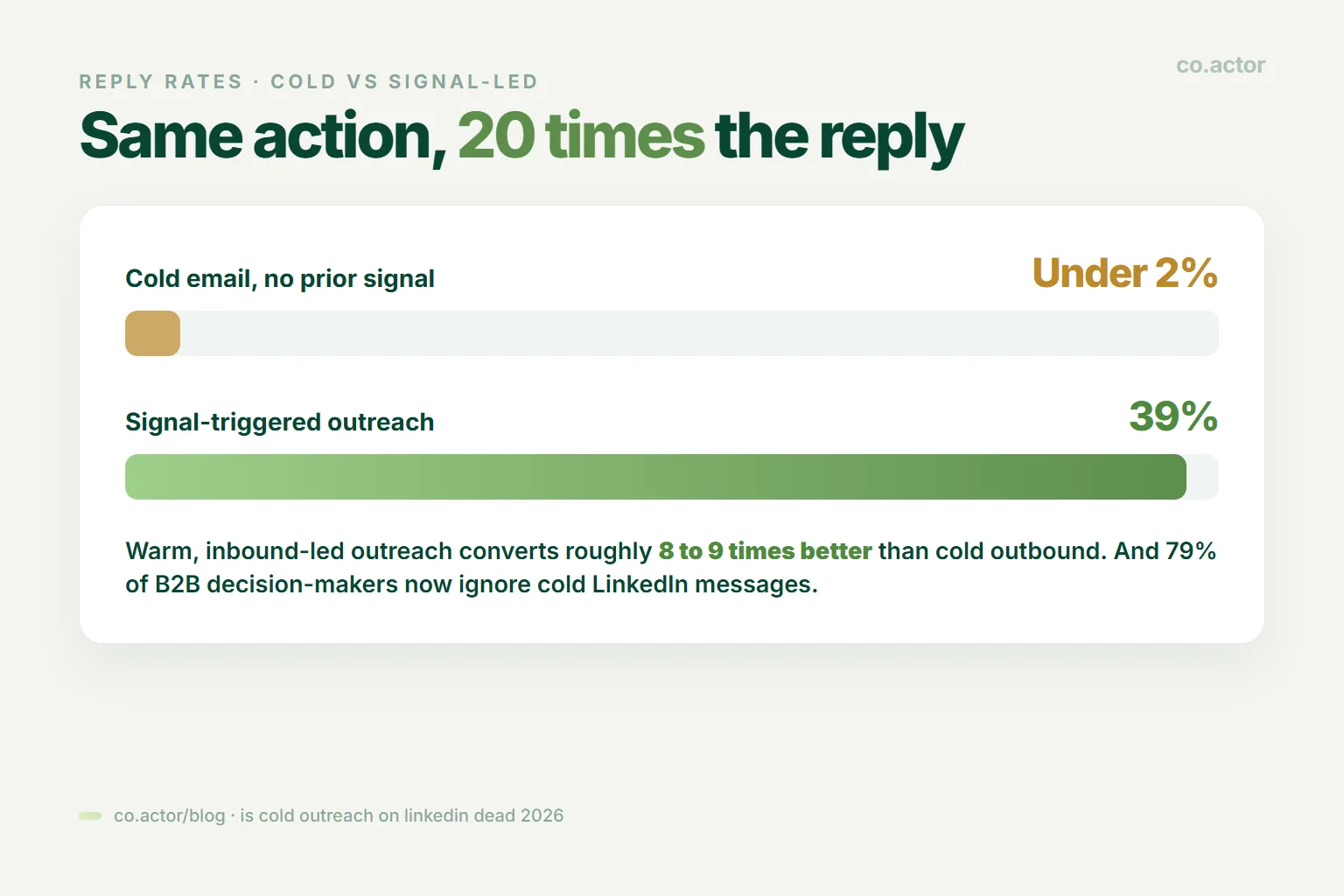
One study put a hard number on the annoyance side: it estimated that 79 percent of B2B decision-makers now actively ignore cold LinkedIn messages. That figure comes from an outreach firm, not from LinkedIn, so treat it as directional. Anyone with a LinkedIn inbox knows it feels about right.
Here is the part that should change how you think about all of it. When the same studies look at outreach that follows a real signal, meaning you reach out to someone because they engaged with your post, downloaded your thing, or commented somewhere you could see, the numbers stop looking sad. Cold email replies at under 2 percent. Signal-triggered outreach replies at 39 percent, more than twenty times better. Warm, inbound-led outreach converts roughly 8 to 9 times better than cold outbound.
LinkedIn Is Capping How Much You Can Send
Even if you wanted to win on pure volume, LinkedIn is making that harder on purpose. There is a cap on how many connection requests you can send in a week. For most accounts it is around a hundred, and while LinkedIn does not publish the exact figure, it enforces it plainly. Push past it and you get "You have reached the weekly invitation limit." The cap resets on a rolling seven-day basis, not on a tidy Monday, so there is no clean way to game it. Sales Navigator and very active accounts sometimes get a bit more headroom, but nobody gets a firehose.
A second, quieter limit catches more people: your pending requests. If you have sent a pile of invitations that nobody accepted, LinkedIn reads that as a sign your requests are not wanted, and it starts restricting you before you even hit the weekly number. A lot of ignored invites is itself a signal that you are doing it wrong.
Underneath all of it, LinkedIn watches for behavior that looks mechanical: sending at perfectly even intervals, firing identical messages at hundreds of strangers, running a browser tool that connects while you sleep. All of it raises flags, and the platform acts on those flags faster in 2026 than it used to. The tools promising to scale your outreach are usually scaling your way toward a restriction. Put the limits and the math side by side and the picture is clear. LinkedIn is capping how many people you can reach at the same time buyers are ignoring most of the ones you do reach.
Who Still Needs Cold Outreach
None of this means you should never reach out. Plenty of people genuinely need outbound, and telling them to just post and wait would be its own bad advice.
- Agencies and consultants without a big brand, because inbound alone will not fill a pipeline when few people know your name yet.
- B2B software teams selling into a narrow, specific set of accounts, because paid ads cannot reliably reach forty exact people.
- Recruiters, because the right candidate is not going to apply on their own.
- Founders in the early days, before there is any inbound engine to lean on. Our founders guide goes deeper on that stage.
So the question was never whether to reach out. The question is what reaching out should look like now that the old way stopped working. Across every 2026 study and every practitioner still getting replies, the answer is strikingly consistent.
What Good LinkedIn Outreach Looks Like Now
The shift is from volume to relevance, and it is less about clever wording than about the order you do things in. It comes down to four habits, and the order they happen in matters as much as the habits themselves.
Be visible first. Good outreach starts long before the message, with being seen by the people you eventually want to talk to, so that when your name shows up in their inbox it is not the first time. Someone who has read two of your posts and seen you leave a smart comment on a discussion they were in is not a stranger anymore, and they do not respond to you like one. A steady personal brand is what makes that possible.
Lead with something real. Not a compliment, which everyone has learned to discount, but a specific and recent detail: something they posted last week, a change at their company, a genuine observation about the problem they are clearly working on. The test is simple. If your opening line could be copied and pasted to a thousand other people, it is a mail-merge, not personalization, and they will know.
Give before you ask. This is the part most people cannot stand to do. You share the useful thing, the relevant example, the honest take on their situation, and you let the conversation be a conversation for a while. The highest-performing sequences in the research do not even mention a fit or a quick call until the fifth touch or later. Everyone else asks for the meeting in message one, which is exactly why message one gets ignored. Our networking playbook covers how to build those relationships at scale.
Keep it small. A hundred well-researched, relevant messages will beat a thousand templated ones on every metric that matters, and they will not get your account restricted or your name quietly muted by the people you were trying to reach.
The Warm System: Outreach Is Step Five
Relevance cannot be bolted on at the end with a better template. It has to be built first. The clearest version of this we know runs on one line: posting more does not create pipeline, relevance does. In a system built that way, outreach is not step one. It is step five.
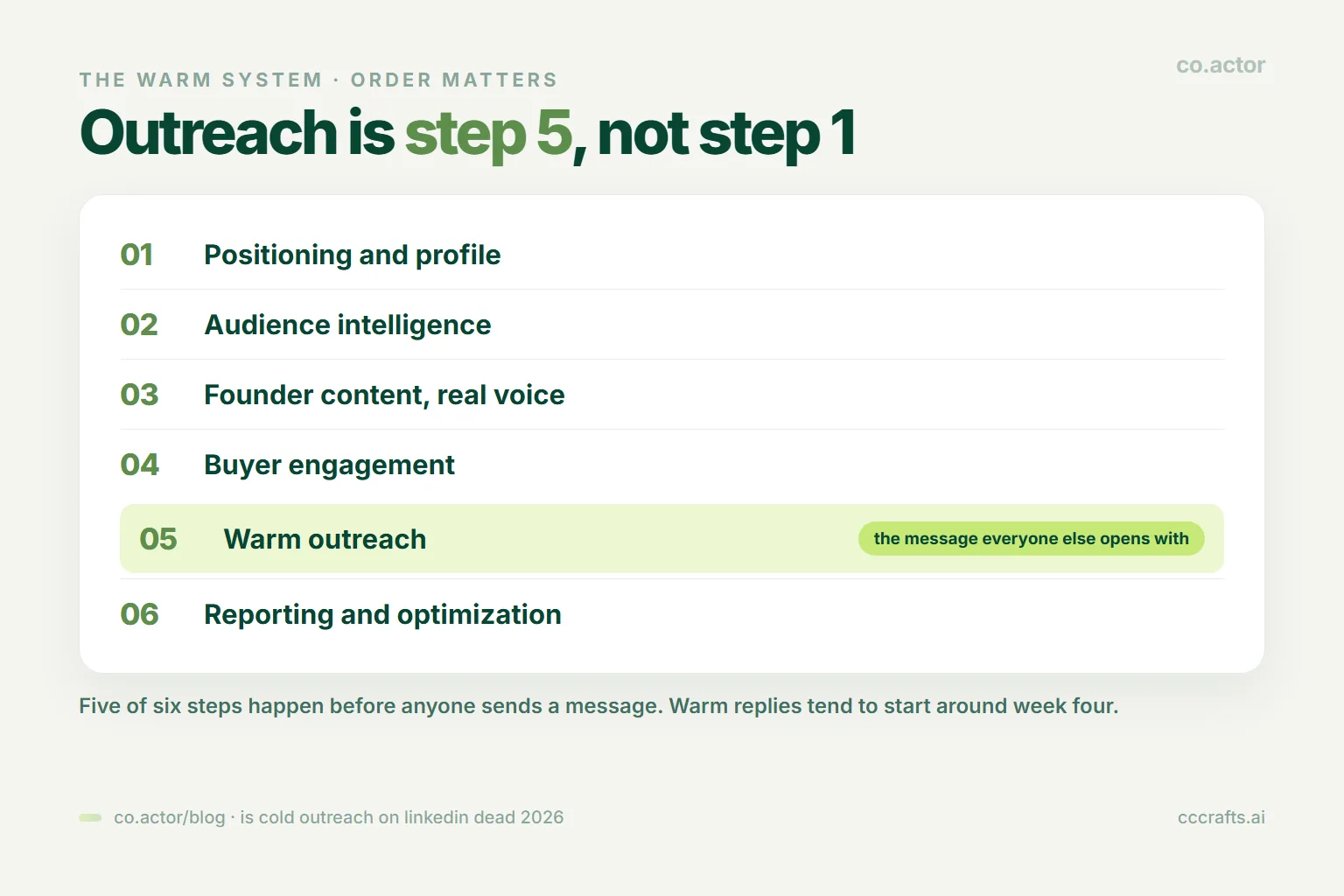
The order matters more than any single step, so read it in order. First, positioning and profile: rebuild the profile so authority reads the moment someone lands on it, because nobody warms to a stranger with a cold page. Second, audience intelligence: map what buyers read, react to, and trust, and deliver it as a weekly brief. Third, founder content: a dedicated writer ships three to four posts a week in the executive's real voice, built from real interviews, not AI-written filler. This is what makes the name familiar before any message arrives.
Fourth, buyer engagement: every week, engage with the posts of the exact accounts you want to reach, before a single word of outreach goes out. This is the step everyone skips, and skipping it is why their outreach lands cold. Fifth, warm outreach: only now does anyone get a message, and only people who have already seen the content and encountered the name. Sixth, reporting: report on the touches, the replies, and the warm leads every week, and keep tuning.
Five of the six steps happen before anyone sends the message everyone else opens with. That ordering is the entire reason the model works. The cold-DM crowd is doing step five with none of the four steps that earn it, then wondering why the message lands cold. This is the same approach behind any real social selling motion: warm outreach is what is left of selling once you have done the work that makes someone willing to hear from you. No pods, no bought likes, no bots, and none of it risks the account. It is roughly sixty to ninety minutes a month of the executive's time, and the warm replies tend to start showing up around week four.
Your Action Items This Week
- Read your own inbox as a buyer. Scroll your last twenty received messages and notice which ones you would reply to. That instinct is the same one your prospects use on you.
- Stop pitching in message one. If you reach out at all, make the first message a real question or a genuinely useful thought, with no ask attached.
- Warm up before you write. Before you message anyone, engage with something they posted. Let them see your name at least once before it shows up in their inbox.
- Trade volume for research. Cut your outreach list in half and spend the time you saved learning something specific about the people who are left.
- Build the thing that makes outreach warm. Post consistently to the people you want to reach, so your next message continues a relationship instead of starting one.
Frequently Asked Questions
Is cold outreach on LinkedIn dead in 2026?
The lazy, templated version is close to dead. Vendor studies put cold reply rates at 2 to 10 percent, with under one percent becoming a real opportunity, and one outreach firm estimated 79 percent of B2B buyers ignore cold messages. Warm, signal-led outreach still works.
What is a pitch-slap?
A connection request with no note, followed within seconds or minutes of you accepting by a long sales message and a calendar link. The instant reply is usually an automated bot, which is why it feels impersonal.
What reply rate does cold LinkedIn outreach get?
Between 2 and 10 percent reply, a fifth to a third of those agree to a meeting, and under one percent become a real opportunity. Signal-triggered outreach replies at around 39 percent.
How many connection requests can you send per week?
Around 100 for most accounts, on a rolling seven-day reset. Too many pending, unaccepted requests triggers restrictions before you even hit the weekly cap.
What is the difference between cold and warm outreach?
Cold means contacting someone out of nowhere as a name on a list. Warm means they already know you from your posts, your comments, or a mutual contact before you message them.
Who still needs cold outreach?
Agencies and consultants without a brand, B2B software teams selling into named accounts, recruiters, and early-stage founders with no inbound engine yet.
Make Your Next Message Warm Before You Send It
Serge Bulaev is the CEO and founder of Co.Actor, a LinkedIn growth platform for B2B founders and their teams. He writes about content systems, profile positioning, and how the LinkedIn algorithm rewards modern creators.
Sources
- 2026 outbound and cold-outreach benchmarks from agencies and outreach vendors (directional, not official LinkedIn data)
- Vendor estimate: 79% of B2B decision-makers ignore cold LinkedIn messages
- Signal-triggered versus cold reply-rate comparisons from 2026 outreach studies
- LinkedIn weekly invitation limit behavior (enforced, exact number unpublished)
Related Reading
Written by
