LinkedIn does not behave like Instagram or TikTok, where attention trickles in around the clock. It runs on the workday. People open the app between meetings, during a coffee, on the morning commute — and then they close it and go back to work. That rhythm makes timing one of the few levers you can pull without writing a single new sentence.
The numbers back it up. The same post can earn three to five times more impressions at 9 AM on a Tuesday than it does at 10 PM on a Saturday. This guide breaks down the best time to post on LinkedIn in 2026 — by day, by hour, by audience type, and by timezone — then shows you how to find the window that fits your own following. The figures below draw on aggregate engagement patterns across more than 150,000 posts from 2025 and 2026, cross-checked against LinkedIn's own creator analytics.
TL;DR — The Short Version
- Post Tuesday to Thursday, 8-10 AM. Those three midweek mornings hold about 68% of the week's engagement.
- Tuesday at 9 AM is the single strongest slot, with roughly 34% higher click-through than weekend posts.
- Publish 30-60 minutes early. The feed needs that long to distribute a post, so aim for 8:30 AM to catch the 9 AM window.
- Weekends cost you 60-70% of your reach. Sunday evening is the only exception worth a test.
- Consistency beats perfect timing. A steady 3-5 posts a week outperforms a scattered daily grind.
In this article
- Why timing is the cheapest lever you have
- The best days to post (and the ones to skip)
- The best hours: LinkedIn's bimodal rhythm
- B2B vs B2C: your audience moves the clock
- Timezone strategy for a scattered audience
- Finding your own best time
- How often to post
- Match the format to the slot
- Timing mistakes that quietly cost reach
- The bottom line: a schedule you can keep
- Frequently asked questions
Why Timing Is the Cheapest Lever You Have
Most advice about growing on LinkedIn asks you to change the hard things — write sharper hooks, film more video, comment for an hour a day. Timing is different. It costs nothing extra. You are publishing the post anyway; the only decision is when.
And the payoff is real. Because LinkedIn distributes a post to a slice of your network first and then expands reach based on early engagement, the moment you hit publish decides who sees it in the crucial first hour. Land in a live window and the algorithm has an active audience to test against. Land at midnight and that first test happens against no one.
Key Takeaway: Timing does not fix weak content, but it multiplies strong content. Get the post right first, then get the hour right — in that order.
The Best Days to Post (and the Ones to Skip)
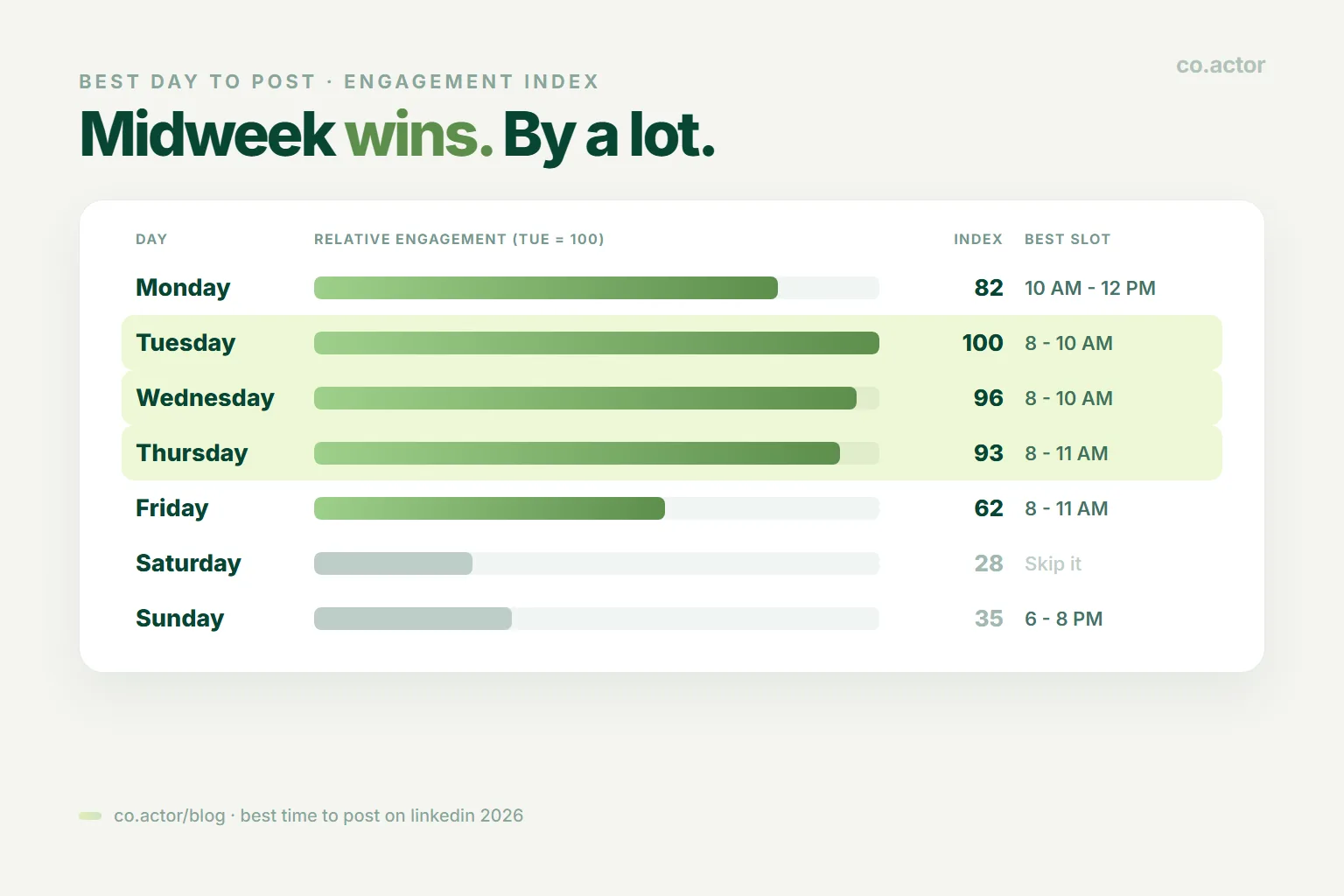
Not every day carries equal weight, and the pattern has barely moved in three years. The midweek stretch dominates. If you index every day against Tuesday at 100, the shape of the week is easy to read.
| Day | Engagement index | Best slot | What's happening |
|---|---|---|---|
| Monday | 82 | 10 AM - 12 PM | Slow start; inboxes come first |
| Tuesday | 100 | 8 - 10 AM | Peak day across every industry |
| Wednesday | 96 | 8 - 10 AM | Nearly identical to Tuesday |
| Thursday | 93 | 8 - 11 AM | Slightly wider engagement window |
| Friday | 62 | 8 - 11 AM | Falls off a cliff after lunch |
| Saturday | 28 | Skip it | Lowest day of the week |
| Sunday | 35 | 6 - 8 PM | Small evening spike as people prep for Monday |
The read is simple. Tuesday, Wednesday, and Thursday sit within a handful of points of each other and together capture close to 70% of the week's activity. Friday is a half-day at best. Saturday barely registers.
Key Takeaway: If you can only manage three posts a week, put them on Tuesday, Wednesday, and Thursday mornings. That single choice captures nearly seventy percent of the week's available engagement.
The Best Hours: LinkedIn's Bimodal Rhythm
Within a good day, the hours are just as uneven. LinkedIn engagement follows a bimodal curve — a tall morning peak, a dip through the afternoon, and a modest bump around lunch and the end of the day. Here is the shape of Tuesday through Thursday, indexed against the 9 AM high point.
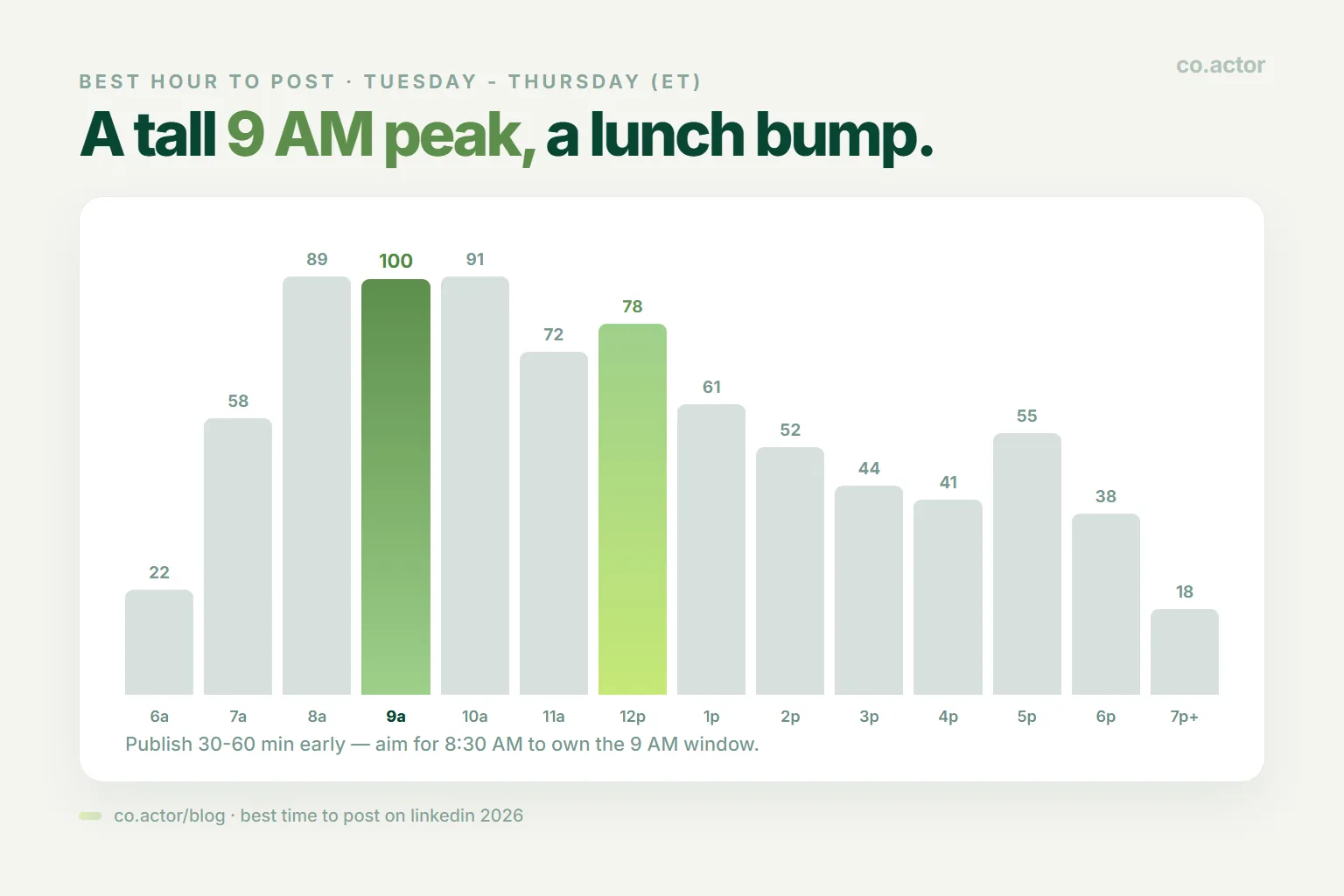
The morning block from 8 to 10 AM does the heavy lifting, with 9 AM as the clear high point (index 100). A second, smaller window opens at lunch around noon (index 78), and there is a faint end-of-day flicker near 5 PM. Everything after 7 PM falls away.
Publish Before the Peak, Not During It
Here is the detail most people miss: the feed takes 30 to 60 minutes to fully distribute a post. If your audience is most active at 9 AM, publishing at exactly 9 AM means the algorithm is still warming up while your best moment passes. Hit publish at 8:00 to 8:30 instead, so the post is already circulating when people arrive. If you want the mechanics behind that first-hour test, our breakdown of the algorithm goes deeper.
Key Takeaway: Aim to publish 30-60 minutes before the window you actually want. For the 9 AM peak, that means an 8:30 AM post.
B2B vs B2C: Your Audience Moves the Clock
The aggregate numbers describe an average that nobody's audience matches exactly. The biggest source of variation is who you are talking to.
B2B audiences — the SaaS buyers, consultants, and enterprise operators — cluster tightly in the morning. Decision-makers check LinkedIn during their first work block, and by 11 AM they are in meetings. That leaves a narrow prime window of 8 to 10 AM, Tuesday to Thursday, plus a brief lunch opening. Weekends and Friday afternoons are close to dead for them.
B2C audiences — coaches, personal brands, HR and community folks — browse more loosely. Their morning peak still holds, but the lunch slot (12 to 1 PM) and early evening pull more weight, and Monday performs better for them than it does for B2B. Saturday still underdelivers, though Sunday evening is fair game.
Industry nudges the peak too. Financial services skews earlier (Wednesday, 8 AM, near market open). Healthcare runs later (Thursday, 10 AM). Recruiting and HR catch a Monday-morning job-market surge. Personal development creators find early risers on Monday at 7 to 8 AM. The midweek-morning core holds, but the exact hour shifts a notch with the room.
Timezone Strategy for a Scattered Audience
One detail catches a lot of people out: LinkedIn serves your post based on when your connections are active, not when you happen to press publish. A 9 AM ET post surfaces in a London follower's feed in their early afternoon — if they are still around. So the question is never "what time is it for me," it is "what time is it for most of my audience."
Apply an 80/20 rule. Find where roughly 80% of your followers sit and optimize for that zone. For most English-language creators that means Eastern Time, since it covers the largest professional hubs on the platform.
- US-focused: post around 8:30 AM ET. It is early on the West Coast, but the post gathers momentum in the East and is already trending by the time California logs on.
- Europe-focused: post around 8:00 AM CET. That covers London, Paris, Berlin, and Amsterdam, whose morning rush mirrors the US pattern.
- Truly global: post twice with different content — once near 8:00 AM GMT for the Europe and APAC overlap, once at 9:00 AM ET for the Americas. Two posts, not one duplicated.
Finding Your Own Best Time
Every benchmark above is a starting point, not an answer. Your audience has its own rhythm, and the only way to find it is to look at your own numbers. This is where a lot of generic advice stops being useful and your own data takes over.
Start With Native Analytics
LinkedIn's built-in analytics, available on pages and creator profiles, show when your followers are online. That alone narrows the field. Pair it with the impressions and engagement figures on your recent posts and you already have a rough map. For a fuller sense of which numbers actually predict reach, see our guide to the metrics that matter.
Run a Four-Week Test
To rule out content quality as a variable, keep everything constant except the clock:
- Prepare about a dozen posts of similar type and quality — say, all text-only thought-leadership pieces.
- Publish three a week at fixed, different times: 8 AM, 10 AM, and noon.
- Hold the day steady — for example, always on Tuesday — so the hour is the only thing changing.
- After four weeks, compare average engagement per slot and let the winner become your default.
Key Takeaway: Give each time slot at least three or four posts before you trust it. One post going viral at an odd hour is noise, not a pattern.
How Often to Post
Timing and frequency are two ends of the same lever. Post too often and you cannibalize your own reach; post too rarely and the right windows sit empty. The data points to a clear sweet spot.
- Three to five posts a week is the growth range for most accounts and teams.
- Leave at least 24 hours between posts. Publish twice in one day and the second post typically loses 40 to 50% of its impressions to the first.
- Consistency outranks everything. A steady midweek rhythm beats a burst of daily posts followed by silence.
This is also where a repeatable system earns its keep. Deciding the exact minute for every post is a tax you pay over and over; a standing weekly cadence — Tuesday, Wednesday, and Thursday mornings, say — removes the decision entirely. A dependable content engine is what turns "post more" from a resolution into a habit, and it matters far more for a whole team than for a single account.
Match the Format to the Slot
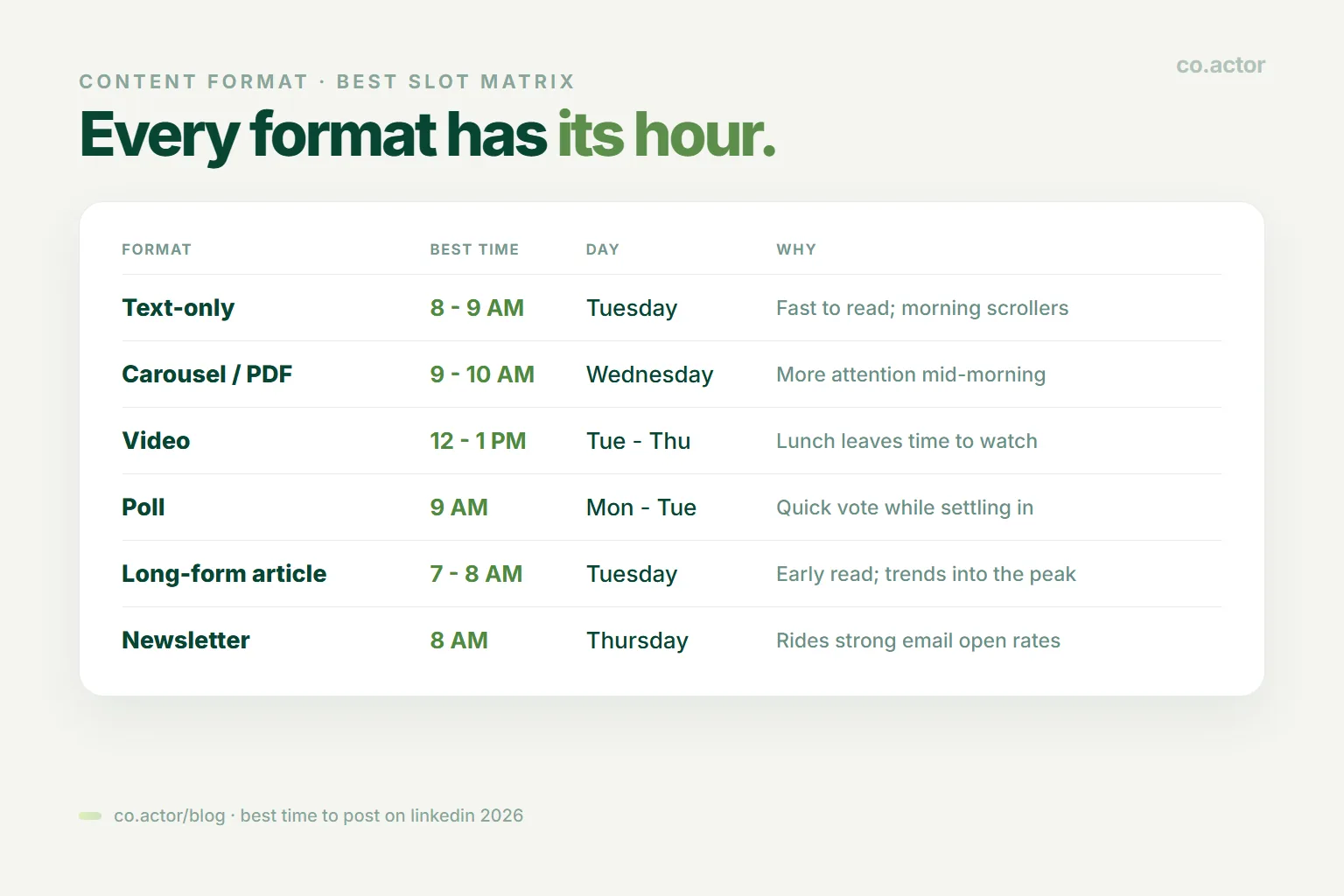
Different formats ask for different amounts of attention, and attention itself moves through the day. A quick text post fits a busy morning; a video wants the slower lunch break. Use this as a planning grid, not a rulebook.
| Format | Best time | Best day | Why |
|---|---|---|---|
| Text-only | 8 - 9 AM | Tuesday | Fast to read; catches morning scrollers |
| Carousel / PDF | 9 - 10 AM | Wednesday | A little more attention mid-morning |
| Video | 12 - 1 PM | Tue - Thu | Lunch leaves time to actually watch |
| Poll | 9 AM | Mon - Tue | Quick vote while people settle in |
| Long-form article | 7 - 8 AM | Tuesday | Early deep reading; trends into the peak |
| Newsletter | 8 AM | Thursday | Rides Thursday's strong email open rates |
Timing Mistakes That Quietly Cost Reach
Most timing errors are invisible — the post just underperforms and you never know why. A few show up again and again.
- Following generic times without testing. The 9 AM Tuesday rule is an average; your niche may peak an hour off. Verify before you commit.
- Posting more than once a day. The second post competes with the first and usually loses. Space them a full day apart.
- Publishing on the exact round hour. Everyone posts at 9:00 sharp. Offset by five to fifteen minutes to sidestep the crush.
- Optimizing timing over substance. A perfectly timed weak post is still a weak post. Timing amplifies; it does not rescue.
- Expecting Saturday to work. It won't for business content. Sunday evening is the only weekend slot worth testing.
- Drawing conclusions too fast. Fewer than three or four posts per slot is a hunch, not evidence.
If you want to see how these interact with reach over time, our engagement playbook covers the feedback loop between timing, format, and the first-hour test.
The Bottom Line: A Schedule You Can Keep
If you want one recommendation to act on today, here it is: Tuesday, Wednesday, and Thursday at 8:30 AM in your audience's main timezone. That covers roughly 80% of LinkedIn audiences and is the safest place to start.
From there, the optimization path is short. Watch your own analytics, run a four-week test, and adjust once a quarter as your following grows and shifts. The rest is repetition — and repetition is exactly where a consistent presence, whether it is one profile or a whole team, compounds. Great content at the right time, week after week, is the entire game. If you are short on what to actually publish in those slots, our post ideas for founders is a good starting shelf.
Frequently Asked Questions
What is the best time to post on LinkedIn in 2026?
Tuesday through Thursday, 8 to 10 AM in your audience's local time. Tuesday at 9 AM ET is the single strongest slot, with about 34% higher click-through than weekend posts. Use it as a starting line, then refine against your own analytics.
What is the best day to post on LinkedIn?
Tuesday, with Wednesday and Thursday close behind. Those three days carry roughly 68% of the week's engagement. Monday works from mid-morning but fades after lunch; Friday drops sharply once the afternoon starts.
Should I post on LinkedIn on weekends?
Usually not — weekend posts pull 60 to 70% less engagement. Sunday evening, 6 to 8 PM, is the one exception worth testing, and Sunday consistently beats Saturday.
Is the best posting time different for B2B and B2C?
Yes. B2B peaks in business hours, Tuesday to Thursday, 8 to 10 AM. B2C has a wider window and also performs at lunch and early evening, with relatively better weekend numbers.
How do I find my own best time to post?
Start with native LinkedIn analytics to see when followers are online, then run a four-week test at fixed times on a steady day. Give each slot at least three or four posts before trusting it.
Does frequency matter more than timing?
Both matter, but consistency wins. Three to five posts a week at good times beats posting daily at random. Timing then amplifies content that is already strong.
Show Up on the Same Days, Every Week
Serge Bulaev is the CEO and founder of Co.Actor, a LinkedIn growth platform for B2B founders and their teams. He writes about content systems, posting cadence, and how the LinkedIn algorithm actually rewards modern creators.
Sources
- Aggregate engagement analysis of 150,000+ LinkedIn posts, B2B and B2C, 2025-2026
- LinkedIn native creator and page analytics (2026)
- Cross-referenced third-party posting-time benchmarks, 2026
Related Reading
Written by
